
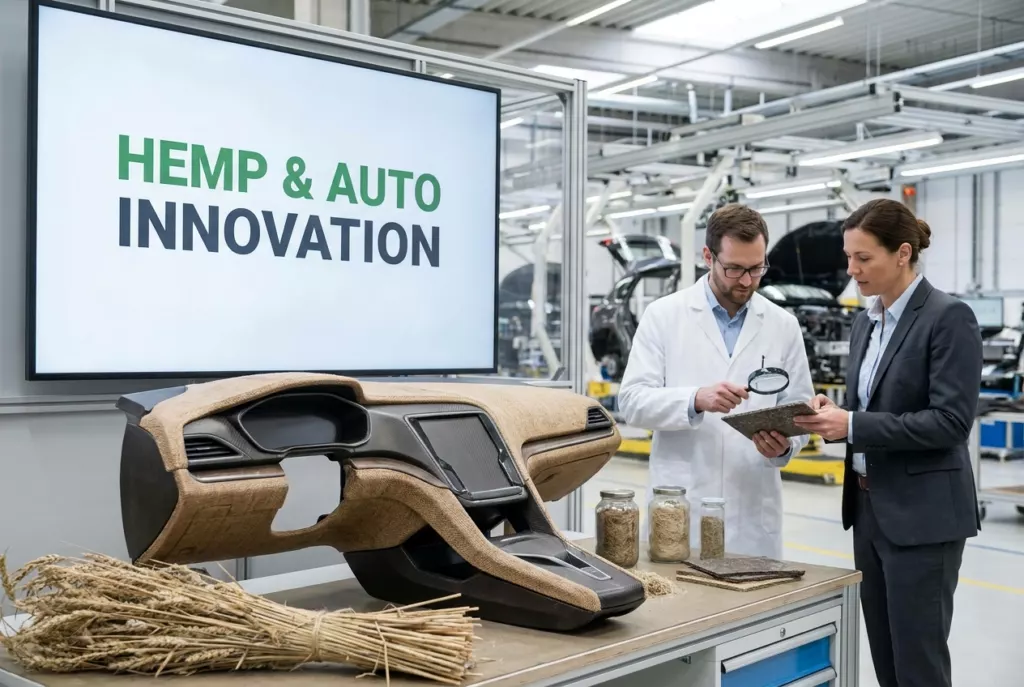
What if the future of cars could be lighter, stronger, and plant-based? Hemp fiber is already making its way into automotive plastics, composites, and interior materials — and this is only the beginning.
Walk a motor show floor and you will hear the loud plotlines: range, torque, screens, autonomy demos. Then follow the conversation backstage—among tier-one suppliers, materials labs, and sustainability teams—and the soundtrack changes. Suddenly people are arguing about grams per part, mold cycles, VOC profiles, and whether a panel can survive thousands of thermal swings without telegraphing every seasonal humidity swing through the cabin.
That quieter plotline is where industrial hemp stops sounding like a novelty crop and starts sounding like engineering vocabulary. Not because every badge-engineered SUV will soon wear a “100% hemp body” sticker—marketing departments would hate the liabilities—but because modern vehicles are assemblies of plastics, textiles, and composites, and automakers have long experimented with plant-derived feedstocks and natural fibers when they want to shave weight, tune impacts, or change the manufacturing footprint of specific components.
How we got here
The automotive materials story of the last decade is not one invention; it is a squeeze play. Regulations and corporate targets push down emissions associated with production and use; consumers still want premium interiors; engineers still chase stiffness-to-weight and predictable crash behavior. In that squeeze, “drop-in” miracles are rare. What shows up instead are iterative swaps: a reinforced composite here, a bio-based polyol there, a textile laminate swapped for a heavier mineral-filled alternative.
Industrial hemp enters this arc mainly as a fiber candidate—typically discussed alongside other bast fibers and natural reinforcements—rather than as a single headline material that solves every polymer-matrix headache overnight. Peer-reviewed reviews of textile-based natural fiber composites for automotive lightweighting summarize how these materials have been explored across interior and structural-adjacent applications where density and processing economics matter, while noting persistent engineering constraints around moisture uptake, fiber-matrix bonding, and consistency at automotive scale (Journal of Materials Science review).
Meanwhile, public-facing OEM announcements often emphasize particular fiber systems that have crossed from motorsport or pilot lines toward production-minded workflows. BMW Group’s communications around natural fiber composites, developed with specialty suppliers, illustrate how a manufacturer can narrate a credible pathway from racing-derived validation toward road-car components—often spotlighting flax-based architectures rather than hemp specifically (BMW Group materials overview). That distinction matters for readers: the industry trend is plant-fiber composites and bio-based chemistry; hemp is one regulated agricultural pathway that can participate where supply, specification, and pricing align.
People & stakes
The OEM program manager lives between contradictory KPIs: reduce mass, reduce perceived cheapness, reduce scrapped parts, and keep timelines pinned to model-year machinery that does not forgive surprises. For that persona, hemp is neither mystique nor mascot—it is a variable in a bill of materials that must survive validation gates.
The tier supplier owns much of the quiet innovation. Automakers frequently integrate novel reinforcements through compounders, laminators, and interior-system integrators who can iterate recipes without rewriting the brand story every quarter. When a fiber works, it tends to enter through existing plastics and composites workflows—compression molding, injection over-molding, prefabricated panels—rather than through a standalone “hemp industry” retail channel.
The grower and regional processor encounter a different timeline. Automotive qualification favors repeatability: stable fiber lots, clean separation of hurd and bast where relevant, predictable logistics, and documentation that fits QA systems. U.S. hemp production sits under a federal framework that defines hemp by THC limits and establishes production oversight through USDA’s hemp program pages (USDA AMS hemp resources), with the regulatory definition formally anchored in codified rules (7 CFR Part 990 overview via eCFR). Compliance is necessary but not sufficient: the farm gate still has to meet industrial specs competitive with incumbent fibers.
Communities around manufacturing plants feel the human stakes in subtler ways—jobs tied to interior assembly, emissions footprints from resin curing, and waste streams from trimming and bonding. Materials choices rarely read as moral drama on Instagram; they show up as odors in the cabin on a humid Tuesday, or as warranty noise three years later.
Consequences & what’s next
If natural-fiber composites and bio-based polymers continue their slow creep from prototypes into higher-volume trims, the consequence is unlikely to be a sudden “hemp car” monoculture. More plausible is a stratified supply chain: premium segments first—where cost per kilogram hurts less and sustainability storytelling pays—followed by broader adoption only where fiber supply stabilizes and recycling pathways mature.
For hemp specifically, the bottleneck is usually not curiosity but industrial packaging: standardized grades, year-to-year uniformity, and proximity between decortication or refining capacity and polymer converters. Without that middle, hemp remains an intriguing pilot-line ingredient—referenced in sustainability roadmaps, tested in panels—rather than a default reinforcement listed beside glass fiber in mainstream commodity specs.
The outlook that best matches current public evidence is iterative: more blended-material interiors, more supplier-led formulations, more selective substitution where mass savings and process emissions improvements survive audit-style scrutiny. Readers should treat any sweeping claim that “the majors are all-in on hemp” as a red flag unless tied to named programs, parts, and supplier disclosures.
The loud revolution is electrification; the quiet revolution is everything else in the bill of materials—fibers, fillers, resins—being weighed gram by gram against durability, cost, and proof.
Behind the headline
Hemp’s industrial promise in automotive design is less about a single “miracle polymer” and more about where lignocellulosic fibers earn their keep: lowering density in certain composites, replacing heavier fillers in selected assemblies, and pairing with matrices chosen for specific crash and fatigue behaviors. Engineers care about fiber orientation, void fraction, surface treatments, and how a cabin material ages under UV and cyclic humidity—not about crop aesthetics.
This is why comparisons to other renewable-material tracks can be clarifying rather than competitive. Trade reporting on automaker sustainable-materials programs has documented long-running corporate investment in bio-based foams and renewable feedstocks alongside fibers such as kenaf and jute in production portfolios (Recycling Today coverage of Ford sustainable materials programming). Those parallels help explain the mechanics: OEMs iterate across several plant-derived pathways simultaneously because risk management demands alternatives when one feedstock spikes in price or fails a validation batch.
Policy context still shapes feasibility for U.S.-linked storytelling: hemp cultivation is regulated distinctly from marijuana under federal hemp rules, which matters for banking, interstate commerce narratives, and how confidently a supplier can cite domestic sourcing. For manufacturing readers, the operative lesson is separation of ag regulatory clarity from tier-one qualification; both must clear for a fiber to become quietly ubiquitous.
Verification & sources
This piece deliberately separates three tiers of certainty. Widely corroborated mechanics include the engineering rationale for natural-fiber-reinforced polymers in automotive lightweighting discussions and the documented existence of OEM investment in natural fiber composites and renewable interior technologies—reflected in manufacturer communications and composites literature (peer-reviewed review; BMW Group overview).
Country- and program-specific hemp adoption is harder to stabilize into a single statistic without drifting into proprietary supplier claims. Public sources frequently discuss hemp as one bast-fiber option among several; treating flax deployments as interchangeable proof of hemp deployments would be misleading.
U.S. hemp production oversight is documented through USDA AMS materials and the codified domestic hemp production framework (USDA AMS; eCFR Part 990). Where this article names archetypes rather than individually verified executives, it is doing so for explanatory clarity rather than attributing quotes or confidential sourcing.
Editorial standards
Hemp.com publishes educational and industry-context reporting intended to meet readers where supply-chain complexity actually lives. This narrative uses composite roles—OEM program staff, supplier engineers, growers—to explain incentives without impersonating real individuals or fabricating interviews.
Uncertainty is stated plainly where evidence is uneven: natural fibers are a real automotive theme; hemp’s share of that theme varies by region, supplier, and model cycle. This article does not provide medical advice, does not imply therapeutic outcomes from industrial materials, and avoids encouraging any unlawful activity.
If naming conventions shift after publication—common with evolving OEM supplier branding—editors should revise links and wording to match the primary source rather than preserving stale shorthand.
Explore further
For readers building a mental map of the industry, the useful onward journey is triangulation: pair manufacturer communications with composites literature, then ground crop narratives in federal hemp-program documentation (USDA AMS hemp hub). That sequence reduces the chance of confusing regulatory hemp status with commercial qualification status.
Directory relevance and disclosure: Hemp.com maintains directories and partner content formats that may highlight processors, consultants, equipment providers, or ancillary services. Listings may be commercial relationships; editorial articles should be read as explanatory context, not as individualized endorsements of specific vendors unless explicitly labeled. When evaluating suppliers for automotive trials, request lot testing data, matrix compatibility notes, and references aligned to your target polymer process—treating directory entries as starting points rather than guarantees.
Find suppliers
Browse verified industrial hemp businesses in the Hemp.com directory.