
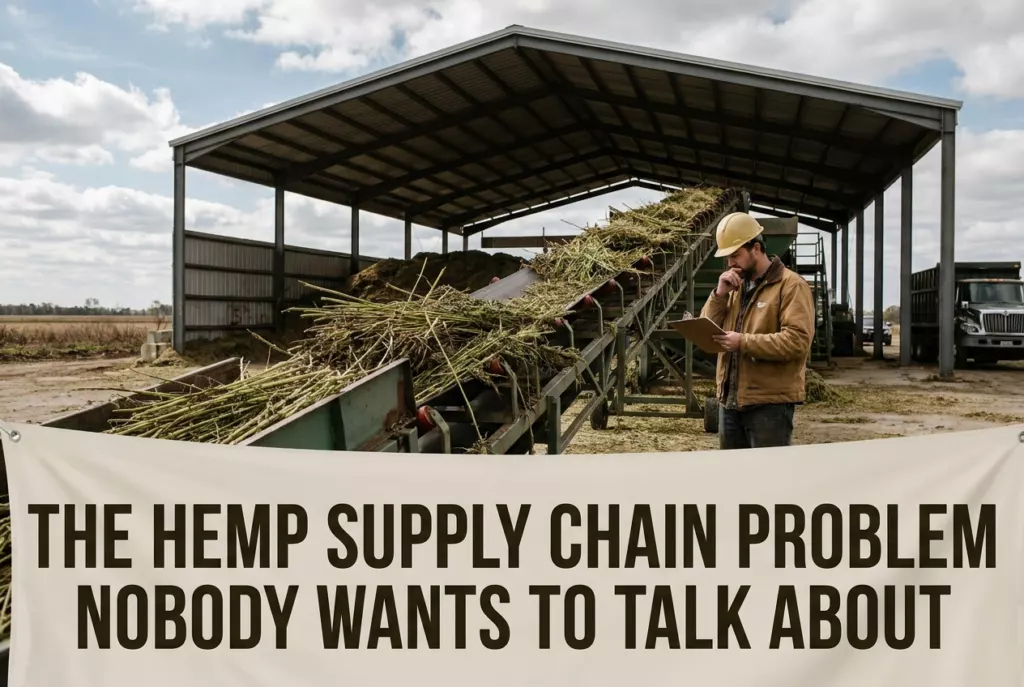
The realities of product quality, logistics of delivery and expectations in the Hemp industry…
Picture a warehouse bay on a humid afternoon: pallets of biomass arrive with paperwork that almost matches reality—moisture a touch high, potency quoted two ways, foreign matter debated by whoever is holding the scoop. Nobody is lying on purpose; everybody is trying not to be the bag-holder when the load fails a buyer’s spec. That friction is the hemp supply chain in miniature: not one scandal, but thousands of small mismatches that add up to a market that still feels half-built.
The uncomfortable truth is that hemp’s industrial promise—fiber, grain, cannabinoids, ingredients—depends on infrastructure that never arrived all at once. Federal rules framed what could be grown and handled within an oversight system administered by USDA, but those rules did not conjure consistent dryers, decorticators, standardized contracts, or forgiving margins. So the story behind the story isn’t “bad farmers” or “bad brands.” It’s a young commodity trying to behave like a mature one without the middleware of grading, liquidity, and trusted intermediaries.
How we got here
In the United States, hemp’s modern chapter reopened after statutory changes treated hemp differently from marijuana under federal law, with USDA administering a domestic hemp production framework through licensing, sampling, testing, and disposal pathways for crops that fall outside compliance thresholds. That framework matters because it defines legality at the farm gate—but legality is not the same thing as a salable product with repeatable quality. Operators learned that in seasons: material could clear compliance tests while still failing what a processor or ingredient buyer needed.
Over time, the arc bends toward specialization and realism. Early cycles rewarded optimism; later cycles rewarded logistics. Grain and fiber pathways advance where dedicated handling exists; cannabinoid lanes concentrate where labs, extraction capacity, and contractual clarity can absorb volatility. State policy layering adds another contour—how states structure licensing and coordinate with federal oversight influences where infrastructure investments feel safest. For a plain-language overview of how states approach hemp in relation to federal law, see the National Conference of State Legislatures hemp overview.
Meanwhile, public statistics remain an honest mirror: USDA’s National Agricultural Statistics Service publishes hemp survey materials and releases that illustrate fluctuating intentions and outcomes rather than a smooth climb. That unevenness is what a fragile supply chain prints on spreadsheets long before it prints on headlines.
People & stakes
Farmers carry biological risk first—weather, pests, harvest windows—and then market risk: who will take the material, on what terms, and how quickly payment arrives if specs drift. Processors and manufacturers carry capital risk; equipment amortizes against throughput, and throughput depends on feedstock uniformity they rarely control. Brands and formulators carry reputation risk; they need traceability and consistency, but they are often several contractual hops away from the field.
Regulators carry public-interest risk—preventing diversion into illicit channels while enabling a lawful industry—which pushes testing and documentation burdens onto operators who may face inconsistent lab interpretation across jurisdictions. Standards developers and trade associations (where credible) try to translate chaos into specs; where those bodies are thin, buyers improvise house standards and suppliers chase moving targets.
The stakes stay human even when the conflict sounds technical: a rejected load can mean payroll deferred, a dryer bottleneck can mean spoilage, a formulation change can mean a SKU pulled from shelves. The supply chain problem is distributional—risk piles onto whoever lacks bargaining power or redundancy.
Consequences & what’s next
The consequences show up as slower adoption curves for industrial hemp products than headline rhetoric suggested. Without predictable throughput and grading, manufacturers often default to incumbent inputs—cotton, polyester, established oilseeds—because switching costs include qualification, insurance, and sourcing teams trained for stability.
What happens next is conditional, not inevitable. If regional processing clusters mature—consistent inbound specs, transparent premiums and discounts, shared cleaning or drying capacity—the chain shortens and trust compounds. If contracts stay opaque and testing variance stays high, capital stays cautious and the industry remains episodic: bursts of planting followed by painful congestion at chokepoints.
For readers tracking federal program mechanics that influence harvest-time compliance (and therefore whether biomass becomes sellable at all), USDA’s Agricultural Marketing Service summarizes the Domestic Hemp Production Program. That connection matters because compliance friction at harvest is often the first hidden tax on the supply chain.
Hemp’s bottleneck isn’t ambition—it’s coordination: the boring work of matching biomass to machines, specs to labs, and promises to paper.
Behind the headline
Treat industrial hemp as several supply chains wearing one name. Fiber wants mechanical processing networks that reward consistent bast content and low contamination; without decortication and reliable logistics, straw piles up as an expensive monument to missing infrastructure. Grain behaves more like other oilseeds when handling resembles other oilseeds—cleaning, storage aeration, food-grade pathways—but those parallels are not automatic. Cannabinoid-focused pathways emphasize chemistry and compliance sensitivity in ways fiber and grain do not; the same regulatory word—“hemp”—masks radically different unit economics.
For concise congressional background on statutory definitions and the federal regulatory posture—useful for grounding debates without medical claims—the Congressional Research Service publishes Defining Hemp: A Fact Sheet (CRS R44742). Pair that framing with USDA statistical publications on hemp acreage and production via NASS hemp statistics to discuss supply responsiveness when demand signals are noisy.
Peer-reviewed work on agronomy, fiber quality, and processing is expanding; as a discovery path (not a substitute for reading individual studies), PubMed-indexed research can be explored with targeted searches such as industrial hemp fiber. Hemp.com stays neutral on medical outcomes; this editorial focuses on industrial mechanics and market structure.
Verification & sources
Verified themes: Federal hemp production oversight is described publicly by USDA AMS; hemp-related agricultural statistics are published through USDA NASS survey products referenced on NASS’s hemp survey page. Interstate policy variation is commonly summarized by nonpartisan state-legislature research organizations such as NCSL.
What remains speculative without case-specific evidence: localized processor margins, county-by-county chokepoints, and individual brand sourcing strategies. This draft avoids invented acreage figures, spot-price tables, and unnamed “industry surveys,” because they age quickly and can mislead.
Transparent gaps: Commercial benchmarks (regional biomass pricing, standardized grading adoption rates) shift quarter to quarter; where we do not cite a primary publisher or dataset, treat numbers you encounter elsewhere as provisional and trace them to named sources.
Editorial standards
This piece uses industry archetypes and a composite warehouse scene to explain systemic friction; it does not attribute quotes to real named individuals or imply on-the-record interviews where none were supplied in the brief.
Hemp.com does not provide legal advice or operation-specific compliance guidance; operators should confirm obligations with qualified counsel and with USDA and relevant state authorities. We avoid medical claims and therapeutic framing for hemp derivatives.
Corrections: if program URLs, survey methodologies, or statutory summaries change, update links and narrative accordingly and note substantive corrections at the editor’s discretion.
Directory relevance: Hemp.com listings are most useful when they encode operational reality—processing capabilities (fiber versus grain versus extraction), certifications, geographies served, and transparent contact pathways—because those fields reduce search friction in a supply chain short on trustworthy intermediaries. Any monetized placements or paid partner listings should be disclosed clearly to readers.
Find suppliers
Browse verified industrial hemp businesses in the Hemp.com directory.