
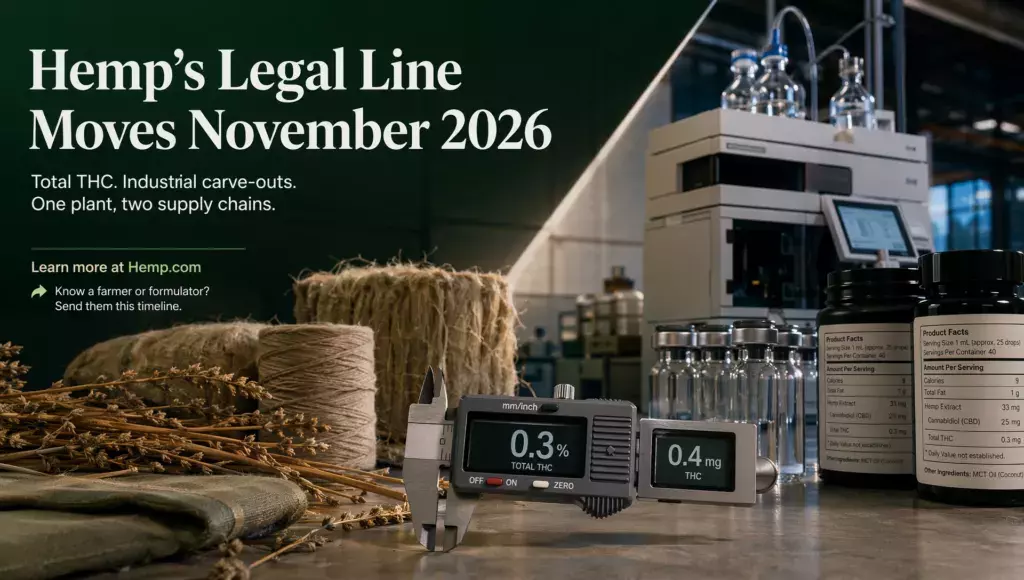
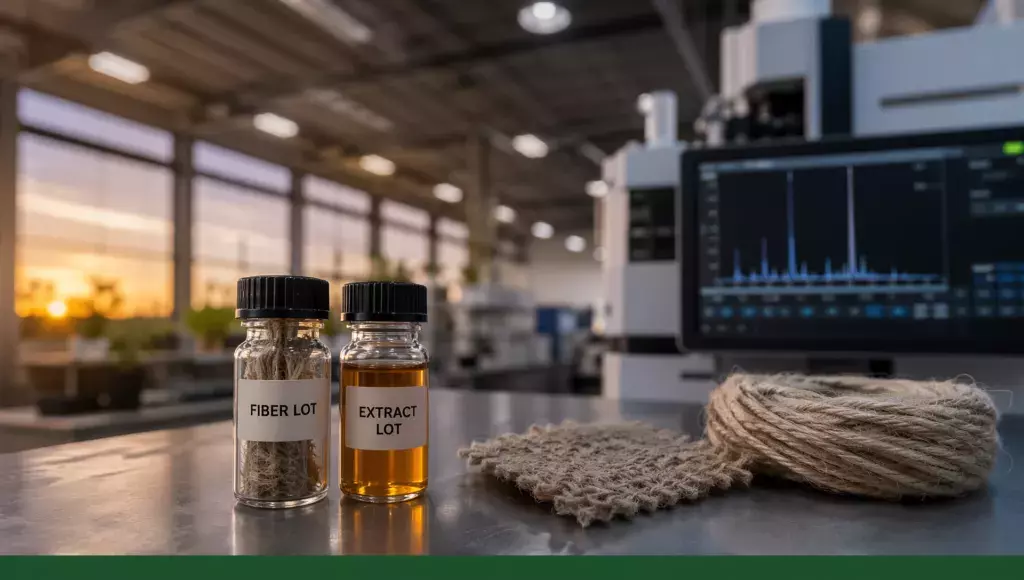
On a Kentucky fiber field and in a Colorado extraction lab, the same plant species is doing opposite jobs. One row becomes textile-grade hemp fiber bound for automotive composites and building materials. Down the supply chain, another batch becomes gummies, drinks, and vapes marketed under the same federal hemp label that unlocked U.S. cultivation after the 2018 Farm Bill.
That split identity—industrial crop versus fast-moving consumer product—just collided with federal law. On November 12, 2025, Congress enacted the FY2026 agriculture appropriations package (P.L. 119-37, Division B), embedding a rewrite of how the United States legally defines hemp. The change does not take effect immediately. It lands on November 12, 2026, giving farmers, processors, retailers, and regulators roughly one year to adapt—or to push Congress toward a different path.
The stakes are not abstract. The new statute shifts from a delta-9 THC threshold to a total THC standard, adds explicit protections for industrial hemp, and draws hard lines around certain hemp-derived cannabinoid products. Supporters frame the move as closing a loophole that allowed intoxicating products into convenience stores. Industry groups warn it could destabilize farms, wipe out compliant CBD shelves, and push commerce underground. Both sides agree on one thing: the current patchwork is not sustainable.
The Hemp Legal Story
To understand what changed, start with 2018. The Agriculture Improvement Act (P.L. 115-334) removed hemp from the Controlled Substances Act’s definition of marijuana when plant material contained no more than 0.3% delta-9 tetrahydrocannabinol on a dry weight basis. Cultivation exploded under USDA’s Domestic Hemp Production Program, and a parallel consumer market for cannabinoid extracts grew almost as fast.
Congressional researchers and FDA officials documented a problem: products labeled hemp could contain other tetrahydrocannabinols—delta-8 THC is the most cited example—that still produce intoxicating effects. Some were sold in formats resembling snack foods. The FDA issued warning letters, published consumer safety alerts, and tracked adverse event reports, including cases involving children. Policymakers began calling this the “farm bill loophole”: low delta-9 on paper, psychoactive in practice.
Section 781 of P.L. 119-37 amends 7 U.S.C. §1639o. When it becomes effective, hemp means Cannabis sativa L. and its derivatives with a total tetrahydrocannabinols concentration—including THCA—of not more than 0.3% on a dry weight basis. The law explicitly includes industrial hemp grown for stalk, seed, fiber, microgreens, and similar non-cannabinoid uses. It also excludes specific categories: viable high-THC seeds, intermediate products above 0.3% combined total THC and THC-like cannabinoids, final retail cannabinoid products above 0.4 milligrams of combined total THC per container, and cannabinoids that are synthetic or manufactured outside the plant when the statute’s exclusion criteria apply.
Excluded products are not hemp under federal law; they fall back under marijuana’s Controlled Substances Act framework. The Senate Appropriations Committee stated the aim was to prevent unregulated sale of intoxicating hemp products. Before enactment, the Congressional Research Service noted that cannabis regulators in several states and some state attorneys general had supported definitional tightening along these lines, while hemp trade groups argued for product regulation rather than reclassification.
Congress left a implementation runway. USDA must rework hemp production rules before the deadline. FDA must consult other agencies and publish cannabinoid lists and container guidance within 90 days of enactment. Multiple bills already propose repeal, delay, alternative THC thresholds, or FDA-led product frameworks—signals that the November 2026 line is a deadline, not necessarily the final word.
The surprising THC debate
Here is the detail most headlines skip—and the one fiber growers, CBD formulators, and compliance officers are debating in the same breath: the new law’s 0.4 milligram per-container cap is so strict that it may affect products nobody intends to get anyone high.
Trade press and industry advocates, including reporting in Agri-Pulse, note that many widely sold “full spectrum” CBD products contain more than 0.4 mg of total THC per bottle or jar—even when marketed as non-intoxicating. Under the post-2026 definition, those formulations could fall outside legal hemp unless reformulated, retested, and relabeled. That is a different problem from banning delta-8 gummies mimicking candy brands, yet both ride the same statutory language.
At the same time, the statute’s explicit carve-out for industrial hemp—fiber, grain, seed derivatives, immature leaf crops—is Congress’s clearest signal that the plant’s material future matters. Hempcrete, textiles, biocomposites, and food-grade hemp seed oil were never the target. The tension is structural: one botanical feedstock, two supply chains, one legal definition trying to separate them by chemistry measured in milligrams and tenths of a percent.
What’s at stake for the Hemp industry?
Consumer safety advocates and state regulators see upside in tighter federal guardrails. CRS analysts document FDA concerns about intoxicating hemp products sold without approved drug or food-additive pathways, copycat packaging, and adverse events requiring emergency care. A total-THC standard aligns field testing with how heat converts THCA into active THC—closing a compliance gap USDA’s own rules already anticipated through post-decarboxylation testing methodology in the Domestic Hemp Production Program. For parents, teachers, and public-health officials, clearer federal lines may reduce ambiguous products in general retail.
Farmers and hemp businesses face a different ledger. The U.S. Hemp Roundtable and allied lawmakers publicly opposed the appropriations language, arguing it threatens jobs, state-regulated markets, and rural farm revenue. Sen. Rand Paul (R-KY) warned on the Senate floor that the provision could override state frameworks and harm hemp farmers already navigating volatile commodity markets—concerns echoed in Agri-Pulse coverage. Growers cultivating cannabinoid varieties near the 0.3% total THC line face heightened hot-crop risk: fields that test “hot” must be destroyed or remediated under USDA rules, with no insurance safety net comparable to conventional row crops.
Industrial supply chains sit somewhat apart—but not entirely. Explicit industrial hemp inclusion protects fiber and grain pathways if USDA implements distinct testing and licensing tracks, an approach the House-passed Farm, Food, and National Security Act would extend. Processors still depend on stable seed genetics, banking, and interstate transport. If cannabinoid market contraction reduces overall hemp acreage, fiber and grain sectors could lose shared infrastructure such as decortication capacity and regional drying facilities.
Enforcement agencies inherit ambiguity. CRS notes it remains unclear how aggressively DEA, FDA, and DOJ will enforce against products that become marijuana under federal law while some states continue permissive retail rules. Resource limits, state-federal conflict, and banking disruptions could shape outcomes as much as the statute text.
Did you know?
- From 1970 until the 2018 Farm Bill, hemp was federally classified as marijuana under the Controlled Substances Act—despite centuries of industrial use for rope, paper, and textiles.
- The 2018 definition keyed legality to delta-9 THC only. The 2025 amendment switches to total tetrahydrocannabinols including THCA, matching how laboratories measure what consumers may actually absorb after heating.
- P.L. 119-37 gives industry a 365-day transition: signed November 12, 2025; effective November 12, 2026—unless Congress delays or repeals the provision first.
- The law requires FDA to publish lists of naturally occurring cannabinoids, THC-class cannabinoids, and cannabinoids with similar effects—definitions that will determine which products survive federal scrutiny.
- CRS reports that excluded hemp-derived products revert to marijuana status under the CSA, potentially triggering the same collateral consequences—banking, transport, tax—that have constrained state-legal cannabis markets, though federal enforcement priorities remain uncertain.
What to keep your eye on…
If you grow hemp, buy hemp products, invest in hemp materials, or write state rules, you are operating inside a one-year policy experiment with a fixed calendar date. Watch four signals between now and November 2026.
First, USDA rulemaking: how the department separates industrial hemp from cannabinoid production in licensing, sampling, and destruction protocols. Second, FDA’s cannabinoid lists and container definition, which translate statutory language into pass-fail product tests. Third, Congressional action on bills such as repeal measures (H.R. 6209), alternative THC thresholds (S. 2112), or FDA product frameworks (S. 3474)—any of which could move before the deadline. Fourth, state responses: some states already regulate consumable hemp; others still mirror the old delta-9 standard, creating a federal-state seam CRS warns may persist.
Readers tracking industrial applications—hemp fiber in automotive parts, hemp hurd in insulation, seed protein in food—should watch whether explicit industrial carve-outs translate into simpler field compliance. Readers concerned about intoxicating products in general retail should watch whether federal reclassification actually removes those SKUs or simply reroutes them. Neither outcome is guaranteed today.
Why Hemp.com
Hemp.com tracks this transition because the industrial hemp economy depends on predictable rules—not on whether any single product category wins a political fight. Our coverage connects federal statutory text to farm-gate realities, consumer-label literacy, and the material innovations that made hemp a serious candidate in plastics, construction, and textiles long before cannabinoid markets existed.
We will continue publishing neutral explainers, primary-source summaries, and directory resources as USDA, FDA, and Congress act. If you operate in this space, treat November 12, 2026 as a planning milestone—not a rumor on social media.
Verification & sources
Primary sources for this article include the Congressional Research Service In Focus IF13136 (December 2025), CRS Insight IN12620 on enforcement implications, the amended statutory text at 7 U.S.C. §1639o, USDA’s Domestic Hemp Production Program, and FDA public warnings on delta-8 THC products. Industry impact estimates cited in trade coverage are attributed to industry advocates unless independently verified by federal data.
Editorial standards
This article presents competing stakeholder positions without endorsing either outcome. It does not provide legal advice, medical guidance, or consumption recommendations. Hemp-derived cannabinoid products remain subject to FDA jurisdiction; FDA states delta-8 THC has not been evaluated for safe use in food and has documented adverse event reports. Enforcement predictions are inherently uncertain; where federal agencies have not published final implementation rules, we describe statutory requirements and flag open questions explicitly.
Explore further
Continue on Hemp.com for state hemp program trackers, industrial hemp supplier directories, and deep dives on fiber decortication, hemp building materials, and grain markets—sectors explicitly protected in the new statutory industrial hemp definition. If you comment on this policy, ground your perspective in documented compliance costs, consumer-label clarity, or supply-chain data; that is the conversation worth having before November 2026.
Find suppliers
Browse verified industrial hemp businesses in the Hemp.com directory.