
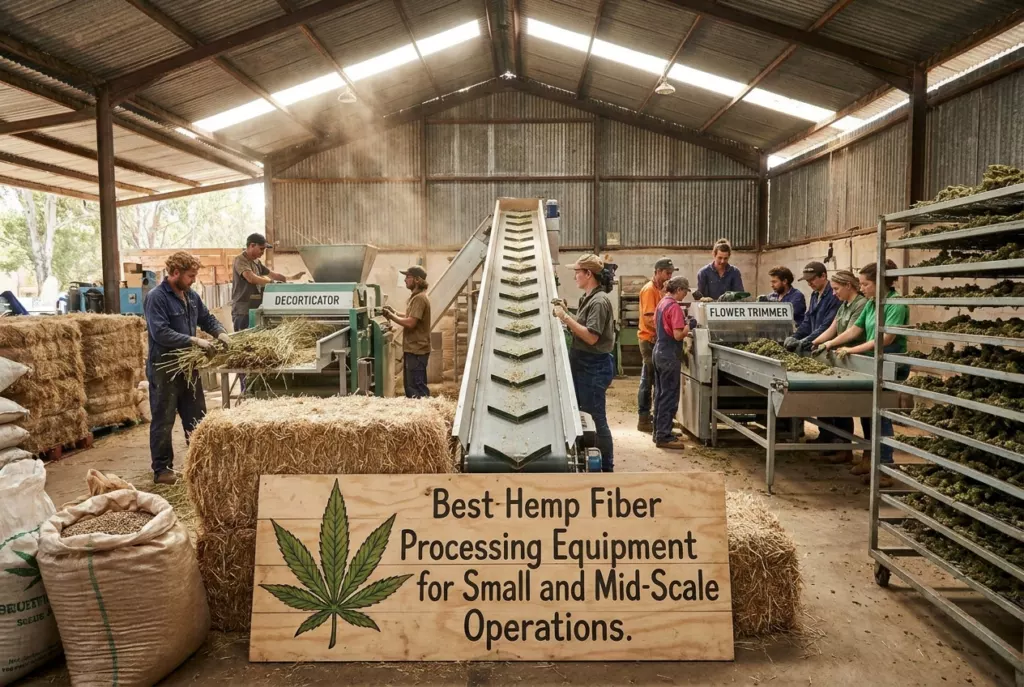
Industrial hemp fiber moves through a chain that is part agriculture, part materials handling, and part manufacturing QA. For small and mid-scale operators, the bottleneck is rarely “one magical machine”—it is matching throughput to realistic feedstock supply, seasonal moisture, and buyer specifications for cleanliness, length, and contaminant limits.
Equipment choices should be anchored to your end product: short technical fibers for composites or nonwovens, longer line fiber for textiles (where processes get more exacting), or hurd-focused outputs for lightweight aggregates and animal bedding. If you optimize the wrong step, you will pay capex for capacity you cannot sell—or produce fiber nobody will buy repeat loads of.
Your regulatory foundation in the United States remains tied to hemp as defined under federal rules administered through USDA programs; treat THC sampling and compliant sourcing as part of operational design, not an afterthought. Useful orientation lives on the USDA hemp topics hub and the AMS hemp rules landing pages (USDA hemp topics; AMS hemp rules and resources).
What it means for hemp
For growers, fiber hemp is a logistics game: uniform stands, predictable harvest timing, transport windows, and moisture discipline matter as much as genetics. For processors, margin lives in yield recovery, fiber character consistency, and downstream repeatability. Brands and buyers often evaluate bast materials like any industrial input—spec sheets, audit trails, and penalty clauses for contamination.
Investors should scrutinize whether a facility model matches regional advantages: inexpensive drying/storage space, rail or bulk outbound lanes, access to skilled maintenance labor, and proximity to customers who will pay for semi-processed fiber versus raw hurd. A mid-scale plant that tries to mimic a multinational textile supply chain without the same buyer pipeline tends to fail on working capital, not on “missing a cooler machine.”
Across industrial hemp, fiber processing sits adjacent to established bast industries (flax/kenaf mechanics share DNA). Your differentiation is rarely novelty—it is batch control, documented moisture and dust management, and contracts that reflect realistic grading. Where public datasets on hemp fiber pricing remain uneven year to year, internal benchmarking (loss rates, energy per ton, downtime) becomes your competitive intelligence.
Playbook: what to do now
Use this as a Monday-morning procurement and commissioning roadmap—not a shopping list of brands. Always validate throughput claims against your stalk morphology, targeted throughput hours per season, and local utilities limits.
| Stage | Typical equipment families | What “good” looks like |
|---|---|---|
| Inbound & staging | Weighbridge/scales, moisture probes, covered bays, forklifts/telehandlers | Traceable lots; moisture tracked to reduce spoilage and fire risk |
| Primary size reduction | High-torque shredders/choppers (often paired with magnets) | Consistent particle geometry feeding the decortication step |
| Decortication / separating bast from hurd | Hammer-mill variants, roller-and-impact decorticators, modular lines | Clean separation with tunable settings; documented wear-part cycles |
| Cleaning & sorting | Air legs, screens, oscillating tables, optical sorting (as budgets allow) | Fiber meets buyer contaminant thresholds without destroying length |
| Drying (when needed) | Batch dryers, continuous dryers (fuel/ag permits dependent) | Controlled moisture for storage stability and predictable downstream handling |
| Dust & safety | Baghouses/cartridge collectors, spark detection, explosion isolation planning | Written housekeeping; compliance orientation with local AHJ expectations |
| Baling & outbound | Fiber balers, hurd densification, sealed totes for premium grades | Labeled lots tied to intake metadata for recalls and disputes |
Steps to become a successful hemp processor (operator checklist)
- Define the SKU first: hurd-only, bast technical fiber, or graded line fiber—each implies different cleaning intensity and customer QA.
- Model throughput honestly: seasonal peaks, planned downtime, and realistic labor shifts beat brochure horsepower.
- Visit running lines: bring representative stalk samples and measure losses across each stage; negotiate warranties tied to performance bands.
- Build QA early: length distribution targets, ash/contaminant checks, moisture envelopes—align methods with what buyers actually penalize.
- Engineer dust from day one: equipment selections should integrate collection and maintenance access—not ductwork as an afterthought.
- Contract clearly: grading disputes, rejection thresholds, and arbitration pathways reduce existential conflicts.
- Standards literacy: textile-adjacent buyers often reference consensus test methods; ASTM publishes widely referenced materials testing resources (ASTM International)—map which methods your customers cite before you scale capex.
Do now / watch / avoid
- Do now: baseline moisture and inbound contamination on pilot batches; document settings vs outcomes.
- Watch: utility demand spikes during drying; maintenance parts lead times for wear-heavy units.
- Avoid: buying “maximum capacity” without outbound contracts and trained operators—idle depreciation kills small plants faster than imperfect yields.
Risks & compliance
Fiber processing is regulated noise plus chemistry plus mechanical hazard management. You should assume overlapping oversight: agricultural hemp compliance pathways (including USDA hemp program orientation materials), local fire and building codes for dust-handling installations, air permits where dryers or large collectors apply, and occupational safety expectations comparable to other biomass milling operations. This section is not legal advice; treat it as a diligence prompt list for counsel and your authority having jurisdiction.
Biggest challenges to get started often cluster into predictable buckets:
- Feedstock variability: cultivar, planting density, retting approach (field vs water vs enzyme—each has tradeoffs), and harvest timing change fiber yield and purity batch-to-batch.
- Moisture and spoilage: hemp stalk masses can behave like wet lignocellulosic fuels; poor staging invites heating, mold, and insurance headaches.
- Seller/buyer specification mismatch: processors quote tons; buyers purchase grades—without mutual definitions you get rework and rejection risk.
- Capital sequencing: oversized primary sizing creates fines; undersized cleaning yields reject piles—both consume cash without revenue.
- Maintenance maturity: rural staffing constraints matter when bearings, belts, and screens dictate uptime.
Testing and documentation: maintain chain-of-custody discipline from field lots through outbound bales. Where THC sampling applies to regulated hemp activities in your jurisdiction, integrate sampling logistics into harvest scheduling—not last-mile scrambling.
Contracts: specify sampling methodology references where feasible (buyers may cite industry-standard test frameworks); ISO maintains internationally referenced standards publishing infrastructure (ISO)—whether a particular hemp fiber SKU requires ISO-referenced methods depends on the customer and region.
Cost & tradeoffs
Transparent ballpark pricing for hemp-specific fiber lines is difficult to state globally because quotes swing with currency, steel inputs, automation depth, and import duties. What you can budget intellectually is the economic shape of each tradeoff:
- Manual vs automated cleaning: labor-heavy sorting lowers capex but raises variance and headcount risk; optical sorting raises capex but can stabilize premium grades if inbound feedstock is consistent.
- Centralized vs modular lines: modular upgrades reduce stranded capital when throughput assumptions change; integrated lines can lower footprint but increase dependency risk.
- Drying choices: fuel costs and permitting complexity often dominate lifecycle economics more than the sticker price of the dryer box.
- Wear parts: screens, hammers, knives—model replacements quarterly until you have operating history.
If your spreadsheet lacks buyer-linked premiums for cleaner/longer fiber, stop optimizing machinery until you have price deltas tied to grades—otherwise you cannot calculate ROI honestly.
Opportunities
Advantage accrues to operators who pair modest capex with obsessive lot discipline: predictable ash targets, stable moisture, and documented machinery settings. Mid-scale sweet spots often emerge where regional haul distances favor local hurd outlets while bast travels farther as higher-value semi-processed fiber.
Lean in if you have secured multi-year offtake interest, access to skilled millwright support, and space for controlled staging/drying. Wait or pilot smaller if contracts are speculative, power/service upgrades are uncertain, or your feedstock partners cannot commit to harvest uniformity standards.
Adjacent revenue streams—dust-controlled hurd for lightweight applications, co-products where markets exist—can smooth seasonality, but each SKU adds QA overhead; diversification without operational maturity spreads mistakes across product lines.
At a glance
- Fiber profits hinge on grade discipline and downstream specs—not peak machine horsepower.
- Prioritize moisture staging, dust control, and maintenance realism before expanding capacity.
- Use a stage-by-stage table to align procurement with your SKU, not a generic “fiber plant.”
- Regulatory and safety layers stack: hemp compliance pathways plus local codes for biomass milling and drying.
- Economic decisions require buyer-linked premiums; avoid capex without graded pricing anchors.
- ASTM/ISO references matter when customers cite consensus test methods—confirm before scaling cleaning investments.
Verification & sources
Verify claims using primary regulators and standards publishers rather than forum anecdotes. For U.S. hemp rule orientation and program links, start with USDA’s consolidated hemp portal and AMS hemp administration pages (USDA hemp topics; AMS hemp rules). For buyer-driven QA language, trace references to published test method catalogs such as ASTM International and ISO.
Limits: equipment pricing, regional subsidy programs, and live throughput benchmarks change quickly and vendor-specific; this article avoids quoting unreliable dollar ranges or dated production statistics. Where your state offers hemp-specific agricultural guidance, prefer official state agriculture department publications over secondary summaries.
Editorial standards
Hemp.com publishes practical industry intelligence for operators and buyers. This draft avoids medical claims, illegal guidance, and unsourced statistical assertions. Equipment mentions are categorical (machine families and process stages) rather than ranked endorsements of specific vendors.
Monetization and directory disclosure: if Hemp.com lists paid directory placements, affiliate relationships, or sponsored equipment profiles alongside related content, those relationships should be disclosed prominently near any linked listings or calls-to-action. Editorial recommendations here are framed as decision criteria; readers should independently validate specifications with vendors and qualified professionals.
Explore further
Directory CTAs: explore Hemp.com directories for processing equipment providers, engineering firms, and testing laboratories—using filters aligned to fiber versus grain versus extraction workflows. When contacting vendors, request reference installs at comparable tonnage, spare parts lead times, and written performance guarantees tied to your feedstock samples.
Find suppliers
Browse verified industrial hemp businesses in the Hemp.com directory.