
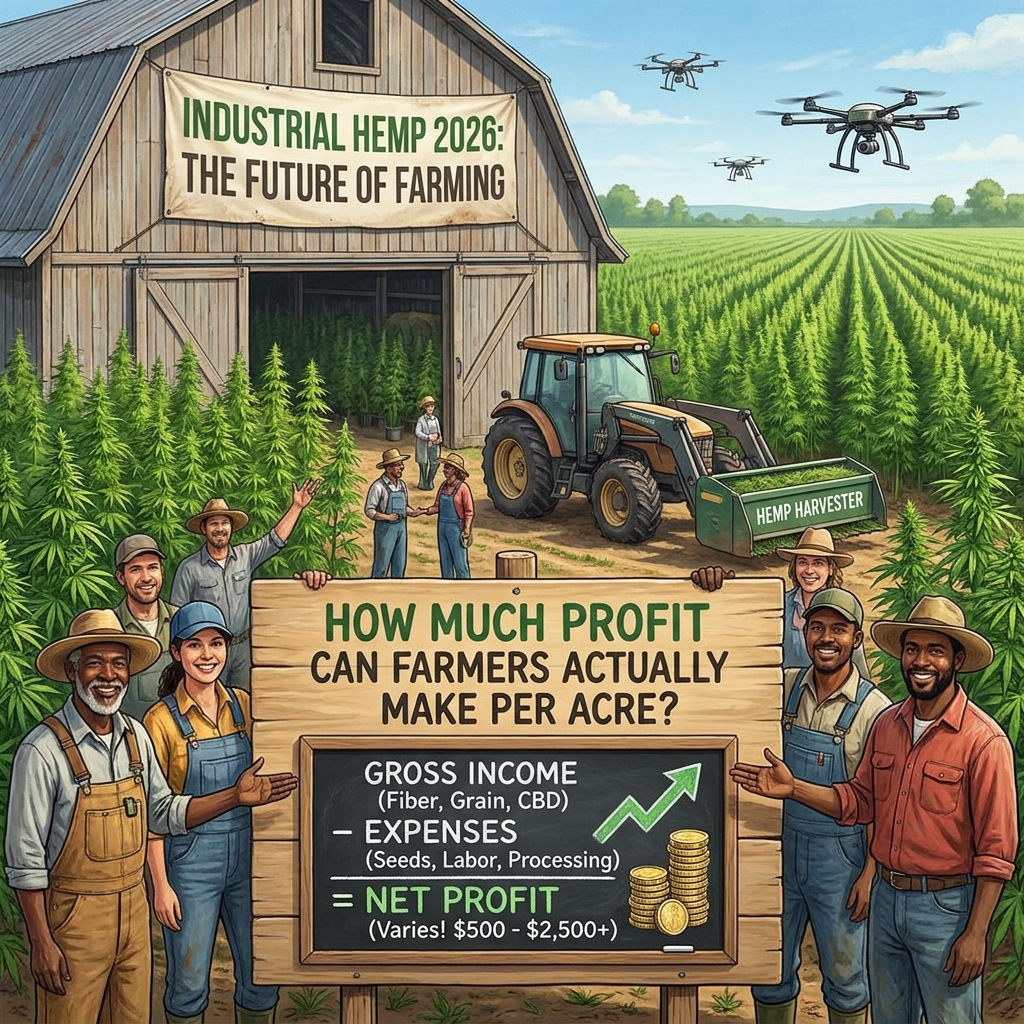
The blunt takeaway: “Profit per acre” for industrial hemp is not a single industry statistic you can quote like corn or soybeans. It is a scenario output—highly sensitive to whether you are optimizing for fiber tonnage, grain/seed, or floral biomass destined for regulated downstream markets, plus your ability to execute harvest, drying/handling, and THC compliance.
That uncertainty matters because hemp often carries higher operational complexity than mainstream row crops: licensing workflows, sampling/testing logistics, disposal risk for non-compliant lots, and thinner or less standardized buyer markets depending on the channel.
For Hemp.com readers running compliance, procurement, or farm ops, the productive question is not “what’s the average profit?” It’s “what revenue paths are contractable in my region, what yields are achievable on my soils, and what costs routinely wipe out margins?”
What it means for hemp
Industrial hemp functions as multiple supply chains wearing one agronomic name. That split is why acre economics diverge so sharply.
Fiber pathways reward consistent throughput and specification-driven processing: stem yield and handling traits interact directly with mill/retting logistics and transportation economics. Without credible processor coordination, gross revenue assumptions can collapse quickly—even when field biomass looks impressive.
Grain and seed pathways behave closer to familiar crop Marketing years—yet still hinge on cleaning, food-grade specifications, and identity preservation through handling. Small surprises at harvest (moisture management, dockage, contamination) can convert a promising yield spreadsheet into a salvage scenario.
Floral-oriented production is frequently the most compliance- and labor-intensive orientation at the farm gate because schedules, scouting intensity, and sampling/testing outcomes can dominate outcomes. Hemp.com stays neutral on medical outcomes or product efficacy; treat floral economics strictly as a regulated agricultural-input supply chain problem driven by contracts, compliance, and processing demand—not therapeutic narratives.
Across channels, the “winner” is rarely who plants hemp—it’s who has repeatable execution plus counterparty reliability. USDA’s hemp production overview materials summarize federal program expectations producers navigate nationally; see the Agricultural Marketing Service hemp hub for the baseline regulatory framing (USDA AMS hemp production resources).
Playbook: what to do now
Use this as a Monday-morning workflow: lock assumptions, stress-test margins, then validate with primary sources.
| Decision lens | What to do now | What to watch monthly | What to avoid |
|---|---|---|---|
| Market channel choice | Write down your primary buyer type (fiber processor, grain buyer, floral contractor) and the minimum specifications they require before you estimate revenue. | Basis risk signals: delivery windows, reject rates, spec changes, freight disruptions. | Planning off “national hype averages” instead of named counterparties and realistic haul distances. |
| Yields & agronomy | Build three scenarios (conservative / expected / upside) using local soil history and rotations—not brochure yields. | Pest pressure, lodging, moisture swings; harvest bottlenecks. | Single-point yield assumptions without harvest-loss buffers. |
| Compliance & lots | Map sampling/testing timing against your harvest plan; budget time for retests and contingency handling. | Rule updates, lab variability discussions, disposal workflows. | Treating compliance as a paperwork step rather than a production constraint. |
| Finance & contracts | Model cash flow by week of season (establishment through delivery), including drying/storage and shrink. | Counterparty behavior: delays, amendments, defaults. | Verbal “handshake” commitments for high-capital channels. |
- Build a “minimum viable margin” sheet: start from delivered revenue after discounts, then subtract operating cash costs you cannot defer.
- Separate capex from opex: specialized handling equipment can dominate payback timelines—especially if throughput is uncertain.
- Use interactive budgets: land-grant extension teams publish hemp enterprise budget tools intended for scenario planning (example hub: University of Kentucky hemp marketing & economics resources).
- Ground-truth industry scale: track USDA National Agricultural Statistics Service hemp survey publications for macro supply signals over time (NASS hemp production survey overview).
- Maintain an evidence folder: licenses, lab paperwork, weigh tickets, contracts—this is operational hygiene, not “nice-to-have.”
Risks & compliance
Hemp profitability is partly a compliance engineering problem. Federal hemp production rules establish licensing, sampling/testing, and THC-related compliance themes producers must follow under USDA oversight (USDA AMS hemp production resources). States and tribes administer many programs day-to-day, so requirements can differ materially by jurisdiction.
Common landmines that blow up margins:
- Hot lots / non-compliance pathways: disposal, diversion, or rework scenarios can erase gross revenue while leaving field costs sunk.
- Sampling timing mismatch: misalignment with harvest readiness increases retest risk and scheduling churn.
- Interstate movement friction: even when federal definitions align, practical movement can depend on documentation discipline and state program interfaces—verify current rules with your regulator.
- Contract ambiguity: spec thresholds, reject clauses, and payment triggers matter more in thin markets.
For a concrete example of how state programs operationalize cultivation oversight (fees, registration steps, and program scope vary), Colorado publishes hemp program information at the Department of Agriculture (Colorado Department of Agriculture hemp program). This is illustrative of state-specific administration, not universal policy.
Disclaimer: Hemp.com provides industry intelligence, not legal advice. Involve qualified counsel for interstate contracts, hemp licensing disputes, and interpretations affecting your operation.
Cost & tradeoffs
Honest economics starts by naming what consumes cash before “profit” appears.
Operating cost pressures (typical themes):
- Establishment: fertility, seed/transplant economics, weed control intensity by channel.
- Harvest & logistics: moisture management, transportation, labor spikes during narrow windows.
- Compliance overhead: sampling/testing cadence, recordkeeping labor, potential remediation.
- Shrink and quality discounts: cleaning losses, contamination, spec mismatches.
Capital tradeoffs: specialized dryers, storage, and handling lines can improve salvage rates—but they shift risk from “field volatility” to “asset utilization risk.” If throughput drops, fixed-cost absorption punishes margins quickly.
Where public tools help: USDA Economic Research Service publications discuss hemp market development constraints and why thin markets complicate planning—useful for framing uncertainty rather than guaranteeing prices (ERS publication details page for industrial hemp status and market potential). Treat any enterprise budget as a template you must localize with your yields, interest rates, rent structure, and contracts.
Data humility: We intentionally avoid quoting a universal dollars-per-acre profit band here because honest benchmarking should come from your county-scale yields, your buyer sheets, and current releases—especially USDA survey outputs when available (NASS hemp survey overview).
Opportunities
Advantage doesn’t accrue evenly; it clusters where execution meets contractable demand.
Fiber and grain operators should lean in when they have (or can credibly build) repeat delivery relationships, predictable logistics, and agronomic systems tuned to specification—not just biomass volume. If regional processing capacity is thin, the strategic move may be coalition-building (grower pools, standardized grading dialogue) rather than expanding acreage alone.
Processors and brands sourcing hemp inputs create upside for farms that behave like suppliers: stable quality distributions, documented traceability, and realistic scheduling. Procurement teams reward suppliers who reduce rework.
Investors and lenders should treat hemp acre proposals like venture manufacturing: scrutinize utilization, working capital seasonality, and counterparty concentration. A strong narrative without verified contracts is a common failure mode.
When waiting is rational: if you cannot secure testing logistics, drying/handling capacity, and a enforceable offtake path aligned to your chosen channel, “planting to learn” can be an expensive education—sometimes pilot scale on owned infrastructure is the superior staged bet.
At a glance
- Profit per acre is a scenario output, not an industry constant—channel choice dominates.
- Fiber, grain, and floral pathways imply different cost stacks, buyer specs, and compliance intensities.
- USDA AMS defines federal hemp production themes producers must navigate; states/tribes administer many operational details.
- Use NASS hemp surveys for macro benchmarking over time, not for guaranteeing farm-gate checks.
- Extension enterprise budgets are practical scenario tools—localize yields and prices ruthlessly.
- Contracts and logistics frequently matter more than agronomic optimism—model downside first.
Verification & sources
Readers should verify claims using primary sources and localized budgets.
- Federal program framing: USDA Agricultural Marketing Service hemp hub (USDA AMS hemp production resources).
- Macro production statistics (survey-based): USDA National Agricultural Statistics Service hemp survey documentation (NASS hemp survey overview).
- Market-structure context (research synthesis): USDA Economic Research Service publication landing page (ERS industrial hemp publication details).
- Scenario budgeting tools: land-grant extension economics hubs such as University of Kentucky hemp marketing & economics (UK hemp marketing & economics).
- State rule operationalization example: Colorado hemp program portal (Colorado Department of Agriculture hemp program).
Limits: Hemp markets evolve quickly; older syntheses may miss today’s buyer landscape. Hemp.com does not guarantee completeness of external pages or eternal URL stability—bookmark sources and download authoritative PDFs when offered.
Editorial standards
Hemp.com publishes practical intelligence for industrial hemp operators and adjacent supply-chain stakeholders. This piece prioritizes decision support over sensational profit claims.
Methodology: framing draws on publicly documented federal hemp oversight themes (USDA AMS), publicly described statistical survey programs (USDA NASS), USDA ERS research publications for market-structure context, and widely used land-grant extension budgeting approaches—without asserting proprietary farm-gate pricing datasets.
Medical neutrality: no therapeutic claims; hemp-derived product pathways are discussed strictly as regulated commerce and agricultural production economics.
Directory & monetization transparency: Hemp.com operates directory and informational assets; where listings or partners appear alongside editorial content, those relationships should be disclosed adjacent to the placement per site policies. This draft contains no paid placements.
Explore further
Next reads (conceptual): deep dives on fiber processor contracting terms, grain cleaning and food-grade handling economics, harvest logistics planning, and THC sampling QA—paired with state regulator portals relevant to your farm location.
Directory utility: Use Hemp.com’s directory workflows to identify processors, testing-support ecosystems, and service providers aligned to your channel—but diligence remains mandatory: verify certifications, references, and contractual protections independently.
Find suppliers
Browse verified industrial hemp businesses in the Hemp.com directory.