
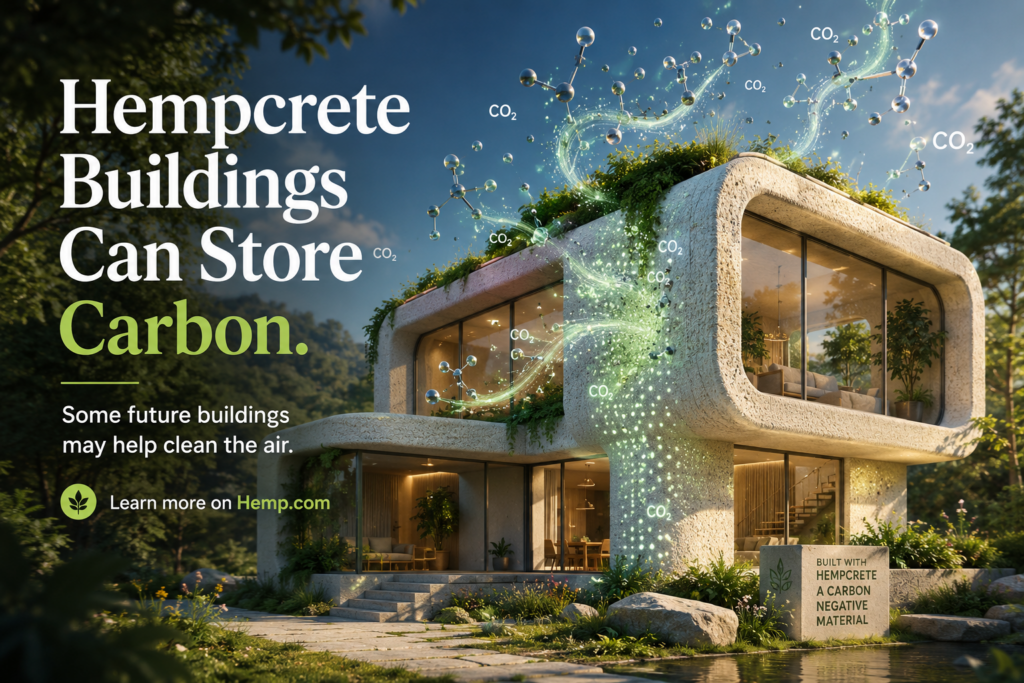
For decades, builders talked about greener walls. Then a quiet shift happened: industrial hemp stopped being a novelty crop and started showing up in building codes as a real infill material. The headline is simple and surprising at once—walls made from hemp can store carbon, not just cut energy bills.
That is not marketing fluff. Peer-reviewed life-cycle studies describe hemp-lime composites—hemp hurd mixed with lime-based binders, often called hempcrete—as materials that can hold biogenic carbon captured while the plant grows, and in some cases pull additional carbon dioxide back into the binder as it cures and ages. If the supply chain scales, tomorrow’s homes could do more than use less cement. They could bank carbon inside the envelope for the life of the building.
The core industry problem
The core problem is not whether hemp absorbs carbon in the field. It does, like other fast-growing crops. The harder question is what happens after harvest: processing, trucking, binder chemistry, wall density, fire and moisture performance, and whether a project still counts as carbon-storing once every step is added up.
Construction remains one of the world’s largest sources of greenhouse-gas emissions, driven heavily by cement, steel, and conventional insulation. Hemp-lime offers a different model—a bio-based infill that insulates and can remain in place for decades. But it is typically non-structural. Frames still carry loads. Mix recipes vary. Add too much ordinary Portland cement or ship materials long distances, and the carbon math can flip from favorable to disappointing.
In the United States, the bottleneck has also been regulatory. Without a recognized path in model building codes, every hemp-lime project risked custom engineering, delays, and cost overruns—even after the 2018 Farm Bill reopened commercial hemp production. Infrastructure for building-grade hurd, trained installers, and consistent testing lagged behind the climate pitch.
Deep reporting
European researchers have studied hemp-lime walls for years. A widely cited life-cycle assessment of hempcrete blocks, published in Journal of Cleaner Production, found that biogenic uptake during hemp growth and carbonation in lime binders can yield a negative carbon footprint for the material—meaning more carbon is stored than emitted in production—though the authors noted real-world carbonation may proceed more slowly than earlier models assumed, with significant binder carbonation concentrated in outer wall layers in their 240-day tests (ScienceDirect abstract).
More recent modeling work posted through the U.S. National Science Foundation repository examined dozens of hempcrete formulations and estimated that in-situ binder carbonation could recover a meaningful share of manufacturing emissions, while biogenic storage could push total life-cycle results negative for some mixes—but not all. High-density recipes with substantial Portland cement content could still end up net-positive emitters (NSF PAR record).
On the policy side, the U.S. Hemp Building Association reported that hemp-lime construction entered the 2024 International Residential Code as Appendix BL, giving builders of one- and two-family homes a standardized path where states adopt that code (USHBA announcement). Code text visible through public code viewers describes hemp-lime as a nonstructural infill with defined density ranges and references multiple ASTM test methods for thermal, fire, and moisture performance.
What this story still lacks for full newsroom verification: current U.S. acreage dedicated to building-grade hurd, installed square footage by state, and independent cost comparisons on recent commercial projects. Those figures should be treated as editor follow-ups rather than assumed.
What is really changing
Why this matters goes beyond one eco-friendly demo home. Buildings lock materials in place for 50 years or more. If a wall assembly verifiably stores carbon at scale, hemp construction becomes a supply-chain strategy—linking farm policy, processor specs, and municipal climate plans—not just an architectural curiosity.
Code recognition changes the economics of attention. Architects and insurers pay attention when materials appear in adopted model codes. That can pull investment toward decortication, hurd grading, and regional batch plants. It also raises the stakes for honest accounting: cities tracking embodied carbon in permits will ask for documented mix designs, not brochure claims.
Second-order effects are already visible in the standards pipeline. Trade groups have described efforts to extend hemp-lime recognition beyond residential infill into broader commercial codes and formal ASTM product standards—work that is ongoing and uneven (USHBA). Meanwhile, life-cycle researchers emphasize that how hemp is grown—fertilizer, drying energy, transport—can matter as much as what is built.
Who wins and who loses
Who benefits: Hemp growers and processors with access to construction markets; rural regions seeking higher-value outlets than commodity fiber alone; builders and designers in jurisdictions that have adopted IRC Appendix BL; and climate-oriented housing programs looking for measurable embodied-carbon reductions backed by third-party life-cycle methods.
Who is exposed: Producers stuck in CBD-centric supply chains without hurd capacity; projects that import binders and hurd across long distances; specifiers who treat all hemp-lime mixes as automatically carbon-negative; and conventional insulation manufacturers facing new competition in fire-rated, vapor-permeable wall systems—if hemp-lime costs fall and labor training expands.
Who waits and watches: Commercial developers needing International Building Code pathways beyond residential infill; insurers and appraisers awaiting broader actuarial history; and municipalities that want farm-to-wall carbon data in climate disclosures but do not yet have reporting templates for bio-based assemblies.
Evidence file
Carbon storage mechanisms: (1) Biogenic carbon in hemp hurd—the CO2 absorbed during plant growth that remains embedded when hurd is bound into walls. (2) Binder carbonation—lime-based binders can reabsorb atmospheric CO2 over time as they cure and age, a process studied in hemp-lime life-cycle literature (Ruggieri et al., 2017; recent formulation modeling).
Research cautions: Carbonation rates may be slower and less uniform than early assumptions; transport, binder type, and mix density strongly influence results; end-of-life pathways for hemp-lime remain less documented in some studies. A 2023 Springer chapter on U.S.-oriented hempcrete mixes notes carbon negativity depends on hemp content and lime assumptions in the life-cycle boundary (Springer chapter). Separate cradle-to-gate work on hemp-based boards in Western Australia reported negative embodied emissions for the functional unit studied, with results sensitive to grid electricity versus onsite renewables (MDPI Materials).
Policy and standards: USDA administers the U.S. domestic hemp production program under the 2018 Farm Bill framework (AMS hemp page). NRCS materials note industrial uses including building applications among potential hemp products (NRCS). IRC Appendix BL governs hemp-lime as nonstructural infill with referenced ASTM tests (IRC 2024 Appendix BL viewer).
Industry outlook
Three scenarios are plausible over the next several years.
Base case: Hemp-lime grows as a regional infill insulation in owner-built, affordable-housing, and climate-grant projects in code-adopting states. Carbon benefits are real but modest at national scale until hurd supply standardizes.
Upside: Commercial code acceptance, ASTM product standards, and embodied-carbon procurement rules align. Regional hemp-building clusters emerge—farm, decorticator, batch plant, trained installer—with documented mix libraries and third-party carbon labels.
Downside: Overclaimed “carbon-negative building” marketing outruns verification; high-cement mixes and long-haul logistics undermine life-cycle results; labor shortages and unfamiliar inspection workflows slow adoption.
The most credible near-term opportunity is not claiming hemp homes will single-handedly clean the air. It is pairing lower operational energy from well-insulated envelopes with verified stored biogenic carbon—a dual benefit that fits industrial hemp’s broader push into durable goods beyond cannabinoid markets.
Sources & methodology
This feature synthesizes publicly available life-cycle research, U.S. federal hemp program materials, model building-code appendix text, and trade-association reporting on code adoption. It does not rely on fabricated interviews, proprietary datasets, or unsourced market statistics. Claims about carbon storage follow peer-reviewed and repository-published life-cycle assessment methods; where evidence is mixed or context-dependent, that uncertainty is stated in the body.
Before publication, editors should independently verify: current IRC adoption by state; the latest USHBA and ASTM standard timelines; any project-specific cost or performance figures intended for the final draft; and that all outbound links resolve to the cited documents. Human review of carbon-accounting language is required so the piece does not overpromise medical or environmental outcomes beyond what construction science supports.
Find suppliers
Browse verified industrial hemp businesses in the Hemp.com directory.