
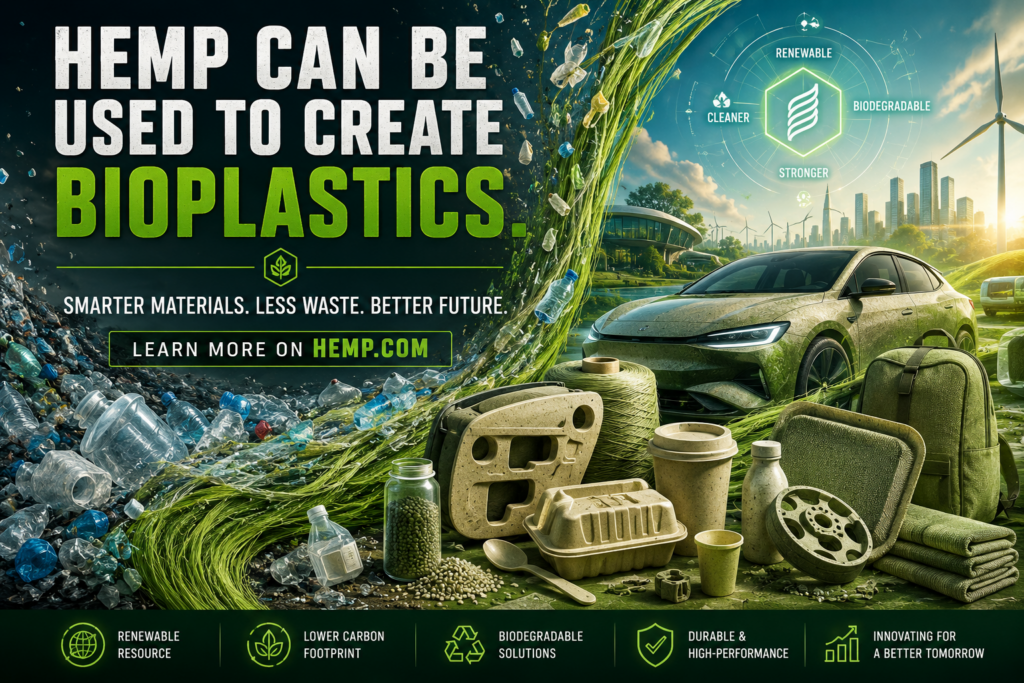
Walk past a checkout line today and you will see the same contradiction on repeat: brands promising “plant-based” packaging while the global plastics system still runs on fossil feedstocks at industrial scale. Into that tension steps industrial hemp—a crop whose stalks are unusually rich in cellulose and whose story has been sold, again and again, as a shortcut to plastic that is renewable, stronger, and gone in months instead of centuries.
The surprise is not that hemp can participate in plastics. Researchers and automakers have worked with hemp fiber composites for years. The surprise is how quickly marketing outruns manufacturing: many products labeled as hemp plastic are not a single miracle polymer, but a recipe—hemp fiber or cellulose blended with conventional resins, additives, and performance requirements that dictate whether anything actually composts. For a general reader, the real headline is simpler and harder: hemp bioplastics are plausible, even exciting, but they are still an infrastructure story—farms, decortication, pulping, compounding, certification—not a slogan.
The core industry problem
At the center of the hemp bioplastics conversation is a supply-chain mismatch, not a lack of botanical potential. After the 2018 Farm Bill directed USDA to stand up a domestic hemp production program, U.S. growers gained a legal path to raise fiber hemp—but downstream capacity to turn stalks into uniform cellulose, nanocellulose, or compounded pellets remains thin compared with century-old petrochemical plastics.
Technically, industrial hemp is attractive because bast fibers in the stalk carry high cellulose content. Peer-reviewed reviews commonly cite cellulose in bast fibers on the order of roughly 55–72%, alongside hemicellulose and lignin that must be managed in processing. Turning that biomass into a film, tray, or bottle requires extraction, bleaching or refining choices, plasticizers, and often blending with other polymers to hit moisture barriers, heat resistance, or shelf life. That is where claims fracture.
Industry groups such as European Bioplastics stress a distinction consumers rarely hear: biobased does not equal biodegradable. A material can be derived from plants yet persist in the environment; another may biodegrade only under industrial composting conditions defined by standards like EN 13432—not in a backyard bin or the open ocean. Without consistent labeling, hemp becomes a green halo on products whose end-of-life path is still ambiguous.
Scale first: the plastics economy is enormous. UNEP reporting frames global plastic production at roughly 400 million tonnes per year, with only a fraction recycled and substantial flows entering waterways. Trade data from Plastics Europe put world plastics production at about 430.9 million tonnes in 2024 in its annual “Plastics—the Facts” series—useful context for how small hemp-based volumes remain even as interest rises.
On the hemp side, literature reviews describe multiple product pathways: natural fiber reinforcement in thermoplastics (for example polypropylene composites studied by U.S. Forest Service researchers), pulp and nanocellulose routes for films and packaging, and emerging work on hurds and fines for micro- and nanofibrillated cellulose. A 2025 review in Journal of Bioresources and Bioproducts on industrial hemp waste valorization notes real progress in biocomposites and packaging, but also flags standardization and scalability as open constraints—echoing what processors say privately about variable feedstock and equipment tuned for wood or fossil pellets, not hemp stalks.
What is really changing
Why this matters now is policy plus procurement, not Pinterest optimism. The European Commission’s 2022 policy framework on biobased, biodegradable, and compostable plastics—summarized by European Bioplastics and EU environmental communications—pushes clearer claims and waste-route matching. Single-use restrictions and corporate Scope 3 pressure are pushing packaging teams to audition alternatives even when unit economics still favor polyolefins.
For hemp, the analytical through-line is fit-for-purpose. Short-life molded fiber trays, agricultural mulch films with certified composting pathways, and automotive interior panels that need fiber reinforcement are structurally different bets than shelf-stable beverage bottles. Hemp’s value may be highest where cellulose replaces or reduces petro-resin in applications that tolerate fiber performance limits—especially moisture uptake and processing temperatures—rather than where marketing implies a drop-in replacement for every PET bottle.
Second-order effects run through rural economies: fiber hemp could diversify farm revenue if decortication and pulping sit near production regions, cutting freight on bulky stalks. Without coordinated offtake contracts, however, processors risk idle equipment when CBD-hemp swings dominate planting decisions. The unresolved systems question is coordination—who signs the first long-term fiber offtake at a price that covers harvest, storage, and quality grading.
Who wins and who loses
Potential winners include fiber hemp growers with access to decortication and pulping partners; equipment firms selling steam explosion, enzymatic, or mechanical refining lines tuned for hemp; brands that need credible biobased content for regulated markets; and automotive suppliers continuing decades-long natural fiber composite programs. USDA-linked research on hemp fiber thermoplastics and construction biomaterials signals ongoing public R&D support for performance data—not consumer hype.
Exposed players include small brands that overclaim “biodegradable” without naming conditions or certification; farmers stuck with stalks and no buyer; and recyclers facing hybrid blends that contaminate mechanical recycling streams. Incumbent petrochemical producers are not “losers” in volume terms anytime soon—they still control cost curves, feedstock security, and global logistics. Hemp bioplastics win niches first; they do not flip the 430-million-tonne plastics complex overnight.
Consumers sit in the middle: they want less guilt at the same price point. Until composting infrastructure and labeling catch up to material science, the risk is disillusionment—another “green” material that still ends up in landfill without the right facility.
Evidence file
Botany and materials science: Reviews in MDPI’s Molecules document bast-fiber composition, automotive uses, and comparative performance of hemp with other natural fibers. A 2025 open-access review on industrial hemp waste as a precursor for bioproducts catalogs pathways from textiles to biocomposites and notes limits on standardization.
U.S. policy and research: USDA AMS publishes hemp production rules under 7 CFR Part 990. U.S. Forest Service literature includes peer-reviewed work on hemp fiber polypropylene composites across temperature ranges relevant to automotive interiors.
Definitions and environmental context: European Bioplastics’ FAQ defines biobased versus biodegradable claims. UNEP’s plastics vital graphics anchors pollution scale. Plastics Europe publishes annual global production totals used in industry benchmarking.
What we did not treat as primary evidence: Commercial market-size forecasts from paywalled syndicated reports, social posts claiming bottles “decompose in weeks,” and advocacy blogs quoting precise price-per-pound spreads without audited methodology. Those may directionally suggest cost premiums, but this draft avoids citing them as fact.
Industry outlook
Over the next several years, the most credible near-term growth for hemp in plastics is likely in cellulose-rich intermediates—pulp, nanocellulose additives, fiber-filled composites, and molded fiber packaging—rather than a single branded “hemp plastic” resin displacing PET globally. Packaging pilots tied to EU single-use rules and corporate compostable pledges will continue; automotive lightweighting will keep using natural fiber mats where specifications already accept them.
Three scenarios are worth tracking. In a coordination scenario, regional clusters link fiber acres to decortication and a compounding line with multi-year offtake, lowering feedstock risk. In a commodity-blend scenario, hemp remains a 10–30% filler in fossil polymers—better marketing than circularity unless recyclability is engineered. In a standards-led scenario, certification to composting or biobased content rules separates serious suppliers from greenwashing, favoring firms that publish test data and waste-route instructions on the label.
For Hemp.com readers, the practical takeaway is educational, not miraculous: hemp can help make plastics smarter only when the full chain—crop, processing, polymer design, disposal—is designed together. That is slower than a slogan, but it is how industrial transitions actually happen.
Sources & methodology
This feature was assembled from peer-reviewed reviews, USDA and U.S. Forest Service research publications, European Bioplastics definitional materials, UNEP plastics reporting, and Plastics Europe industry statistics. It does not rely on fabricated interviews, proprietary datasets, or field visits. Claims about market size from commercial syndicated reports were excluded where methodology is opaque. Before publication, editors should verify all outbound links, add a named byline with relevant expertise disclosure, attach primary interviews with at least one processor and one brand sustainability lead, and confirm any statistics added late in edit. Where compostability or strength claims appear in marketing copy, require third-party test citations or remove the claim.
Find suppliers
Browse verified industrial hemp businesses in the Hemp.com directory.