
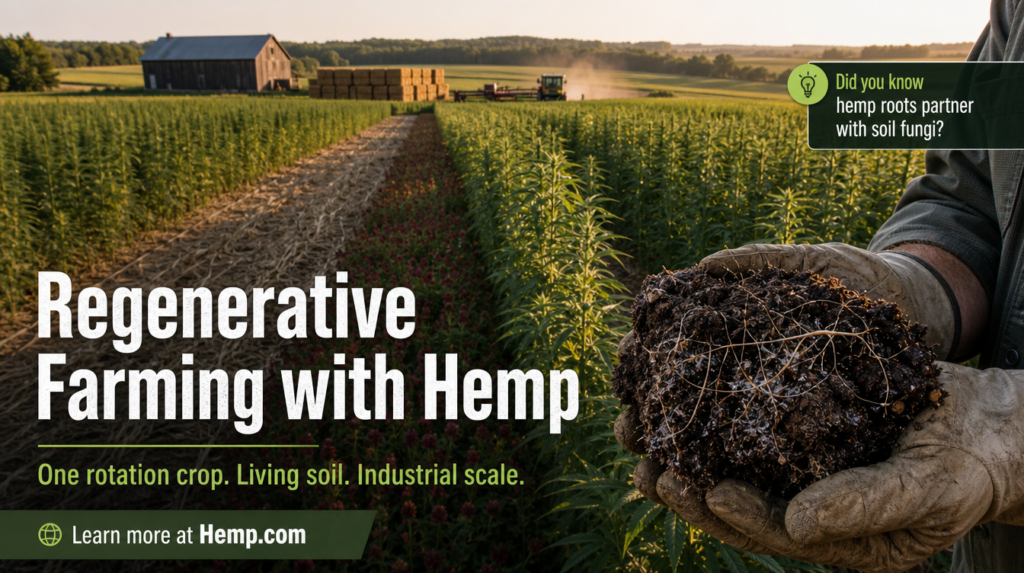
Across the American farm belt, a quiet shift is underway. Fields that once depended on heavy tillage and synthetic inputs are being managed for something older and more fundamental: living soil. Regenerative agriculture treats the ground not as a substrate for crops, but as a biological system—one that stores water, cycles nutrients, hosts microbes, and holds carbon.
Into that shift walks industrial hemp (Cannabis sativa L.), a fast-growing fiber and seed crop legalized as a U.S. agricultural commodity under the 2018 Farm Bill framework. Hemp is not a silver bullet. But its deep roots, high biomass, and rotational flexibility make it one of the most intriguing plants for farmers trying to restore soil function while diversifying revenue.
The question is no longer whether hemp can grow in industrial supply chains. It is whether hemp can help grow the soil those supply chains depend on.
What is Regenerative Farming?
Regenerative farming is often described in broad terms—soil health, biodiversity, climate resilience—but on the ground it means specific practices: diverse crop rotations, cover crops, reduced disturbance where agronomically viable, integrated nutrient management, and attention to microbial life. The USDA Natural Resources Conservation Service Regenerative Pilot Program, launched in late 2025 with substantial federal investment, frames regenerative agriculture as an outcomes-based conservation approach centered on soil health, water management, and long-term productivity.
Industrial hemp fits that framework because it behaves differently from many commodity crops. It produces large amounts of biomass in a single season. Its root system can penetrate deep soil layers, which may help break compaction and leave organic residues that feed soil biology. A widely cited review in Agriculture notes that hemp cropping systems are suitable for rotation, cover cropping, and integration with livestock waste applications—core tools in regenerative systems.
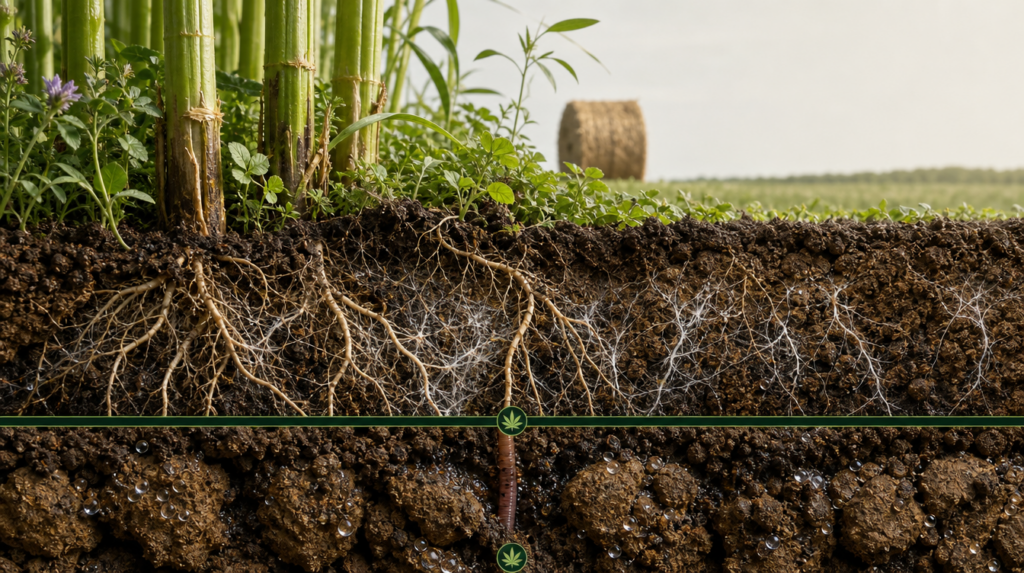
Research is catching up to farmer interest. At the Rodale Institute’s Pocono Organics Research Center, a two-year USDA-supported trial evaluated industrial hemp varieties under regenerative organic practices and found consistent colonization by arbuscular mycorrhizal fungi—symbiotic organisms linked to nutrient uptake and stress tolerance in many crops. That USDA Agricultural Research Service publication suggests hemp roots may participate actively in the soil food web, not merely pass through it.
Practical integration matters. Recent organic rotation research published through the Rodale Institute examined tillage, cover crops, and nitrogen management in hemp–barley systems. Hemp suppressed weeds once established and contributed carbon to deeper soil layers in prior literature cited in that work—but establishment often still required tillage in the study conditions, reminding growers that regenerative design is site-specific. Hemp rewards planning: cultivar choice, rotation timing, and post-harvest residue management all shape whether the crop builds soil or simply extracts from it.
When managed as part of a whole-farm system—not a one-off novelty—hemp can anchor a regenerative farming with hemp strategy that links ecological recovery to industrial markets for fiber, hurd, seed, and emerging biomaterials.
Hemp’s surprising insight
Here is the insight most readers miss: hemp’s greatest soil superpower may not be what it pulls from the sky, but what it leaves behind underground.
Hemp is frequently promoted for carbon capture because it grows fast and produces dense biomass. Published estimates for atmospheric CO₂ uptake vary widely—roughly 8 to 22 metric tons per hectare per year appear across peer-reviewed and institutional reviews, depending on climate, cultivar, and end-use of harvested material. Carbon in harvested fiber or hurd can remain stored when processed into durable products; carbon in short-lived uses may return to the atmosphere more quickly. The net climate benefit depends on what happens after harvest.
Less discussed—but increasingly documented—is hemp’s role in phytoattenuation, a form of phytoremediation where plants stabilize or draw contaminants while rebuilding biological activity. Research on cadmium-, lead-, and nickel-polluted soils published in Agronomy found industrial hemp varieties tolerated contamination levels that would limit other crops. Studies using soil from the Tar Creek Superfund area in Oklahoma, reported in Soil Systems, showed hemp roots interacting with heavy metals under controlled conditions—with uptake patterns varying by metal, contamination level, and amendments such as biochar.
Crucially, science does not support treating hemp as a magic cleanup crop for every site. Metals often concentrate in roots rather than moving uniformly into harvestable fiber. End-use pathways must respect contamination risk. But on marginal or degraded land, hemp may help restart biological cycles that conventional remediation struggles to afford—turning soil repair from a liability into a managed agricultural process.
That is the shareable pivot: industrial hemp can be both a carbon-depositing crop and a biological restart button for tired soil—when science, regulation, and market design align.
Industry stakes
Regenerative farming with hemp sits at the intersection of three large forces: farm economics, climate policy, and industrial supply chains.
Farmers and land managers face rising input costs, weather volatility, and pressure to diversify beyond corn–soy rotations. Hemp offers a high-biomass rotation option and potential access to fiber, seed, and carbon-related revenue streams. USDA conservation programs—including EQIP-supported practices documented in NRCS partnerships with organic hemp growers—can help finance cover crops, soil testing, and infrastructure that make regenerative transitions feasible.
Processors and brands are scouting low-carbon feedstocks for textiles, biocomposites, insulation, and packaging. Hemp grown under verified regenerative practices could carry stronger environmental claims than generic “sustainable” labeling—if traceability and soil outcomes are measured, not assumed. Methodology frameworks such as those developed by the Hemp Carbon Standard attempt to quantify carbon removal alongside soil health practices, though market acceptance is still evolving.
Researchers and policymakers must close agronomic gaps. Hemp fertilizer needs vary by end use—fiber, grain, or cannabinoid production—and regional data remain thin compared with decades of corn and wheat research. The USDA continues project work on incorporating hemp into cropping systems, including ecological cost–benefit modeling in regions such as the Pacific Northwest.
Who must adapt? Monoculture-dependent supply chains, brands that source without soil context, and any operator treating hemp as a quick extractive crop rather than a rotation partner. The winners will be systems thinkers: growers, cooperatives, and manufacturers who treat soil organic matter as an asset on the balance sheet—not an externality off it.
Did you know?
- Hemp roots may partner with soil fungi. USDA-supported research at Rodale Institute found arbuscular mycorrhizal fungi—including Rhizophagus intraradices and R. irregularis—colonizing hemp roots under regenerative organic management, suggesting active participation in soil nutrient networks.
- Rotation design changes outcomes. Organic hemp–barley research linked tillage, cover crops, and nitrogen management to both yield and soil organic carbon pools—with weed suppression benefits from established hemp carrying into the following small-grain crop.
- Carbon math depends on harvest fate. Literature reviews cite roughly 8–22 metric tons of CO₂ uptake potential per hectare for hemp biomass, but long-term sequestration increases when fiber and hurd enter durable products rather than short-lived disposal pathways.
- Phytoremediation is real—but nuanced. Peer-reviewed studies document hemp tolerance and uptake of cadmium, lead, nickel, and zinc in contaminated soils; metals often concentrate in roots, so remediation strategies must match end-use safety standards—not assume all harvested material is interchangeable.
- Federal conservation is aligning with regenerative outcomes. The NRCS Regenerative Pilot Program ties financial support to whole-farm assessments, soil health testing, and practices such as conservation crop rotation and cover cropping—tools hemp growers already use to protect soil between cash crops.
You saw it early
Most consumers still associate hemp with a single product category. Most farmers still lack region-specific playbooks for hemp in rotation. That gap is exactly why reading about regenerative farming with hemp now puts you ahead of the curve.
Watch for three signals over the next few growing seasons: expanded USDA soil-health outcome data from regenerative program enrollments; more peer-reviewed rotation trials pairing hemp with small grains, legumes, and cover-crop mixes; and clearer market rules for fiber and carbon co-products grown on restored land.
The industrial hemp story is shifting from novelty crop to systems crop—one node in climate-smart agriculture, not a sidebar. Farmers experimenting today with cover crops, reduced disturbance where viable, and hemp in rotation are building the reference farms tomorrow’s supply chains will cite.
You are seeing the soil-first version of hemp’s industrial future before it becomes standard procurement language.
Why Hemp.com
Hemp.com tracks industrial hemp where it matters most: at the junction of farming practice, environmental science, and real markets. Regenerative agriculture is not a branding exercise—it is a measurable shift in how land is managed. Industrial hemp is not a miracle plant—it is a high-biomass, rotation-ready crop with documented ecological roles and fast-evolving supply chains.
We document that transition with evidence-oriented reporting: what research supports, what remains uncertain, and what farmers, processors, and policymakers are testing in the field. As regenerative farming with hemp moves from conference slides to contract specifications, Hemp.com connects the science, the growers, and the industrial applications reshaping agriculture.
Verification & sources
Soil health and regenerative practice descriptions align with the USDA NRCS Regenerative Pilot Program framework emphasizing soil health testing, conservation crop rotation, cover crops, and nutrient management. Hemp agronomic and environmental claims draw on the peer-reviewed review by Adesina et al. in Agriculture (2020), USDA ARS/Rodale Institute mycorrhizal research (2022–2023 field trial summary), and Rodale Institute–linked organic rotation research on hemp and barley published in 2026.
Phytoremediation and phytoattenuation statements reference Agronomy (2023) and Soil Systems studies using Tar Creek–area contaminated soil. Carbon uptake ranges (approximately 8–22 metric tons CO₂ per hectare per year) appear across multiple literature reviews and institutional analyses; figures vary by region, cultivar, and accounting method, and should not be treated as universal field guarantees.
Where site-specific remediation or carbon credit claims are concerned, professional soil testing, regulatory guidance, and qualified agronomic advice are essential.
Editorial standards
This article is educational editorial content for Hemp.com, not agronomic prescription or environmental remediation guidance. We do not claim that growing hemp cures soil, eliminates all contamination, or guarantees farm profitability. Phytoremediation research describes biological processes under specific conditions; contaminated-site use requires regulatory compliance and safety protocols for harvested material.
We avoid medical or nutritional outcome claims tied to hemp consumption. References to food quality reflect general regenerative-agriculture principles—healthier soils support nutrient cycling in diversified systems—not assertions that industrial hemp fiber production directly improves unrelated food crops without rotation evidence on a given farm.
No interviews or farmer quotations in this piece are presented as direct quotes from named individuals; narrative examples are composite scenes for clarity. Statistics appear only where tied to published research or federal program descriptions.
Explore further
Explore more on Hemp.com: guides to industrial hemp farming, hemp fiber supply chains, and hemp building materials that can extend carbon storage beyond the field. Our directory connects growers, processors, and service providers working across hemp textiles, biocomposites, and regional hemp innovation hubs.
If you are implementing regenerative practices with hemp, look for partners familiar with USDA NRCS conservation planning, organic certification requirements for hemp under the USDA hemp production program, and regional extension resources. Regenerative farming with hemp works best as a network—soil labs, cover-crop seed suppliers, fiber mills, and carbon-program developers sharing the same field data.
Hemp.com is building that connective tissue so the industrial hemp transition is documented, searchable, and grounded in what the soil—and the science—actually show.
Find suppliers
Browse verified industrial hemp businesses in the Hemp.com directory.