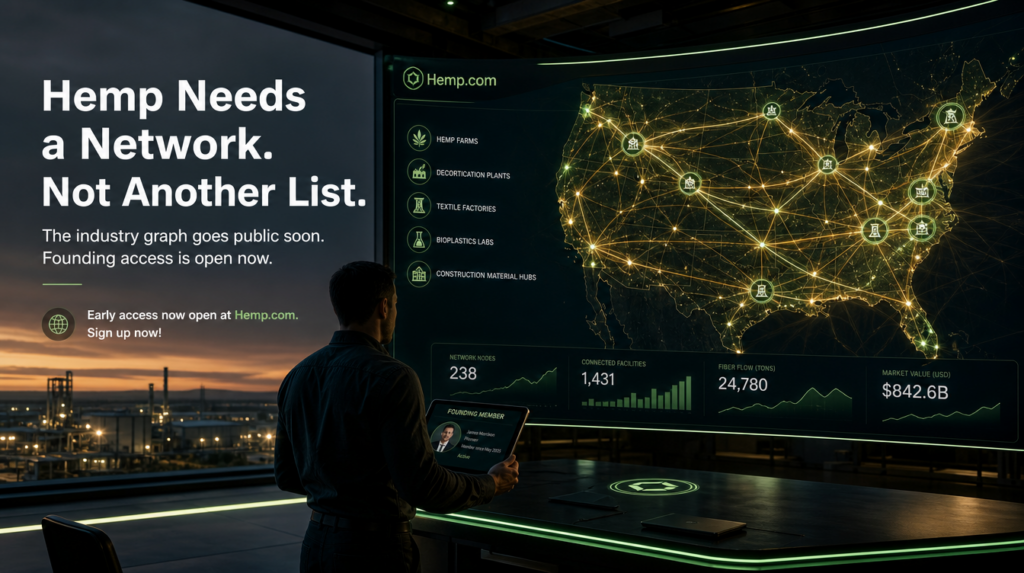
Picture a factory floor waiting on hemp fiber that was harvested three states away—but nobody on either side can name the broker who closed the gap last season. Picture a materials engineer with a bioplastic formulation that could replace petroleum packaging, searching LinkedIn threads for a decortication partner who actually answers emails. Picture a farmer who grew a compliant crop under federal rules, then watched price discovery happen in a group chat instead of a market.
That is not a failure of hemp as a material. Hemp fiber, hemp hurd, hemp seed oil, and hemp-derived polymers are entering serious conversations about sustainability, construction, textiles, and renewable manufacturing. The gap is coordination. The people, companies, market signals, and opportunities shaping industrial hemp still live in disconnected folders, trade-show handshakes, and spreadsheets nobody shares.
Something is shifting. The industries betting on hemp—automotive suppliers, insulation makers, fashion brands, regenerative agriculture programs—do not need another brochure. They need a map.
The story
For decades, industrial hemp carried a historical reputation and a modern promise: a renewable feedstock that can touch plastics, paper, textiles, building materials, and advanced composites. Since the USDA established the domestic hemp production program, U.S. growers and handlers have operated under clearer federal guardrails—but clarity on paper does not automatically create clarity in commerce.
Walk any hemp conference and you hear the same refrain from operators in different corners of the supply chain: great meetings, slow follow-through. A processor needs consistent fiber quality. A brand needs traceability. An investor needs to see which teams are actually shipping, not just posting. A farmer needs buyers who understand decortication windows and storage specs. Everyone is building something real; almost nobody can see the whole board.
Hemp.com has spent years documenting industrial hemp applications, policy context, and supply-chain reality—not as hype, but as infrastructure for understanding. The next step is structural: organizing the people, companies, market signals, and opportunities shaping hemp into one living industry graph—a searchable, evolving network where identity, credibility, and discovery are designed in from the start, not bolted on after the fact.
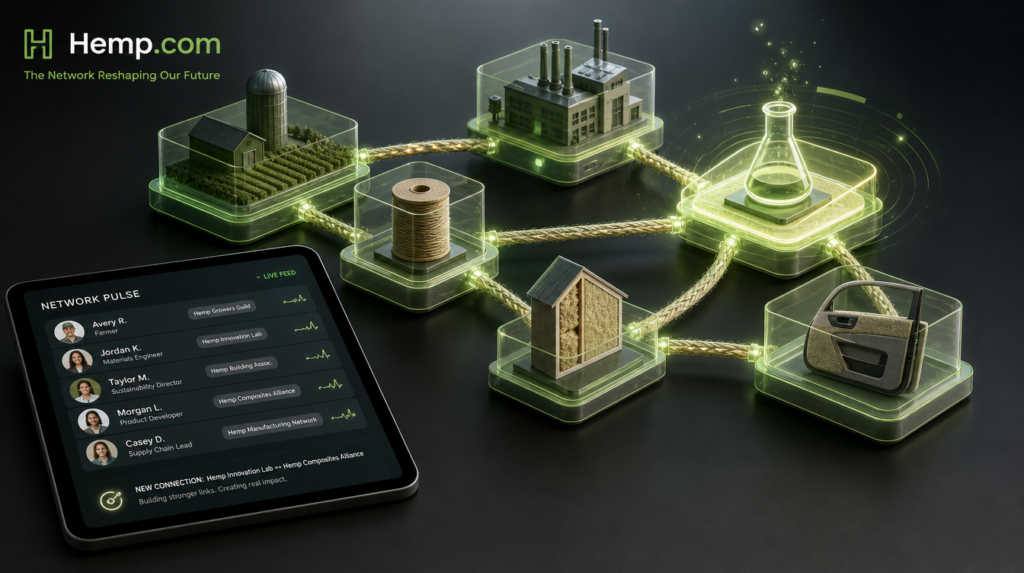
That network is in pre-launch. The public version is coming. The founding layer is being built now—with admin-reviewed profiles, company affiliations, searchable connections for buyers and partners, and visible momentum through founding status, share cards, and Network Pulse updates that show an industry moving in real time.
If you grow, process, invest, manufacture, buy, or build in hemp, this is the window where early participation actually shapes what the map looks like when everyone else arrives.
The surprising insight
The bottleneck in industrial hemp is rarely the plant. It is the missing connective tissue.
Most outsiders assume hemp stalls because of regulation or agronomy. Operators on the ground often tell a different story: they have material, they have demand, they even have capital—but they cannot find the right counterpart fast enough to keep contracts, trials, and pilot lines alive. Hemp innovation moves at the speed of manufacturing partnerships. Without a shared industry graph, every deal still starts at zero trust and zero context.
A living network changes the math. When a public profile states who you are and what you are building, when affiliations and review signals filter noise from substance, when buyers can search operators by capability instead of guessing from a logo on a banner—discovery compresses from months to days. That is not a social media feature. It is supply-chain infrastructure for a crop trying to compete in trillion-dollar material markets.
The surprising part: the industry does not need one more directory PDF. It needs a network that updates when someone lands a fiber contract, opens a decortication line, or publishes a new hemp-plastic spec—so the next person does not reinvent the same introduction chain from scratch.
Industry stakes
Industrial hemp sits at the intersection of agriculture, advanced materials, and climate-conscious manufacturing. Textile mills exploring hemp blends, construction firms testing hemp-lime insulation, packaging teams evaluating bio-based polymers, and automotive programs studying natural fiber composites all pull from the same fragmented supplier base. When that base stays invisible, large buyers default to incumbents with established vendor portals—not because hemp cannot perform, but because procurement runs on verified connections.
Who wins if hemp gets organized? Farmers and regional processors who finally appear in the same searchable layer as national brands. Mid-size innovators who need partners more than press releases. Investors who can read market signals instead of chasing rumors. Municipal and institutional buyers exploring low-carbon materials who need credible operator lists, not anecdote.
Who must adapt? Middle layers that profit from information asymmetry. Generic listing sites that collect names but never validate capacity. Anyone still treating hemp as a side forum instead of a primary industrial category.
Policy sets the floor; markets set the pace. Federal hemp rules define compliance, but contracts, specs, and repeat business define survival. A credible industry network does not replace due diligence—it makes due diligence possible at scale. Hemp.com is building that layer with transparent review, optional paid visibility for organizations that want prominence, and future verification signals as the graph matures. That is a business model aligned with discovery, not with obscurity.
Did you know?
- Federal hemp production has a formal USDA framework, but commercial scale still depends on private contracts, regional infrastructure, and buyer trust that no statute automatically creates.
- Hemp touches multiple industrial lanes at once—fiber for textiles and composites, hurd for building materials, seed for food and oil markets—so a single “hemp company” label often hides radically different capabilities.
- Procurement teams reward verifiable connections. Without searchable operator profiles and affiliation signals, innovative hemp suppliers lose deals to legacy materials simply because buyers cannot validate capacity fast enough.
- Market momentum is visible before it is headline news. Fiber off-take conversations, pilot plant announcements, and regional processing investments show up in operator networks long before they reach trade press.
- Founding participation shapes defaults. In platform eras, the earliest credible profiles often become the reference layer everyone else searches against when the public launch opens the doors.
You saw it early
You are reading this before the Hemp.com industry graph goes fully public—that matters. Public launches compress attention; pre-launch phases compress position. The operators, investors, and builders who claim a founding profile now are not chasing a trend after it trends. They are staking coordinates on a map while the map is still being drawn.
Watch for three signals in the months ahead: consolidation of regional processing capacity, larger material buyers publishing hemp content requirements, and verification standards migrating from handshake deals to documented affiliations. The network that captures those signals early becomes the default discovery layer. The people who wait for “proof” usually arrive after the founding shelf is full.
Get on the list before the network goes public. Identity that says what you build. Credibility through review and affiliations. Discovery for partners, buyers, and investors. Momentum you can see—and share. If industrial hemp is part of your future, this is the early side of that future.
Why Hemp.com
Hemp.com exists to document and connect the industrial hemp transition—from farm policy and fiber specs to the companies turning hemp into insulation, packaging, textiles, and building materials. This pre-launch network is the practical extension of that mission: not another static page, but a living graph of who is building what, where momentum is forming, and which connections move the supply chain forward.
We are organizing the industry so the industry can organize itself. Join the Hemp.com pre-launch list, claim your founding presence, and help shape the connective layer hemp manufacturing has needed for years. All hands on deck—the map opens soon.
Verification & sources
This article draws on publicly documented federal hemp policy via the USDA Agricultural Marketing Service hemp program and widely reported industry dynamics around supply-chain fragmentation, processing bottlenecks, and buyer verification challenges in emerging agricultural material sectors. Specific contract volumes, regional pricing, and unnamed operator anecdotes are described as composite industry patterns—not attributed interviews or proprietary Hemp.com data unless otherwise noted on individual profiles after launch.
Hemp.com network features described here—admin review, company affiliations, paid visibility options, founding status, share cards, Network Pulse—reflect the platform’s stated pre-launch product direction and may evolve before public release.
Editorial standards
Transparency: Hemp.com is building and promoting its own industry network. Paid visibility and directory-linked features will be labeled on platform pages. This editorial is a call to action for that pre-launch product; it is not independent third-party journalism about an unrelated service.
No fabricated facts: We have not invented statistics, study titles, executive quotes, or launch dates. FOMO framing refers to structural early-adopter advantage on a platform in pre-launch—not guaranteed financial outcomes.
Industrial focus: Content centers on hemp fiber, materials, manufacturing, and supply-chain coordination—not medical claims or intoxicating cannabis products.
Explore further
While the network finishes pre-launch, explore Hemp.com’s editorial coverage of hemp farming, hemp fiber processing, hemp building materials, hemp textiles, and hemp bioplastics to ground your profile in what you actually ship. When the graph goes live, searchable company and people connections will complement those guides—so readers can move from education to discovery in one place.
Operators ready to be found should request founding access on Hemp.com and prepare a clear statement of capability: crop type, processing stage, certifications, regions served, and partnership interests. Buyers and investors should watch Network Pulse for emerging capacity rather than waiting for annual conference season to rediscover the same contacts.
Find suppliers
Browse verified industrial hemp businesses in the Hemp.com directory.