
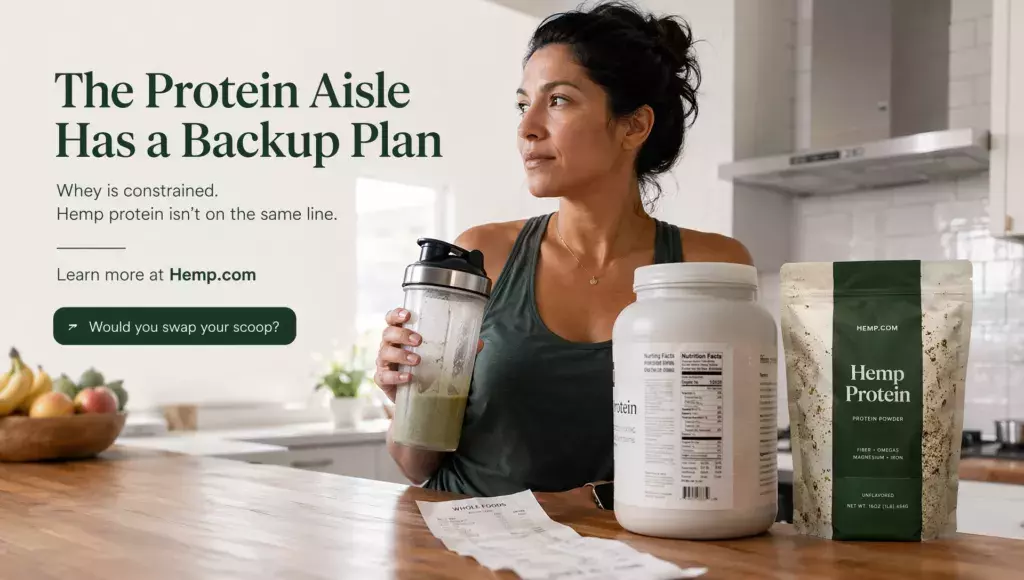
Walk into almost any American supermarket today and protein is everywhere—on cereal boxes, snack bars, ready-to-drink shakes, and the supplement aisle stacked floor to ceiling. That appetite is colliding with a bottleneck most shoppers never see: whey protein concentrate and isolate, the dairy byproducts that power much of the modern protein economy, are in critically tight supply.
According to reporting from AP News, NielsenIQ data shows the average U.S. supermarket now carries tens of thousands of products advertising protein content—demand that has pushed wholesale whey prices to record territory. ABC News cites USDA-linked market reporting that some whey protein concentrate suppliers were already sold out for the remainder of 2026, with agricultural economists noting steep multi-year price increases on key grades.
Meanwhile, on a different branch of the supply chain entirely, industrial hemp growers harvest grain for hearts, oil, and protein powder—ingredients that never pass through a cheese vat. That separation is not a marketing gimmick. It is structural resilience at a moment when one of the world’s most popular proteins cannot scale as fast as the culture around it.
Whey Protein Shortage-Hemp Protein Solution
The whey shortage is not really about a lack of milk. It is about processing capacity. Whey must be filtered, concentrated, and dried into food-grade whey protein concentrate (WPC) or isolate (WPI)—steps that require specialized plants running near full tilt. CNBC reports that U.S. whey protein end-of-month inventories have fallen by roughly half since 2023, while new dairy protein infrastructure can take years to permit, build, and bring online.
Demand drivers stack on top of one another. Athletes and wellness shoppers still anchor the category. Older adults are prioritizing protein at meals. GLP-1 weight-management medications have added another layer: clinicians often advise higher protein intake to help preserve lean mass while appetite drops—a trend widely covered by AP News and The Guardian. At the same time, mainstream food brands keep fortifying everyday products with whey, spreading one ingredient across shakes, bars, baked goods, and snacks.
New Hope notes that over roughly two years, wholesale costs for whey protein concentrate and isolate climbed sharply—well into triple-digit percentage territory on some grades—while retail price pass-through has lagged, meaning further shelf-level increases may still be ahead. Relief from new capacity is expected, but not immediately; industry observers widely point to late 2026 or 2027 before meaningful easing.
Enter hemp protein—powder milled from the seed cake left after cold-pressing hemp seed oil. The USDA classifies hemp grain among legitimate end uses that include protein supplements for human or animal consumption. Unlike whey, hemp protein production does not compete for the same drying lines, forward contracts, or cheese-byproduct economics. For consumers staring at higher whey prices or out-of-stock tubs, that independence matters. For food and supplement brands locked into sold-out ingredient calendars, it can mean the difference between reformulating now or losing shelf space.
Here is the pivot most people miss: hemp is not trying to be whey. It is trying to unhook you from whey’s single choke point.
Here is the pivot most people miss: hemp is not trying to be whey. It is trying to unhook you from whey’s single choke point.
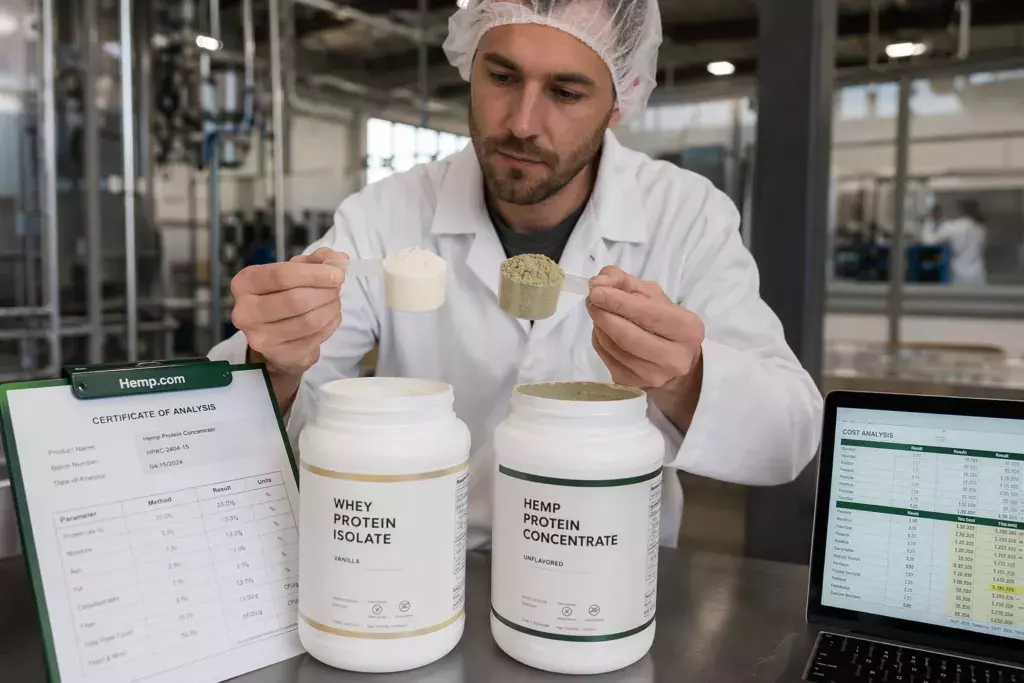
Hemp seed protein powders typically deliver roughly one-third to one-half protein by weight in common retail formats—lower than premium whey isolate on a grams-per-scoop basis, but paired with fiber, minerals, and an favorable balance of omega-3 and omega-6 fatty acids in many formulations. The U.S. FDA has issued “no questions” responses on Generally Recognized as Safe (GRAS) notices for hemp seed protein used in human foods, as summarized by the Food and Drug Law Institute. Food Dive reports that hemp protein contains all nine essential amino acids—one of the relatively few plant proteins that qualifies as “complete”—though formulators and dietitians often note lysine runs lower than in dairy or soy, which is a formulation detail, not a reason to ignore the category.
Translation for everyday shoppers: you may need a slightly larger scoop or a blended shake to hit the same gram target you got from whey isolate—but you are buying into a supply chain that is not waiting in line behind Pop-Tarts and protein doughnuts for the same commodity lot. Translation for brands: partial replacement, blends, and bar/bakery fortification with hemp can stretch scarce whey allocations without pretending one plant protein clone another overnight.
Industry stakes
Consumers: If your go-to whey tub is smaller, pricier, or unavailable, hemp protein powder is a credible pivot—especially if you want plant-based nutrition, avoid dairy allergens, or simply diversify while dairy processing catches up. Mix it into smoothies, oats, or yogurt; pair it with lysine-rich foods across your day if you are fine-tuning amino acid balance; and read labels for protein percentage, since hemp concentrates vary widely by milling and dehulling process.
Brands and procurement teams: The winners in this cycle will not be the companies praying for 2023 whey quotes to return. They will be the formulators building dual-source protein stacks—whey where it still pencils, hemp where it stabilizes cost and availability—and locking contracts before the next demand spike. Hemp grain processing capacity in North America and Europe has expanded in recent years, but the U.S. hemp sector overall remains smaller and more fragmented than dairy protein infrastructure; scaling grain-for-protein acres and certified milling takes deliberate sourcing, not a last-minute spot buy.
Need hemp protein now? If you are a food manufacturer, supplement brand, private-label operator, or co-packer facing sold-out whey contracts and reformulation deadlines, you do not have to navigate origin markets, protein grades (often roughly 50% to 65%+ depending on process), organic certification, or batch COA requirements alone. Contact Hemp.com—we connect buyers with vetted hemp ingredient suppliers, help compare specifications, and support supply-chain planning while whey remains constrained through 2026 and beyond.
Did you know?
- Protein is on nearly everything: AP News cites NielsenIQ data showing the average U.S. supermarket carries 38,708 products advertising protein—spreading whey demand far beyond the gym bag.
- Inventories, not milk, are the story: CNBC reports U.S. whey protein end-of-month inventories have fallen by roughly half since 2023 even as production ticked up—classic bottleneck economics.
- Hemp grain is an official USDA use case: The USDA Farmers.gov hemp page lists grain grown for hemp hearts, pressed seed oil, and protein supplements—positioning hemp as an agricultural protein feedstock, not a novelty.
- Seeds carry serious protein density: Food Dive notes industrial hemp seeds commonly contain roughly 25–35% protein along with fiber, iron, and short-chain omega-3 ALA before further milling concentrates the fraction.
- Regulatory clarity exists for food use: FDA “no questions” GRAS responses for hemp seed protein mean compliant suppliers can market the ingredient in foods for proposed uses—an advantage for brands needing documented, not experimental, inputs.
You saw the hemp solution early
Most shoppers still reflexively reach for whey because it dominated the protein aisle for decades. Most brand decks still treat plant proteins as backup singers. That mental model is expiring in real time as wholesale whey costs reset higher and sold-out contracts force reformulation conversations that should have happened years ago.
You are early if you treat hemp protein as industrial infrastructure—not a fringe vegan alternative. Watch for blended SKUs (whey + hemp, pea + hemp), bar and bakery fortification that hides earthy notes behind cocoa or spice, and procurement teams publishing dual-source specs instead of single-commodity bets. Also watch policy: congressional and USDA discussions continue around separating industrial hemp grain and fiber from floral hemp regulation, which could lower friction for food-grade grain growers if enacted.
The whey crisis will eventually ease when new dairy protein capacity comes online. The smarter play is to never again depend on one byproduct line for an entire category. Hemp will not replace every gram of whey tomorrow—but readers who diversify now will feel less whiplash when the next demand shock arrives.
Why Hemp.com
Hemp.com sits at the intersection of industrial hemp agriculture, ingredient markets, and the businesses trying to turn seed into shelf-stable nutrition. We document supply-chain shifts like the whey squeeze with the same rigor we apply to fiber, building materials, and emerging hemp manufacturing—because protein is now part of the broader industrial hemp story, not a side niche.
Whether you are a consumer experimenting with your first hemp protein smoothie or a brand leader under pressure to keep launches on calendar, Hemp.com is the directory and intelligence layer behind the transition. Explore our coverage of hemp farming, food ingredients, and supply-chain innovators—and when you are ready to source, reach out to Hemp.com for help connecting with hemp protein suppliers that match your grade, certification, and volume requirements.
Verification & sources
Shortage and pricing claims in this article draw on reporting from AP News, ABC News, CNBC, The Guardian, and trade coverage from New Hope. Hemp ingredient and regulatory context references USDA Farmers.gov, FDLI on FDA GRAS status for hemp seed protein, and Food Dive on amino acid profile and seed composition.
Exact wholesale price figures vary by grade (WPC 34%, WPC 80%, WPI), region, and contract timing; we cite directional increases rather than a single universal percentage. Retail price changes may lag wholesale moves. Hemp protein protein-percentage ranges depend on supplier process (dry milled vs. further concentrated) and should be verified per batch COA.
Explore further
For consumers: Compare protein grams per serving, allergen statements, and third-party testing on any powder you buy. If whey unavailable, try unflavored hemp protein in smoothies with fruit and nut butter to balance taste and texture.
For businesses: Document your target protein grade, organic requirements, intended application (RTD, bar, bakery, dry mix), and annual volume before sourcing. Hemp.com maintains connections across North American and international hemp ingredient processors.
Next step: Browse Hemp.com’s industrial hemp directory and ingredient coverage, then contact Hemp.com if your team needs help sourcing hemp protein powder, evaluating suppliers, or planning formulation pivots while whey contracts remain tight. We help match procurement reality to a plant-based protein lane that does not share dairy’s bottleneck.
Find suppliers
Browse verified industrial hemp businesses in the Hemp.com directory.