
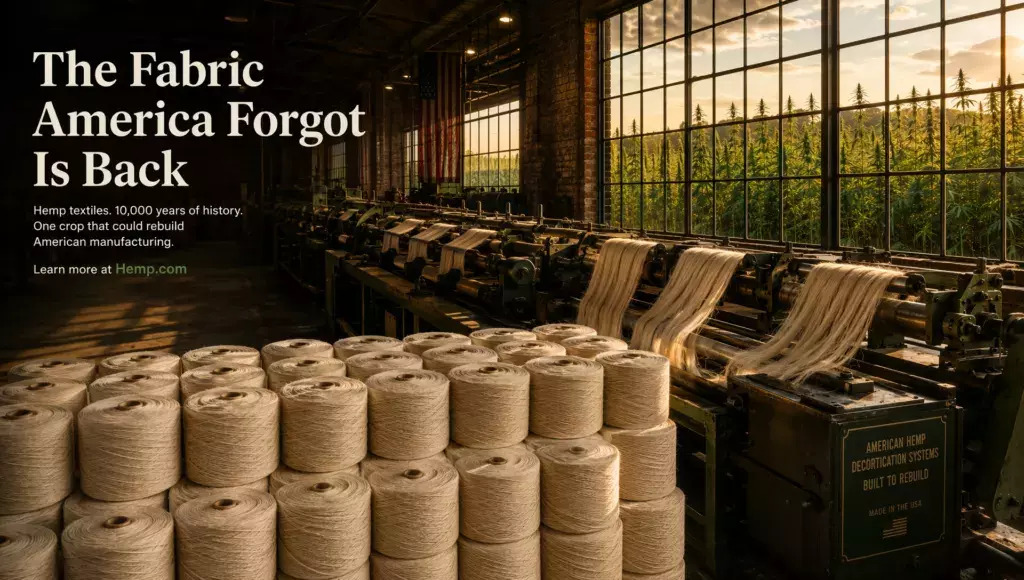
Picture a fabric that requires no synthetic fertilizers, drinks a fraction of the water that cotton demands, and returns nutrients to the soil rather than stripping them. Picture a crop that can be turned into clothing, rope, canvas, insulation, paper, and industrial textiles — all from the same stalk. Picture the United States growing millions of acres of it for over two centuries, supplying its Navy, clothing its settlers, and fueling its early manufacturing economy.
Now picture the government making it effectively illegal in 1937 — not because of the fiber, but because of botanical confusion that conflated an industrial crop with a psychoactive one. In a single legislative stroke, American hemp farming collapsed. The textile mills moved on. The supply chains rerouted. The knowledge dispersed. And for nearly nine decades, the most versatile natural fiber on Earth sat on the sidelines while American consumers bought cotton soaked in pesticides and polyester spun from petroleum.
That era is over. The 2018 Farm Bill reclassified industrial hemp as an agricultural commodity, unlocking domestic cultivation for the first time in generations. The question now is not whether hemp textiles are viable — the rest of the world never stopped proving they are. The question is whether America will rebuild the infrastructure to own this market, or once again hand the manufacturing advantage to someone else.
The story of Hemp…
Hemp — Cannabis sativa with less than 0.3% THC — has been cultivated for fiber for more than 10,000 years. Archaeological evidence from ancient China documents hemp fabric use as far back as 8,000 BCE. Civilizations across Asia, the Middle East, and Europe relied on it for rope, canvas, and clothing long before cotton became commercially dominant. The word canvas itself derives from the Latin cannabis — because sails and painters’ canvases were made from hemp, not cotton.
In early America, hemp was not a curiosity — it was strategic infrastructure. Colonial Virginia made hemp cultivation mandatory for farmers, and several founding-era figures grew it as a cash crop. The U.S. Navy depended on hemp rope and sailcloth for its fleet. The fiber was so critical to national defense that during World War II, the federal government ran the Hemp for Victory campaign, urging American farmers to grow it specifically because the war had cut off Manila rope imports from the Philippines. Farmers responded. The industry functioned. Then the war ended, synthetic fibers arrived, and political winds shifted — and hemp was swept out with the tide.
The Marihuana Tax Act of 1937 had imposed taxes and regulations so burdensome that commercial hemp farming became economically unworkable almost overnight. Later scheduling under the Controlled Substances Act of 1970 completed the prohibition, treating hemp fiber the same as high-THC cannabis for legal purposes. Decades of institutional memory evaporated. Processing equipment rusted. Agronomic expertise migrated abroad.
Meanwhile, the rest of the world kept going. China became — and remains — the dominant global producer and processor of hemp fiber, controlling a substantial share of global hemp textile output. Canada legalized industrial hemp in 1998 and built a functioning industry. France maintained continuous cultivation for centuries. Germany, Romania, and several Eastern European nations preserved their hemp industries through the prohibition years. While American farmers grew corn and soybeans on land that once produced hemp, overseas competitors quietly industrialized what America abandoned.
The Agriculture Improvement Act of 2018 — known as the Farm Bill — changed the legal landscape decisively. Hemp was removed from the Controlled Substances Act’s Schedule I classification and defined as an agricultural commodity, with regulation transferred to the USDA’s Agricultural Marketing Service. States were authorized to develop their own hemp programs. Almost immediately, licensed hemp acreage in the United States surged. Farmers across Kentucky, Colorado, Oregon, North Carolina, and dozens of other states planted their first hemp crops in a generation.
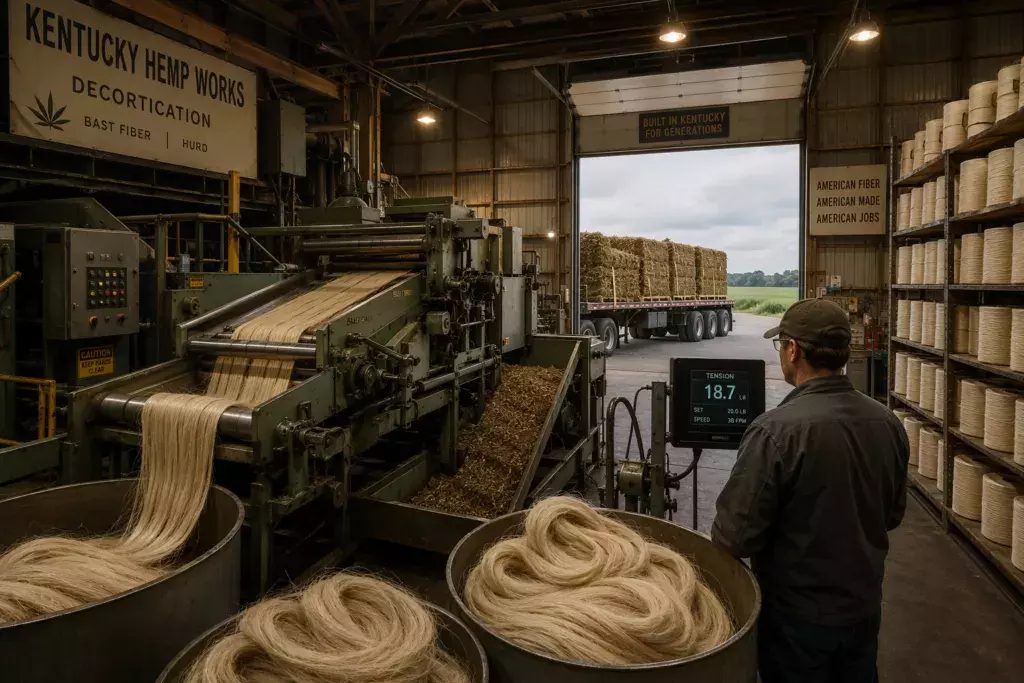
The opportunity is real and the momentum is genuine. What is still missing, and what will determine whether America leads or follows, is processing infrastructure — the decorticators, retting facilities, spinning mills, and weaving operations that transform raw hemp stalk into finished textile-grade fiber. Right now, much of the hemp grown in the United States is still sent overseas for processing, particularly to China, before returning as finished fabric. That round-trip is both expensive and strategically wasteful. Building domestic processing capacity is the industrial challenge — and the economic opportunity — of the next decade.
There is more to the Hemp Story…
Here is the fact that stops most people cold: cotton, the crop we built the modern apparel industry on, uses roughly 16% of all insecticides applied globally — despite covering only about 2.5% of the world’s agricultural land. That statistic, cited repeatedly by agricultural researchers and environmental agencies, reflects the extraordinary chemical load required to grow conventional cotton at commercial scale. Hemp, by contrast, is naturally resistant to most pests and can be grown without synthetic pesticides or herbicides in most climates. It has been described by agronomists as a break crop — one that actually improves the soil conditions for whatever is planted after it, reducing the chemical burden on the land over time.
The water comparison is equally striking. Cotton is one of the most water-intensive crops in global agriculture. Hemp, depending on climate and variety, requires significantly less water to achieve comparable fiber yields. In drought-stressed agricultural regions, that difference is not academic — it is existential for farming communities.
And then there is the carbon story. Hemp grows fast — industrial varieties can reach full stalk height in 70 to 110 days — and during that rapid growth phase it absorbs CO₂ at rates that have drawn serious attention from carbon sequestration researchers. The European Industrial Hemp Association has cited figures suggesting hemp can sequester well over a tonne of CO₂ per tonne of dry harvested biomass, though researchers note that end-use of the material affects the net carbon accounting. Textiles made from hemp and eventually composted or biodegraded return that carbon to the cycle, unlike synthetic fabrics derived from petroleum, which persist in landfills for centuries.
None of this is speculative biology. This is the well-documented agronomic profile of a plant the United States has simply chosen not to grow at scale for the better part of a century. The gap between what hemp can do and what American consumers know about it is one of the most consequential information failures in modern agricultural history.
Hemp Industry stakes
For American farmers, hemp textiles represent a diversification opportunity that cotton, corn, and soy cannot offer in the same way. Hemp can be grown in a wide range of soil types and climates, from the humid southeast to the semi-arid plains. Early licensed growers have demonstrated successful cultivation in over 40 U.S. states. The crop’s rapid maturity cycle means it can fit into existing rotations without wholesale restructuring of a farm’s operations. However, the economics only work at scale if domestic processing infrastructure exists nearby — a farmer who must ship raw stalks overseas for retting and decortication loses most of the margin advantage. State agricultural extension programs and private investment in processing capacity are the bottleneck, and they are beginning to move.
For American manufacturers, the near-shoring argument for hemp textiles is compelling. Global supply chains for cotton and synthetic fabrics have shown profound vulnerability — the COVID-19 pandemic exposed how dependent U.S. apparel and industrial textile production is on distant overseas suppliers. A domestic hemp fiber industry would shorten supply chains dramatically for industrial buyers, from automotive interior manufacturers to construction material suppliers. Hemp-based nonwoven fabrics, for example, are already used in automotive composites in Europe. Bringing that production home requires capital investment in machinery, but the technology is not exotic — it is proven, it exists, and it is scalable.
For apparel brands, the consumer pressure toward sustainable sourcing is not a trend — it is a structural shift in purchasing behavior, particularly among younger demographics. Brands that can credibly source domestically grown, pesticide-free, low-water-footprint hemp fiber are building a competitive moat. The early movers — Patagonia has incorporated hemp into its fiber mix, and several emerging direct-to-consumer brands have built their identity around it — are establishing positioning that legacy cotton-dependent brands will struggle to match without supply chain overhauls.
For consumers, hemp fabric delivers practical performance: it softens with each wash, is naturally UV-resistant, breathes better than cotton in heat, and is inherently antimicrobial, reducing odor in activewear applications. The higher initial price point of small-batch domestic hemp textiles reflects the current absence of economies of scale — not a permanent feature of the material. As processing capacity grows, prices will normalize. The consumer who buys hemp today is not paying an eco-premium for a niche product; they are buying into the early stage of a supply chain that will eventually look ordinary.
Did you know?
- The word ‘canvas’ comes from hemp. For most of Western history, painters’ canvases, ship sails, and tents were made from hemp fiber — not cotton. The etymology runs directly from the Latin cannabis through Old French to the English word still in use today.
- Hemp yields more fiber per acre than cotton. Under comparable growing conditions, hemp can produce roughly two to three times the fiber yield per acre that cotton achieves — while using significantly less water and no synthetic pesticides. That math matters at agricultural scale.
- The U.S. government once actively promoted hemp growing. The 1942 federal Hemp for Victory film — produced by the USDA — instructed American farmers to grow hemp as a wartime necessity. Decades later, the government reversed course entirely. The film was briefly suppressed before resurfacing in archives.
- Hemp fabric gets softer over time, not rougher. Unlike synthetic fabrics that pill and degrade, hemp fiber’s cell structure actually softens with repeated washing and wear while retaining tensile strength — a material property that explains its multi-century use in rope and sailcloth subject to extreme stress.
- Most hemp fabric sold in the U.S. today is processed in China. Despite the 2018 Farm Bill legalizing domestic cultivation, American hemp often travels overseas for retting and spinning before returning as finished textile fiber. Building domestic processing infrastructure is the single biggest gap between hemp’s agricultural potential and its industrial reality in the United States right now.
Hemp is coming back!
The hemp textile industry in the United States is at a genuine inflection point — past the legal barrier, early in the infrastructure build, and ahead of mainstream consumer adoption. That positioning is not a liability. It is a window.
Several converging forces are accelerating the timeline. Federal interest in domestic supply chain resilience — sharpened by pandemic disruptions and ongoing geopolitical tensions — is directing new attention toward agricultural commodities that can support domestic manufacturing. State-level hemp programs have now produced multiple growing seasons of agronomic data, and universities including Kentucky, Colorado State, and Cornell have active hemp research programs studying fiber varieties, soil outcomes, and processing optimization. Private equity has begun moving into hemp processing infrastructure with a seriousness that was absent three years ago.
On the consumer side, the appetite for verified sustainable sourcing continues to grow faster than supply can currently meet. Brands that secure long-term domestic hemp fiber relationships now — before the processing bottleneck is resolved and before competition for supply intensifies — will have structural advantages that latecomers cannot easily replicate.
Watch for three specific developments in the next two to five years: new domestic decorticator installations in established hemp-growing states; brand partnerships that explicitly market U.S.-grown hemp fiber as a supply chain differentiator; and federal or state programs that incentivize processing infrastructure investment as part of broader agricultural development initiatives. When those three signals appear in combination, the scaling phase begins. Readers engaging with this story today are ahead of that moment — which is exactly when the most durable positions in a market are built.
Hemp.com has tracked industrial hemp’s legal, agricultural, and commercial trajectory through every phase of its modern resurgence — from the state-level pilot programs that preceded federal legalization, through the post-Farm Bill cultivation boom, and into the current infrastructure-building period that will determine whether the United States reclaims leadership in this sector or watches it consolidate elsewhere.
The hemp textile story is not a niche interest story. It is an American manufacturing story, an agricultural diversification story, an environmental impact story, and a supply chain resilience story — all in one plant. Hemp.com will continue to document each chapter as it develops: the farmers, the processors, the brands, the policy moves, and the market signals that matter. If you are watching this space — as a farmer, buyer, investor, designer, or informed consumer — you are in the right place.
Explore further
Hemp.com’s industrial hemp directory connects buyers, growers, and processors across the fiber and textile supply chain. If you are a farmer considering hemp cultivation, a brand evaluating domestic fiber sourcing, or a manufacturer exploring hemp-based inputs, the Hemp.com directory is a starting point for identifying U.S.-based operations at each stage of the supply chain.
Related reading on Hemp.com includes coverage of hempcrete and hemp building materials, hemp biocomposites in automotive manufacturing, hemp paper and packaging, and the ongoing policy developments shaping domestic hemp market access. Use the search and category filters to navigate by application, geography, or market segment. The industrial hemp story is broad — this article covers the textile thread, and there is considerably more material to explore.
Find suppliers
Browse verified industrial hemp businesses in the Hemp.com directory.