
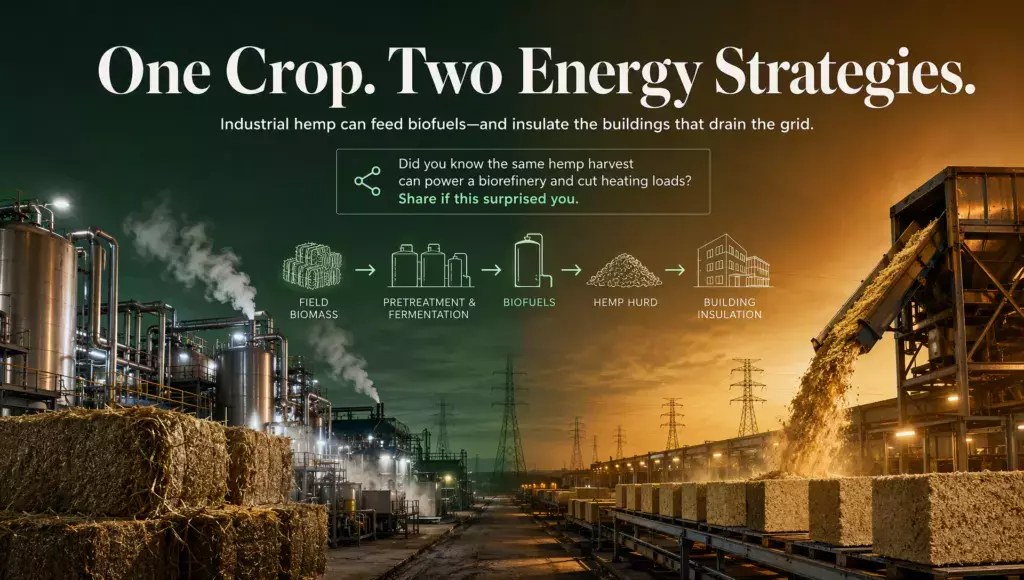
The world is not running out of sunlight. It is running short of usable energy at the moment we need it—on the grid, in fuel tanks, and inside the walls of buildings that never stop drawing power. In 2022, buildings alone accounted for roughly 37% of global energy- and process-related carbon dioxide emissions, according to the 2023 Global Status Report for Buildings and Construction—even as total building energy demand kept climbing.
At the same time, transportation and industry still depend heavily on petroleum-derived fuels whose price and availability swing with geopolitics and weather. The search for alternatives is not abstract policy theater. It is a supply-chain race: find feedstocks that grow fast, process efficiently, and deliver value across multiple product lines—not just one gallon at a time.
Industrial hemp enters that race with an unusual résumé. The same plant that can be fermented into platform chemicals and biofuels can also become insulation that reduces how much energy a structure consumes for decades. That combination—energy production and energy avoidance—is why hemp is attracting serious attention from USDA researchers, biorefinery engineers, and builders looking for low-carbon materials.
Hemp and Energy Scarcity
Energy scarcity shows up differently depending on where you stand in the supply chain. Farmers watch diesel and fertilizer costs. Manufacturers watch electricity bills at decortication plants that separate hemp bast fiber from woody hurd. Developers watch embodied carbon in cement and steel—and the decades of heating and cooling loads locked into every wall assembly.
Industrial hemp does not solve all of that at once. But it addresses multiple pressure points simultaneously, which is rare for a single crop.
On the supply side, hemp is a lignocellulosic biomass crop—rich in cellulose, hemicellulose, and lignin—that researchers are evaluating alongside switchgrass and agricultural residues for next-generation biofuels. Scientists with the USDA Agricultural Research Service note that hemp offers a short cropping period, high biomass yields, relatively low fertilizer and water requirements compared with many commodity crops, and meaningful carbon-sequestration capacity during growth. A USDA ARS project focused on industrial hemp as a bioenergy feedstock is examining integrated deconstruction, fermentation to precursor chemicals, and upgrading of recovered lignin into carbon-based materials—work aimed at making hemp viable inside modern biorefineries, not just on paper.
The conversion pathways are well mapped, even if commercial scale remains uneven. Technical summaries describe hemp biomass moving through anaerobic digestion for biogas, direct combustion or pelletization for heat and power, and biochemical routes that yield bioethanol from stalk carbohydrates and biodiesel from seed lipids. Peer-reviewed modeling in the Journal of Cleaner Production explored integrated plants co-producing ethanol and biodiesel from hemp biomass, illustrating how lipid content in the feedstock dramatically shifts economics—a reminder that variety selection and whole-plant utilization matter as much as chemistry.
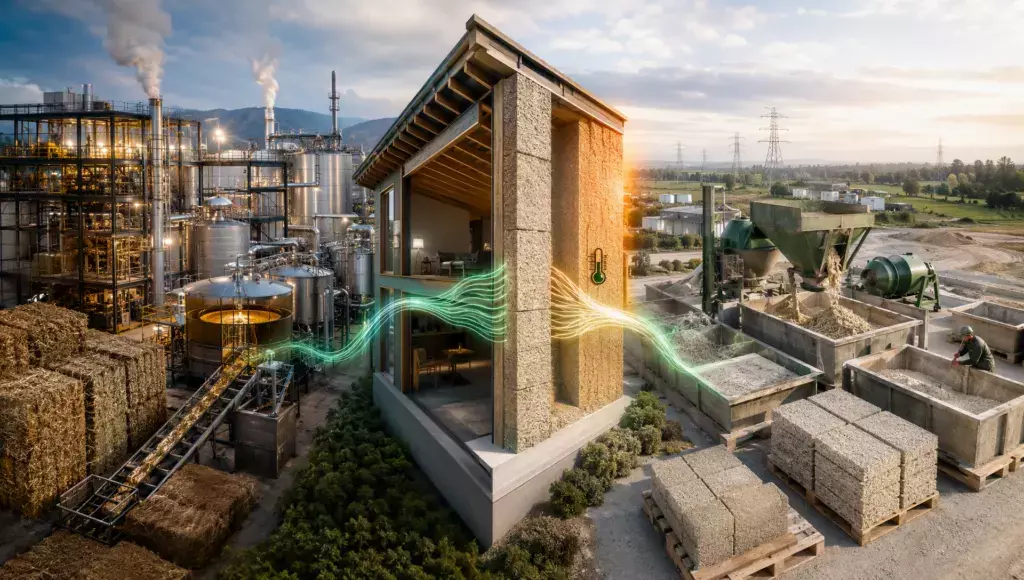
On the demand side, hemp shows up in buildings as hempcrete—a lime-bound bio-composite made from hemp hurd. State-of-the-art reviews document thermal conductivity typically in the range of roughly 0.05 to 0.18 W/(m·K), depending on density and mix design, along with hygroscopic behavior that can buffer indoor moisture. Hempcrete is generally used as non-load-bearing infill insulation, but its thickness and thermal mass can influence heating and cooling profiles over a building’s lifetime. Recent reviews also note inclusion of hemp-lime construction in the 2024 International Residential Code— a regulatory signal that the material is moving from experiment toward standardized practice in parts of the United States.
Between field and finished product, though, the supply chain still faces real friction. A 2024 Scottish Enterprise–commissioned supply-chain study estimated that processing roughly 12,000 tonnes of crop may require decortication capacity on the order of four tonnes per hour—capital investment in the multi-million-pound range before shipping and installation. Electricity is a major operating cost at processing facilities; some European operators have responded by installing large on-site solar arrays to reduce grid dependency. The honest story is that hemp’s energy promise depends on whether the industry can build processing infrastructure, co-product markets, and grid-cleaner operations at the same time.
How Hemp can Help!
Here is the insight that reframes hemp’s energy role: the most valuable energy play may not be turning hemp into fuel—it may be using hemp so we need less fuel in the first place.
Bioenergy from hemp is scientifically credible. USDA researchers are actively testing pretreatment, sugar recovery, and lignin valorization. Biomass technical literature describes multiple fuel pathways from the same harvest. But a systematic literature review in GCB Bioenergy found that feasibility analyses often show standalone hemp-for-bioenergy projects struggling on pure economics—while co-production schemes that also sell fiber, hurd for hempcrete, seed products, or biocomposites look materially stronger.
That distinction matters for energy scarcity. A hectare of hemp directed only toward a low-margin fuel market competes with established energy crops and petroleum scale. A hectare integrated into a biorefinery that also supplies insulation for buildings attacking the 37% buildings-sector emissions share—or long fibers for lightweight composites that reduce vehicle weight—can deliver energy benefits across the lifecycle in ways a single gallon calculation misses.
In other words, hemp’s superpower is not that it replaces every barrel of oil tomorrow. It is that one crop can feed both generation and conservation strategies—a whole-plant logic that fossil feedstocks cannot replicate.
The Stakes are High!
Farmers and regional aggregators win when contracts reward multiple outputs—seed, fiber, hurd, and biomass—rather than forcing a single-product bet. Without stable offtake for co-products, energy-only models leave growers exposed to commodity volatility.
Processors and biorefinery developers face the capital-intensity bottleneck. Decortication, drying, and fractionation are electricity-hungry steps; facility location relative to grid carbon intensity can swing lifecycle results, as life-cycle studies on controlled cultivation have shown for electricity-heavy indoor production. Vertical integration—owning farm relationships, processing, and downstream product lines—is emerging as a strategy to control quality and capture value across the chain.
Construction and materials firms have a growing stake as codes and green-building programs recognize bio-based insulation. Builders who learn hemp-lime assemblies early may capture retrofit and new-build segments where operational energy savings and embodied-carbon narratives align with client demand. Policy tailwinds vary by jurisdiction; readers should verify local code adoption rather than assume uniform access.
Petroleum-linked incumbents are not standing still—petrochemical feedstocks remain cost-competitive at global scale—but they are increasingly measured against lifecycle carbon and grid-aware metrics that favor materials sequestering biogenic carbon during growth.
The transition will not be won by a single headline crop year. It will be won by clusters: farm regions, processing hubs, and product manufacturers coordinated tightly enough that hemp’s energy story is industrial, not anecdotal.
But did you know this?
- USDA Agricultural Research Service scientists describe industrial hemp as a promising cellulosic biofuel feedstock citing short crop cycles, strong biomass yields, and carbon-sequestration during growth—part of active federal research into pretreatment, fermentation, and lignin upgrading (USDA ARS).
- Technical biomass literature outlines multiple energy pathways from one hemp harvest: biogas via anaerobic digestion, heat from pellets or direct combustion, bioethanol from stalk carbohydrates, and biodiesel from pressed seed oil (Biomass Connect).
- Buildings accounted for about 37% of global energy- and process-related CO₂ emissions in 2022—making materials that reduce operational heating and cooling demand a major lever in energy policy (GlobalABC / UNEP 2023 report).
- Hempcrete reviews commonly report thermal conductivity roughly between 0.05 and 0.18 W/(m·K), with performance strongly influenced by density and binder-to-hurd ratio—factors builders must engineer, not guess.
- A systematic review of hemp value-chain literature found co-production models—pairing bioenergy with fiber, hurd, or construction materials—generally outperform standalone bioenergy-only economics (GCB Bioenergy).
Explore further
Explore Hemp.com coverage of hemp farming, processing and decortication, hemp building materials, and biomass innovation for deeper context. Directory listings for hemp processors, construction material suppliers, and regional growers can help supply-chain participants find verified partners—particularly where co-product offtake underpins energy projects. If your company operates in hemp biorefining, hempcrete, or biomass aggregation, consider submitting or updating a directory profile so readers can connect with real capacity, not just theory.
Find suppliers
Browse verified industrial hemp businesses in the Hemp.com directory.