
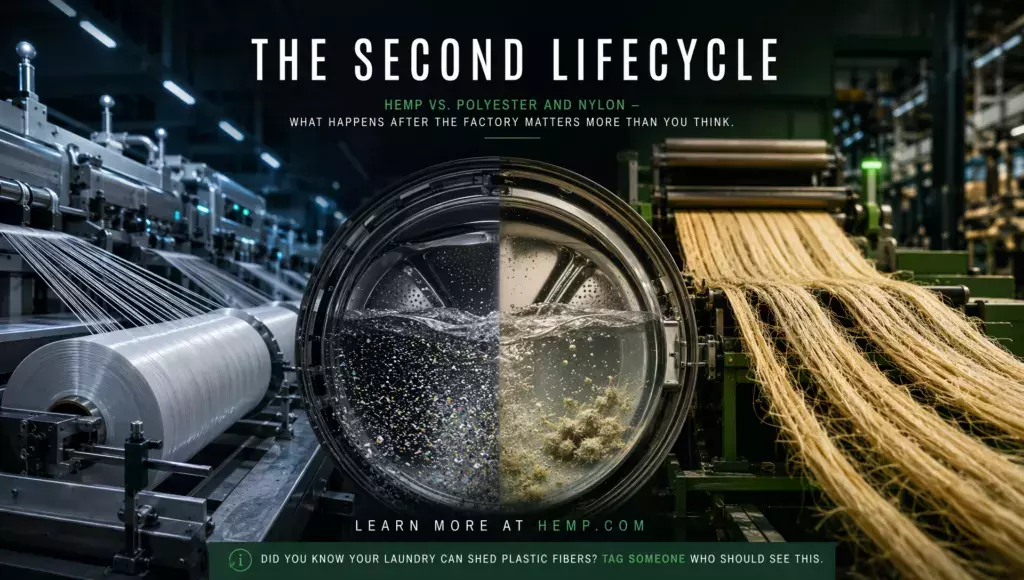
Your wardrobe is heavier than it looks. Not in ounces on a hanger—in chemistry. Roughly 132 million tonnes of fiber entered the global supply chain in 2024, according to Textile Exchange, and fossil-based synthetics drove much of that growth. Polyester alone accounted for about 59% of world fiber output—nearly 78 million tonnes—while polyamide (nylon) remained the second-largest synthetic category.
That scale matters because a fiber’s environmental story does not end when a shirt leaves the factory. It continues in your washing machine, in wastewater pipes, in rivers, and in soil—often invisibly, fiber by fiber. Industrial hemp offers a radically different material logic: a plant-based cellulose fiber grown in fields, not polymerized from petroleum. The comparison is not merely “natural vs. synthetic.” It is two lifecycles colliding in one of the largest material markets on Earth.
The Synthetic Fiber vs Nature Story
For most of the twentieth century, the textile industry rewired itself around plastics. Polyester—polyethylene terephthalate extruded into thread—became the default fiber for performance wear, fast fashion, upholstery, and industrial textiles because it is cheap, strong, wrinkle-resistant, and endlessly tunable. Nylon, a polyamide, followed a parallel path into activewear, swimwear, ropes, and technical fabrics where stretch and abrasion resistance matter.
Hemp, by contrast, is one of humanity’s oldest industrial fibers. Long bast fibers from the cannabis plant’s stalk were used for sails, rope, canvas, and workwear for centuries. A peer-reviewed review in Fibers notes that hemp can produce durable textile materials with relatively fast crop cycles and agronomic traits suited to rotation farming—though outcomes depend heavily on variety, retting method, and processing route.
Lifecycle comparisons usually focus on production: energy, water, land, and greenhouse gases. A Stockholm Environment Institute report comparing cotton, hemp, and polyester found that polyester demands high non-renewable energy per tonne of spun fiber, while hemp’s footprint is strongly influenced by agricultural land use and regional processing practices. More recent life-cycle work continues to show that synthetic fiber production is fossil-intensive—polyester spinning and polymerization alone can require substantial energy inputs compared with many natural fibers.
But production is only the first chapter. The second lifecycle—the use phase—is where synthetics face a problem hemp does not share in the same way.
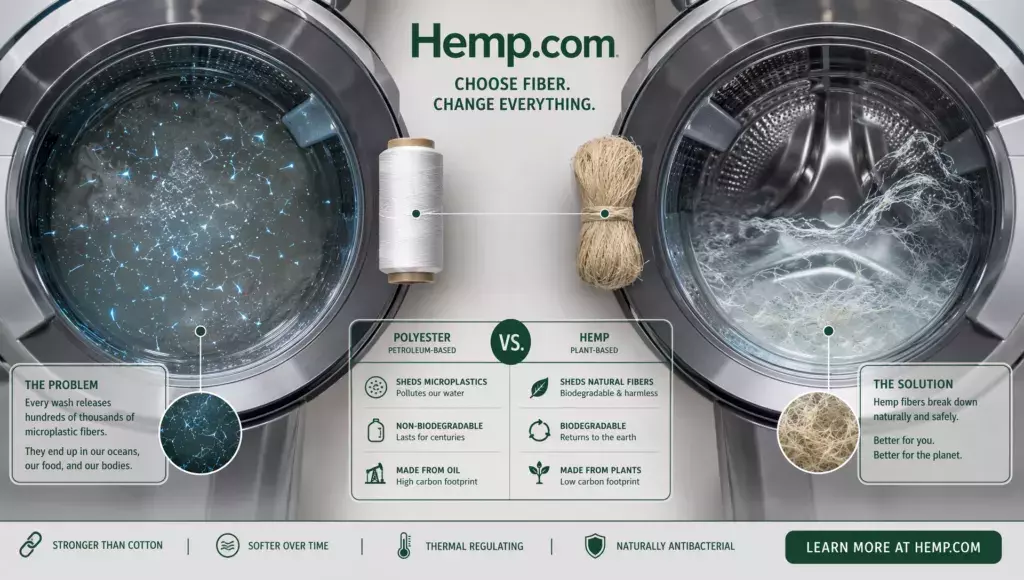
When synthetic garments are worn and washed, they release microfibers: plastic fragments typically less than 5 millimeters across. The U.S. Environmental Protection Agency’s Trash Free Waters program identifies microfibers from synthetic clothing as the most prevalent type of microplastic found in the environment. Laboratory studies have documented wide variation in shedding rates by fabric type, wash temperature, machine design, and cycle length—often ranging from hundreds of thousands to millions of fibers per wash for synthetic textiles.
Hemp sheds fibers in the wash too. Every textile does. The difference is material identity. Hemp fibers are cellulose. They biodegrade. Polyester and nylon fibers are plastic. They persist, fragment, and accumulate.
History adds context—carefully. Popular accounts sometimes claim the 1937 Marihuana Tax Act was engineered to eliminate hemp and clear the runway for nylon. Scholarly reassessment complicates that narrative. Research published in Addiction in 2026 argues that several widely repeated claims about the Act—including a coordinated DuPont conspiracy and a blanket ban on hemp fiber—do not hold up under archival scrutiny. Nylon reached commercial markets around 1939, after the Act passed, and its early applications centered on hosiery rather than industrial cordage. Industrial hemp production actually expanded during World War II under government encouragement.
What is less disputed is the structural outcome: mid-century policy friction, labor economics, and the rise of cheap petrochemical fibers pushed hemp out of mainstream textile supply chains for decades—just as polyester and nylon scaled globally. We are still living inside that material decision.
Shedding is not the problem. Shedding plastic is.
Here is the insight most lifecycle charts miss: shedding is not the problem. Shedding plastic is.
Natural fibers—including hemp, flax, cotton, and wool—release particles during laundering. Environmental researchers consistently distinguish between biodegradable cellulosic or protein fibers and persistent synthetic polymers. A polyester fleece may feel soft in the store; in the environment, its fibers behave like other plastics—resisting breakdown, traveling through wastewater systems, and appearing in aquatic and terrestrial ecosystems.
That reframes durability. Polyester’s long landfill life is often marketed as a virtue. From a microplastic perspective, it can be a curse: a garment that survives decades may shed plastic across hundreds of wash cycles before it ever reaches disposal. Hemp’s reputation for toughness—historically valued in rope, canvas, and workwear—can reduce replacement frequency. Fewer garments over time can mean fewer manufacturing cycles and fewer years of fiber release, though exact outcomes depend on blend composition, fabric construction, and care habits.
Recycled polyester complicates the picture further. Diverting PET bottles from waste streams can reduce virgin polymer demand, but mechanical recycling can alter fiber surface structure. Some studies suggest recycled polyester may shed at different rates than virgin equivalents—a reminder that “recycled” does not automatically mean “pollution-neutral” in the laundry phase.
In other words, the sustainability conversation is not a simple scorecard at the mill gate. It is a loop that runs every time consumers clean their clothes.
The takes have never been higher
The winners and losers in this transition are not abstract. Apparel brands sourcing mostly polyester face rising scrutiny over fossil feedstocks, microplastic leakage, and circularity gaps—less than 1% of global fiber output currently comes from pre- and post-consumer textile recycling, per Textile Exchange. Fiber producers invested in petrochemical capacity have strong incentives to defend synthetics’ performance economics. Washing-machine manufacturers, wastewater utilities, and filter technology firms are entering the conversation as downstream mitigation becomes policy in some regions.
France has moved toward requiring microfiber filtration on new washing machines—a signal that governments may regulate the use phase, not just production emissions. In the United States, microfiber pollution is recognized in federal educational materials, but comprehensive national requirements remain limited as of this writing.
For industrial hemp, the opportunity is real but the market is still small. USDA’s 2025 National Hemp Report estimated about 67.3 million pounds of open-field fiber production across roughly 21,693 harvested acres in the United States—a niche compared with tens of millions of tonnes of polyester. Scaling hemp textiles requires more than good agronomy: decortication capacity, long-fiber handling, spinning infrastructure, and stable standards for fiber quality and traceability.
Brands, mills, and farmers who build that stack early could capture premium segments in workwear, upholstery, composites, and blends where performance and verifiable low-shedding natural content matter. Synthetics are unlikely to disappear—nylon’s stretch properties and polyester’s cost curve remain formidable—but the fiber mix of the 2030s does not have to mirror the 1960s.
Did you know?
- Polyester accounted for roughly 59% of global fiber production in 2024—about 78 million tonnes—making it the world’s most produced textile fiber, according to Textile Exchange.
- The EPA identifies microfibers from synthetic textiles as the most common microplastic type in the environment—often released during ordinary home laundering.
- Research in Environmental Science and Pollution Research found synthetic fabric wash tests releasing on the order of 10⁵ to 10⁶ fibers per kilogram of textile in initial cycles, with wide variation by fabric construction.
- Hemp and linen together have historically represented a small share of global textile fiber output compared with cotton and synthetics—a niche that is re-emerging as brands seek lower-persistence alternatives.
- Archival scholarship on the 1937 Marihuana Tax Act cautions against simplified “hemp banned for nylon” narratives; federal restrictions targeted cannabis commerce broadly, while industrial fiber production followed a more complex—and often burdensome—regulatory path.
What can you do?
Most consumers still evaluate fabrics by touch, price, and brand—not by second-lifecycle chemistry. That is changing. Material disclosure, microplastic research, and filtration policy are moving the conversation from farm and factory to household plumbing.
Watch for three signals: blended-fabric labeling that clarifies synthetic content; pilot programs testing industrial hemp long-fiber supply chains in North America and Europe; and brand commitments that go beyond recycled bottle polyester toward genuinely circular textile-to-textile systems. If global fiber output rises toward Textile Exchange’s business-as-usual projection of roughly 169 million tonnes by 2030, the material choices made in the next few years will echo for decades—in closets, waterways, and soil.
You are early to a shift that starts not with a headline, but with a load of laundry.
Explore further
Explore Hemp.com coverage of hemp textiles, fiber processing, and industrial supply chains for deeper context on decortication, spinning, and market development. Directory listings for hemp fiber mills, textile innovators, and regional growers can help brands and researchers connect with verified industry participants. If you source, manufacture, or research hemp fiber, consider submitting or updating your listing so the directory reflects the emerging second lifecycle of industrial hemp.
Find suppliers
Browse verified industrial hemp businesses in the Hemp.com directory.