
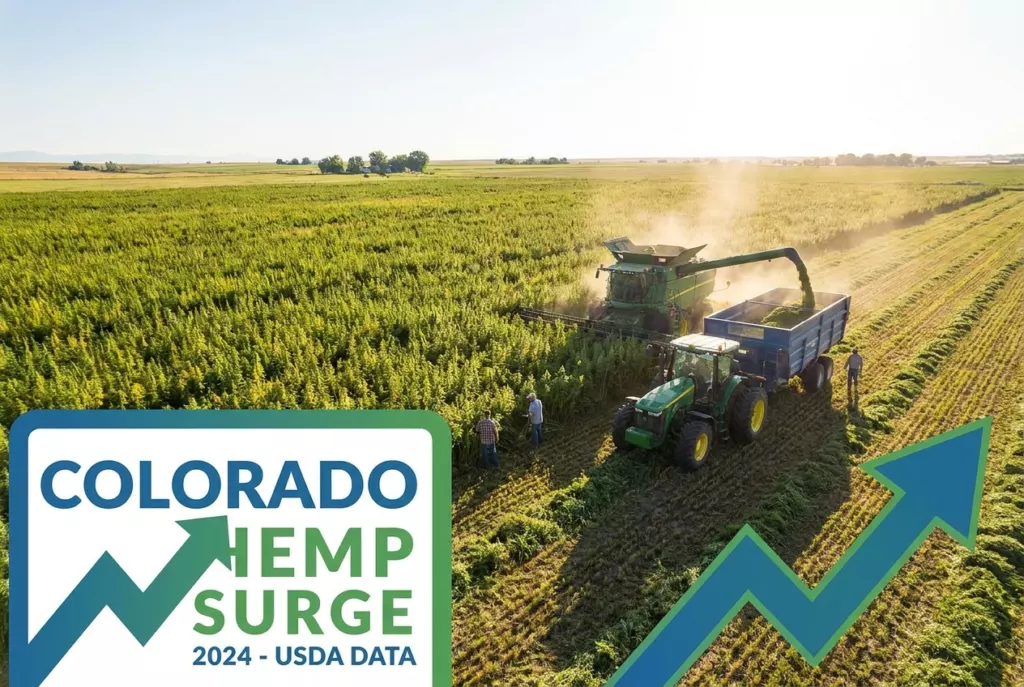
The U.S. Department of Agriculture’s National Agricultural Statistics Service (NASS), in its April 17, 2025 National Hemp Report, estimated Colorado growers planted 2,300 acres of open-field industrial hemp in 2024 and harvested 1,100 acres for all purposes, up from 1,350 planted acres and 450 harvested acres in 2023. Nationally, NASS placed 2024 open-field planted hemp at 45,294 acres (up 64 percent from 2023) and reported sharp year-to-year growth in fiber hemp harvested area, a demand-and-supply dynamic that shapes processing contracts, equipment utilization, and regional logistics for states such as Colorado that host fiber-oriented infrastructure.
Key takeaways
- Colorado planted area: NASS estimated open-field planted hemp rose to 2,300 acres in 2024 from 1,350 acres in 2023 after 1,600 acres in 2022.
- Colorado harvested area (all utilizations): Estimated at 1,100 acres in 2024 versus 450 acres in 2023 and 480 acres in 2022.
- U.S. fiber hemp (open): Harvested area reached 18,855 acres in 2024, up 56 percent from 2023; production was 60.4 million pounds, up 23 percent, while the value of fiber hemp grown in the open was $11.2 million, down 3 percent, signaling price pressure despite larger physical supply.
- Fiber breakout for Colorado in the same report: The 2024 state table shows Colorado fiber rows marked (D) withheld to avoid disclosing individual operations, after the 2023 table showed no published open-field fiber hemp harvest acres for Colorado (“−” per NASS symbols).
- Regulatory frame: Cultivation oversight sits with the Colorado Department of Agriculture’s Hemp Program, while processors of certain hemp products for human consumption fall under separate state public-health registration rules described on the department’s hemp processing page.
What happened
NASS released the 2024 crop-year industrial hemp estimates on April 17, 2025, including state-level open-field acreage for Colorado and national tables segmented by floral, grain, fiber, and seed utilizations. For Colorado, the survey publication represents the federal statistical snapshot most comparable across states, distinct from state registration counts maintained for compliance purposes.
Colorado’s rebound is visible first in the all-utilization acreage ledger: planted area increased by 950 acres versus 2023, and harvested area increased by 650 acres. Floral hemp in Colorado remained a measurable component in 2024—NASS estimated 255 acres harvested for floral hemp in the open, with published yield and production rows—while the fiber-specific harvested-acre figure for Colorado was suppressed in 2024 under NASS confidentiality rules. At the national level, NASS reported fiber hemp harvested area and production rose substantially even as the reported value of fiber hemp production slipped slightly, a pattern consistent with commodity markets where expanded supply can outpace short-run price strength.
Downstream, Colorado’s administrative setup splits responsibilities: hemp cultivation is regulated through the agriculture department’s hemp program, and entities processing hemp into products intended for human consumption or use must navigate registration requirements enforced by Colorado public-health regulators, per the agriculture department’s guidance page on processing, sales, and distribution.
Why it matters
For industrial hemp supply chains, the 2024 estimates matter because they quantify how quickly producers re-entered open-field production after several years of rationalization following the floral-CBD boom. A wider U.S. fiber harvest expands feedstock availability for decortication, pulping trials, nonwoven blends, and construction-material pilots—sectors that depend on predictable tonnage and spec-grade fiber quality rather than cannabinoid content.
Colorado’s location and logistics connections position in-state processors and partners to source stalk material regionally even when NASS withholds certain state fiber disclosures. Elevated national fiber volume can lower unit costs for processors with throughput capacity, but it can also compress farmgate or contract prices when end-product markets absorb fiber slowly; the national fiber value estimate declining modestly while physical production rose illustrates that tension.
From a policy and compliance standpoint, accurate acreage and disposition statistics inform state program staffing, THC sampling workflows, and conversations about farm-program eligibility and risk management. They also give lenders and municipal economic-development offices a neutral baseline when evaluating aggregation, storage, and handling investments tied to bast and hurd streams.
Industry context
Industrial hemp re-entered U.S. agriculture as a broadly cultivated crop after the Agricultural Improvement Act of 2018 reset federal hemp definitions and delegated primary oversight of compliant cultivation to states and tribes with USDA-approved plans. The mid-decade expansion heavily favored floral hemp for cannabinoid extraction; as inventories cleared and prices normalized, many operators pivoted toward dual-purpose or fiber-forward rotations, especially where equipment and offtake agreements existed.
Statistical reporting through NASS’s Hemp Production and Disposition surveys remains the standard public-data backbone for year-to-year comparisons, though confidentiality suppressions like Colorado’s 2024 fiber line limit granular state conclusions readers might expect from registration dashboards alone. Editors should treat planted versus harvested and utilization-specific tables as distinct lenses on the same crop cycle.
Market data / timeline
The table below summarizes publicly released NASS figures cited in this draft; readers should consult the primary PDF for footnotes on symbols and methodology.
| Indicator (open field unless noted) | Geography | 2022 | 2023 | 2024 |
|---|---|---|---|---|
| Area planted, all utilizations | Colorado | 1,600 acres | 1,350 acres | 2,300 acres |
| Area harvested, all utilizations | Colorado | 480 acres | 450 acres | 1,100 acres |
| Floral hemp area harvested | Colorado | Published in report | 235 acres | 255 acres |
| Fiber hemp area harvested | Colorado | See state tables | − (zero) | (D) withheld |
| Area planted, all utilizations | United States | See national tables | 27,680 acres | 45,294 acres |
| Fiber hemp area harvested | United States | See national tables | Published in report | 18,855 acres |
| Fiber hemp production (weight) | United States | See national tables | Published in report | 60.4 million pounds |
| Report release date | USDA NASS | — | — | April 17, 2025 |
What happens next
The next high-impact editorial milestones are the 2025 open-field planting and harvest enumeration and any mid-year or April 2026 NASS hemp release that will show whether 2024’s national expansion persisted or partly retraced. Watch Colorado’s state hemp program updates for registration rule changes, sampling burdens, and THC-compliance trends that can shift growers’ willingness to plant fiber-dominant varieties.
On the commercial side, supply-chain contacts should monitor fiber offtake pricing, transportation costs for low-density bales, and capacity utilization at regional decorticators—factors that determine whether additional acreage translates into durable manufacturing demand. Federal farm-bill reauthorization debates can also adjust research funding, crop-insurance constructs, and cross-border market conditions relevant to bast fiber exports and imported substitute goods.
Sources & verification
Primary statistical source: USDA NASS, National Hemp Report issued April 17, 2025, PDF release.nass.usda.gov/reports/hempan25.pdf, mirrored on the Economics, Statistics, and Market Information System landing page esmis.nal.usda.gov/publication/national-hemp-report/2025-04-17. Methodology and survey scope are described on the agency’s hemp survey guide nass.usda.gov/Surveys/Guide_to_NASS_Surveys/Hemp/.
State program context: Colorado Department of Agriculture hemp program portal ag.colorado.gov/plants/hemp and processing, sales, and distribution guidance ag.colorado.gov/plants/hemp/processing-sales-and-distribution.
Find suppliers
Browse verified industrial hemp businesses in the Hemp.com directory.