
The story opens…
Picture a Monday morning in a small architecture studio: someone drops a moodboard link into the team chat—soft light, rounded corners, the warm suggestion of a wall that “breathes.” Then the thread gets quiet, because the next message is from the person who has to make the building legal. In that gap between inspiration and permit submittal, hempcrete often appears as a kind of optimistic ghost: a hemp building material that sounds contemporary, low-carbon-adjacent, and appealingly “natural,” yet still demands answers you cannot hand-wave—fire, structure, moisture, insurance, and the unglamorous truth that a wall is not an idea; it is a sequence of decisions with signatures on it.
That tension is the real story. Hempcrete is not a mystery compound smuggled out of a wellness brochure; it is, in its common form, a hemp-lime composite made from the woody inner core of the stalk (hurd), combined with binder systems people often shorthand as “lime” but which vary in formulation and curing behavior from crew to crew, climate to climate, and supplier to supplier. The construction industry’s renewed attention is understandable: it is a tactile, craft-adjacent material that plugs into earnest conversations about biogenic inputs and embodied carbon—without magically erasing logistics, QC, liability, or the basic physics of rainwater management.
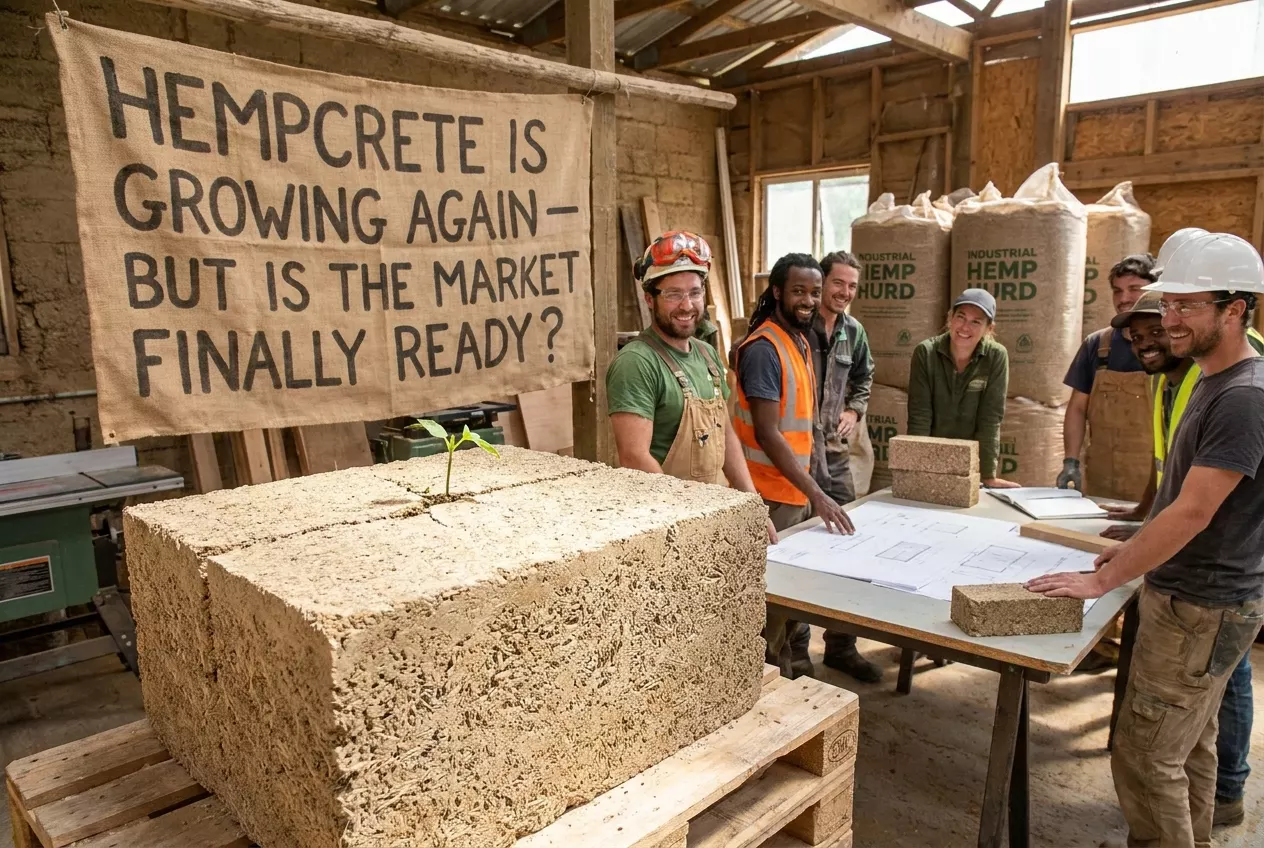
Hemp.com’s framing here is industrial and supply-chain blunt: hempcrete can be genuinely compelling in selected assemblies, educational builds, prototypes, and certain climate-resilient envelopes when detail-driven teams treat it like engineering and procurement, not like a vibe. The market “readiness” question is less about whether Instagram likes it, and more about whether the chain from field to wall is stable enough for owners who do not want their project to become a cautionary LinkedIn post.
How we got here
If you squint, hempcrete’s modern arc looks like a familiar agricultural technology story: long roots in older European practice, a rediscovery phase, a burst of workshops and pilot walls, then a grinding middle period where the romance meets building departments. In the United States, the post-2018 normalization of hemp cultivation under federal rules did not automatically produce a plug-and-play construction SKU; it rearranged possibilities for biomass supply conversations that had quietly struggled when inputs were scarce, inconsistent, or legally awkward to source at consistent spec.
Across that arc, hempcrete oscillates between two futures. One is boutique craft: blower trucks, charismatic builders, charismatic barn raisings—the kind of work that spreads skills and proofs-of-concept, but resists predictable pricing. The other is industrial repetition: repeatable mixes documented with serious test history, QA plans, subcontractor familiarity, code language that inspectors can cite without improvising, and insurance carriers that do not treat the assembly like an exotic pet. Most real projects today sit somewhere in the messy middle: serious intent, uneven national standardization, and code environments that differ dramatically by jurisdiction.
What changed “again,” in the narrative sense, is not a single gadgety breakthrough; it is the accumulation of professional literacy. More architects have now seen a hemp-lime wall in person. More tradespeople have handled batts, forms, and drying schedules. More suppliers can discuss hurd grading with less mysticism. And more public agencies are being asked plain questions they cannot answer from a one-page manufacturer PDF—precisely because standards-setting bodies have been wrestling publicly with hempcrete-specific testing realism, not pretending the category is frozen and finished.
People & stakes
Start with growers: hemp as a federally defined crop lane exists, but cultivation is still a permitting and compliance-heavy business. The USDA’s Domestic Hemp Production framework is where “is this hemp, legally?” gets decided at the farm gate—with implications for biomass markets that extend well beyond ingestible derivatives. Hemp.com treats that connection as operational, not symbolic: the Agricultural Marketing Service’s hemp rules hub is the upstream reality check for how hurds become a construction input at scale without turning a building story into a regulatory accident.
Processors and batching operations sit at the hinge. They translate agricultural feedstock into something a crew can place with tolerances. When hurd quality drifts—moisture, fines content, unknown storage history—mix behavior drifts too, and drift is where confidence dies: not because hempcrete is “delicate,” but because construction purchasing departments hate unbounded variance. Next come designers and engineers, who must translate a biocomposite into load paths, attachments, rain screens, and details that respect how vapor moves; then code officials, who reasonably ask for language that maps to locally adopted codes; then owners and insurers, who carry the quiet veto power of risk tolerance.
The stakes are unevenly distributed. A university build or a passionate nonprofit can absorb learning-curve drama in ways a production homebuilder cannot. A regional supplier network can make hempcrete feel “ready” in one metro and exotic in another—not because the chemistry changes, but because trust and repetition are geographic. In that sense, the market is not one market; it is a patchwork of willingness, skill, and paperwork fluency.
Consequences & what’s next
For communities, the human consequence is less about a single material saving the world and more about whether green jobs rhetoric becomes real, paid training and craft career bridges—especially in places that already have agricultural capacity and would benefit from value-added processing that does not require pretending hemp is a miracle crop. Hempcrete work is labor-rich in the best sense: it rewards crews who understand sequencing, curing, and enclosure strategy. It can also become labor-hostile in the worst sense if teams are forced to improvise without specifications, then blamed when an assembly misbehaves.
Looking forward, the plausible near-term path is not universal replacement of conventional assemblies, but clearer “families” of permitted approaches in friendly jurisdictions, better-documented hybrids (where hempcrete pairs with engineered structural systems rather than pretending to be a universal skeleton), and continued pressure from carbon-accounting conversations—handled soberly—to justify premium decisions on selected projects. The less plausible path is frictionless mainstream adoption everywhere next quarter; building regulation and underwriting do not pivot that fast.
Hemp.com’s outlook posture here is deliberately chill: hempcrete deserves seriousness because buildings last decades and mistakes become expensive folklore. Readiness is less a hashtag than a checklist—supply consistency, credible testing narratives aligned with how regulators actually evaluate assemblies, and trained crews who can repeat success.
Pull quote
A hemp wall becomes “real” the moment someone signs their name next to moisture management—not the moment someone captions it.
Behind the headline
In supply-chain language, hempcrete is a junction between ag processing and mineral binder chemistry, filtered through jobsite choreography. Hurds matter because they give the matrix internal structure and regulate moisture exchange in ways designers may find attractive for certain climates and enclosure strategies—while still requiring disciplined detailing at openings, roofs, and foundations. Claims about embodied carbon deserve humility: comparisons hinge on boundary conditions, service life assumptions, maintenance, and what conventional assembly you benchmark against; Hemp.com avoids presenting loose carbon arithmetic as settled fact.
On the standards side, it matters that ASTM International has publicly described hempcrete-related work aimed at establishing clearer testing expectations—precisely because “borrow a familiar ASTM test and hope” is often where nascent biomaterials stumble. Separately, the wider building-code ecosystem—often discussed through bodies such as the International Code Council and federal measurement science institutions such as the National Institute of Standards and Technology—frames how assemblies become discussable with inspectors and plan reviewers in the United States.
For sustainability program literacy (without treating certification as destiny), organizations such as the U.S. Green Building Council sit in the landscape many commercial teams navigate when selecting materials—not because hempcrete automatically scores points in predictable ways everywhere, but because green-building workflows influence procurement habits and documentation appetite.
Verification & sources
Verified anchors used in this piece: USDA AMS publishes the federal hemp production program overview and linked regulatory materials online; ASTM has issued public communications describing hempcrete-related standards development needs and committee work. Hemp.com treats those as stable references for “what institutions say they are doing,” not as guarantees about every supplier’s brochures.
What remains inherently uncertain without project-specific documentation: market sizing for hempcrete in the United States, nationwide average installed costs, and blanket claims about durability or mold performance across climates. Hemp.com avoids publishing numeric market statistics here because credible totals vary by methodology and quickly become misleading when repeated.
What readers should demand from vendors is documentation, not vibes:
- Mix design transparency: identifiable binder components, target proportions, and curing guidance aligned to enclosure strategy.
- Structural clarity: whether the hempcrete carries load, infills around a frame, or functions primarily as continuous insulation—in each case with details that belong in a stamped package when required.
- Code pathway specificity: how the assembly is presented to plan review relative to locally adopted codes and interpretations.
- Feedstock stability: hurd grading assumptions, moisture and storage discipline, and what changes when the supply lot changes.
When those documents are thin, skepticism is not cynicism—it is professionalism.
Editorial standards
This article uses narrative explainer framing—scene-setting and tension—to help readers understand why hempcrete adoption is uneven. Hemp.com does not fabricate interviews, named quotations, or proprietary project metrics for storytelling gloss; where specifics would normally come from a named source, this draft stays archetypal (inspectors, owners, crews) rather than inventing people.
Hemp.com does not provide medical guidance, intoxicant instructions, or legal advice about cannabis beyond industrial-hemp positioning. When evidence is institutionally thin—especially around performance comparisons and economics—uncertainty is stated directly in the body rather than hidden behind confident adjectives.
Corrections: if an institutional link changes or a factual institutional description becomes outdated, Hemp.com aims to update the digital article and note substantive corrections transparently consistent with editorial policy.
Explore further
If you are exploring suppliers, consultants, craftspeople, or regional networks for hemp building materials, treat Hemp.com as a directory-oriented starting point rather than an endorsement of any single firm. Listing or linking for discovery can be monetized or partnership-supported in some cases; when that applies to a specific page, Hemp.com should surface a clear disclosure adjacent to the commercial relationship so readers can judge incentives.
Onward reading that pairs well with this story includes deep dives into hurd supply and processing economics, permitting case studies written with document-level detail (submittals, test reports, inspector questions), and neutral explainers on enclosure science—because hempcrete’s success is often decided by water, not slogans.
Hemp.com’s goal remains E-E-A-T aligned industrial coverage: accurate mechanics, transparent limits, and a steady refusal to dress marketing language up as peer review.
Find suppliers
Browse verified industrial hemp businesses in the Hemp.com directory.