
Concrete built the modern city. It also left a heavy carbon footprint—cement production alone accounts for a meaningful share of global greenhouse gas emissions, according to industry and life-cycle analyses cited in peer-reviewed construction research. Every new subdivision, warehouse, and retrofit adds embodied carbon before anyone turns on a light switch.
Meanwhile, a fast-growing industrial crop is being milled into something builders can actually specify: hemp building materials that insulate walls, manage moisture, and—in the right assemblies—store biogenic carbon instead of only emitting it. The question is no longer whether hemp belongs on a materials list. It is whether your local code, supply chain, and design team are ready for it.
The story
For most of the twentieth century, U.S. builders could not reliably source industrial hemp for construction. That changed after the 2018 Farm Bill, which directed USDA to establish a national framework for hemp production and removed federal barriers to growing the crop for commercial uses—including the woody inner core called hurds that become hempcrete.
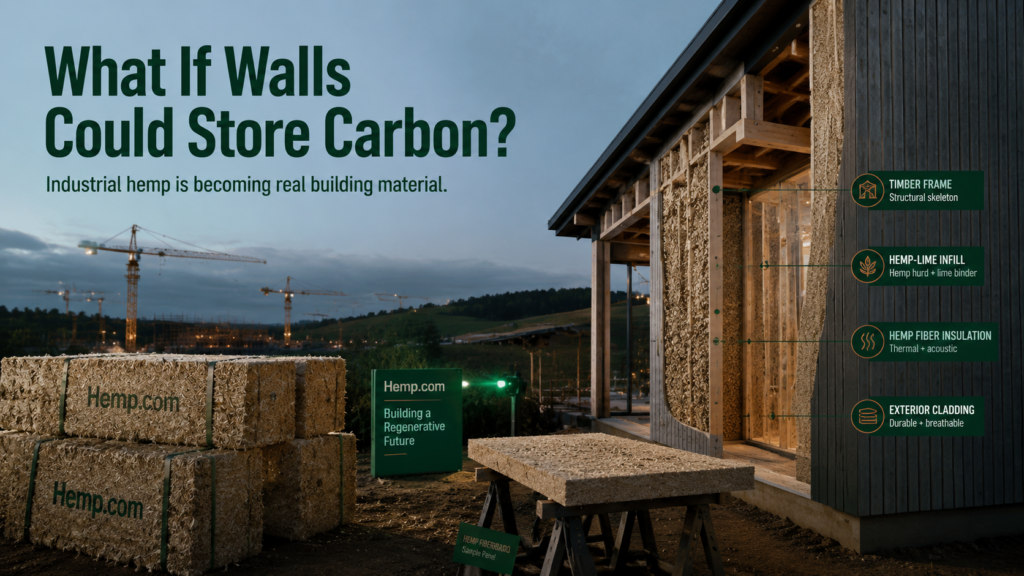
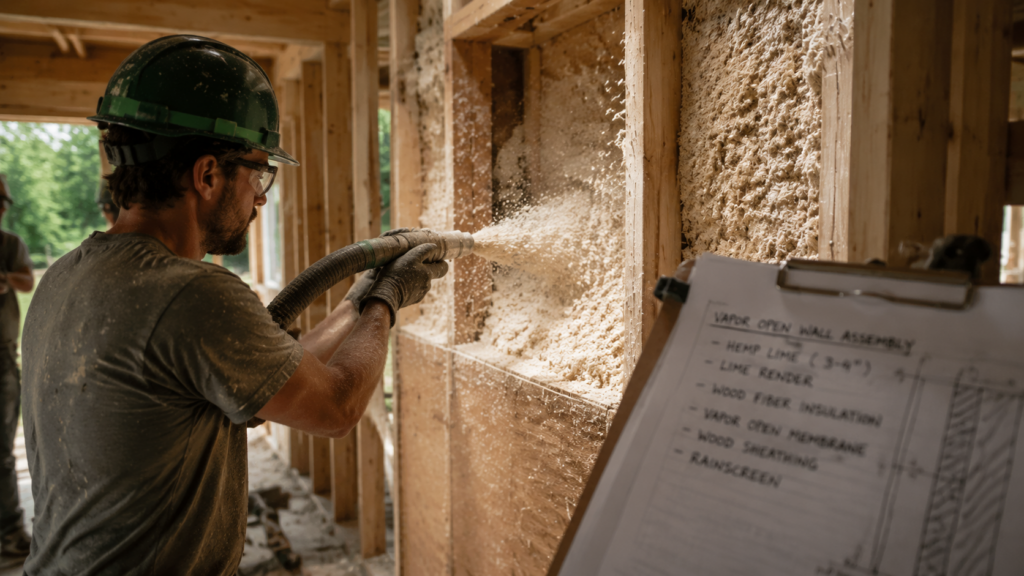
Hempcrete (more precisely, hemp-lime) mixes those hurds with a lime-based binder and water. The result is a lightweight, vapor-permeable infill that wraps structural framing rather than replacing it. Builders cast it in place, spray it, or install prefabricated panels. Alongside hemp-lime, manufacturers offer hemp fiber insulation batts and boards, plus hemp-enhanced fiberboard for interior and sheathing applications where cellulosic performance standards apply.
The regulatory picture is shifting, too. The 2024 International Residential Code includes Appendix BL: Hemp-Lime Construction, a prescriptive pathway for nonstructural hemp-lime infill in one- and two-family dwellings—work the U.S. Hemp Building Association and allied engineers pursued for years. Adoption is still jurisdiction by jurisdiction; appendices are optional until local officials enact them. But for the first time, hemp-lime is written into the model language American residential codes are built on—not relegated to one-off variances.
That matters for architects, developers, and homeowners weighing low-carbon envelopes. Hemp materials will not magically decarbonize housing. They still require skilled installation, compatible detailing, and honest accounting of transport, binder production, and end-of-life. What they offer is a renewable, domestically cultivable feedstock for assemblies that perform differently—and often better on moisture and embodied carbon—than conventional mineral wool or foam-only strategies.
The surprising insight
Here is the shareable pivot: a wall can behave less like a carbon receipt and more like a carbon ledger.
Industrial hemp pulls carbon dioxide from the atmosphere as it grows. When hurds are bound in lime and locked into a building envelope, that biogenic carbon can remain stored for decades. Separately, lime binders undergo carbonation—a slow chemical process in which the material reacts with atmospheric CO2 as it cures and ages. Peer-reviewed life-cycle work on hempcrete consistently highlights both mechanisms as reasons the material can show lower—or net-negative—global warming potential compared with conventional concrete-heavy walls, though results depend heavily on mix design, energy sources, and boundary choices.
A 2024 cradle-to-gate life-cycle assessment published in Results in Engineering found that hempcrete mix designs needed at least roughly 20% hemp by weight, with lime carbonation included in the model, before the material reached carbon-negative global warming potential in the scenarios tested. Review literature in Buildings reports net-negative GWP ranges for hempcrete assemblies under certain assumptions—while also noting hempcrete is non-load-bearing, with compressive strength far below structural concrete.
So the surprise is not “hemp cures climate change.” It is narrower and more industrial: the same plant used for fiber and hurd can become a building material that stores carbon in the envelope while delivering insulation and breathability—if designers treat it as engineered biology, not a green garnish.
Industry stakes
Winners: Farmers and processors with dual-purpose supply chains—fiber and hurd from one crop; regional mills that can deliver consistent hurd sizing; architects and builders who learn hemp-lime detailing early; jurisdictions that adopt Appendix BL and reduce permitting friction; insulation brands positioning hemp alongside other natural-fiber products as ASTM work on natural-fiber blanket specs progresses (ASTM WK94516).
Who must adapt: Code officials in states still reviewing 2024 IRC adoption; structural engineers unfamiliar with nonstructural infill limits; insurers and appraisers who default to conventional assemblies; developers optimizing purely for lowest first cost; any supplier making carbon claims without third-party life-cycle data.
Supply chain scale remains the bottleneck. Hemp hurd for construction competes with other uses and varies by region. Lime binder choices affect both performance and embodied impacts—Portland cement-heavy shortcuts can erase carbon benefits. And “carbon-negative home” marketing outruns evidence fast: full-building LCAs must include foundations, glazing, mechanical systems, and operational energy—not just one heroic wall section.
The market opportunity is real because building codes, farm policy, and climate procurement are converging. The execution risk is treating hemp like a drop-in substitute rather than a system—with framing, breathability, fire testing, and local approval paths designed in from schematic design.
Did you know?
- Hempcrete is not structural concrete. IRC Appendix BL governs hemp-lime as nonstructural infill between or around framing; load-bearing design stays with wood, steel, or engineered systems.
- One crop, multiple building products. Long outer fibers can become insulation and boards; inner hurds feed hemp-lime mixes—an industrial hemp supply chain logic builders are only beginning to specify.
- Lime keeps working after placement. Hemp-lime binders can continue carbonating over time, pulling CO2 from the air as chemistry slowly converts toward calcium carbonate—one reason life-cycle models treat curing as more than a construction-phase footnote.
- Codes moved before culture did. Appendix BL landed in the 2024 model residential code, but appendices take effect only where local jurisdictions adopt them—so two job sites in neighboring counties can face very different permitting paths today.
- Standards are catching up. ASTM committees are developing specifications for natural-fiber blanket insulation covering hemp and other plant-based fibers—signal that hemp insulation is moving from niche toward testable, comparable products.
You saw it early
If you are reading about hemp walls before your subdivision advertises them, you are ahead of the adoption curve—not the research curve. European builders have deployed hemp-lime for years; the U.S. shift is newer, code-anchored, and supply-constrained.
Watch three signals: which states and cities adopt IRC Appendix BL; whether domestic hurd processing scales regionally; and whether developers publish whole-building LCAs instead of material-level slogans. Also track prefabricated hemp-lime panels, 3D-printed hemp mixes in research and pilot projects, and pairing hemp envelopes with electrified, efficient mechanical systems—because stored carbon in walls does not offset inefficient operations.
The future-facing version of housing is not necessarily a sci-fi skyline. It may look like a quiet neighborhood where walls breathe, moisture moves safely through assemblies, and a renewable crop sits in the bill of materials next to timber and glass. That future is being permitted, tested, and bid now—project by project.
Why Hemp.com
Hemp.com tracks industrial hemp where it intersects real industries: farming, processing, standards, and markets that scale beyond headlines. As hemp building materials move from demonstration walls to coded assemblies, we document the suppliers, policies, and project types worth comparing—so builders, buyers, and growers can navigate the same facts.
If hemp belongs in the construction conversation, it belongs with clear specs, verified carbon accounting, and honest limits—not miracle claims. That is the standard we apply across hemp fiber, hemp manufacturing, and the supply chains turning a field crop into walls you can inspect.
Verification & sources
Federal hemp policy is summarized by USDA’s Agricultural Marketing Service (Hemp Laws and Regulations). Model residential code language for hemp-lime appears in IRC 2024 Appendix BL, publicly indexed via UpCodes (Appendix BL viewer). Adoption context is documented by the U.S. Hemp Building Association.
Carbon and performance claims draw on peer-reviewed sources including a 2024 hempcrete life-cycle assessment in Results in Engineering (ScienceDirect) and a 2025 state-of-the-art hempcrete review in Buildings (MDPI). ASTM work item WK94516 describes developing natural-fiber insulation specifications. Portland State University sustainability research has compared hemp-lime insulation scenarios with conventional insulation in published analysis (PDX industrial hemp review PDF).
We did not cite project-specific cost data, fire-test results for individual products, or state-by-state adoption tables here; those vary by manufacturer and jurisdiction and should be verified before specification.
Editorial standards
This article is explanatory journalism, not engineering advice. Hemp-lime assemblies require compliance with applicable building codes, engineer review where triggered—especially in higher seismic design categories—and manufacturer data for fire, thermal, and structural separation.
We use “carbon-negative” and “carbon-storing” cautiously. Life-cycle results vary by hemp content, binder type, electricity mix, transport distance, and whether lime carbonation is modeled. No material is inherently net-zero; performance is design- and context-dependent.
We did not invent interviews, named quotes, or project statistics. Examples are composite industry scenes. Product and permitting guidance should be confirmed with licensed professionals in your jurisdiction.
Explore further
Explore Hemp.com for industrial hemp farming, processing, and supplier directories as they relate to construction feedstocks. Compare hemp fiber suppliers, regional hurd processors, and builders documenting hemp-lime projects.
If you are specifying materials, request environmental product declarations and code documentation—Appendix BL compliance paths, engineering stamps, and fire-resistance test reports where required. If you are growing, ask which hurd grades local hemp building buyers accept and whether contracts cover construction-grade consistency.
Disclosure: Directory listings or linked partners may include sponsored or affiliate relationships where noted on Hemp.com. Editorial coverage is independent of placement fees; always verify claims with primary sources and qualified professionals.
Find suppliers
Browse verified industrial hemp businesses in the Hemp.com directory.