
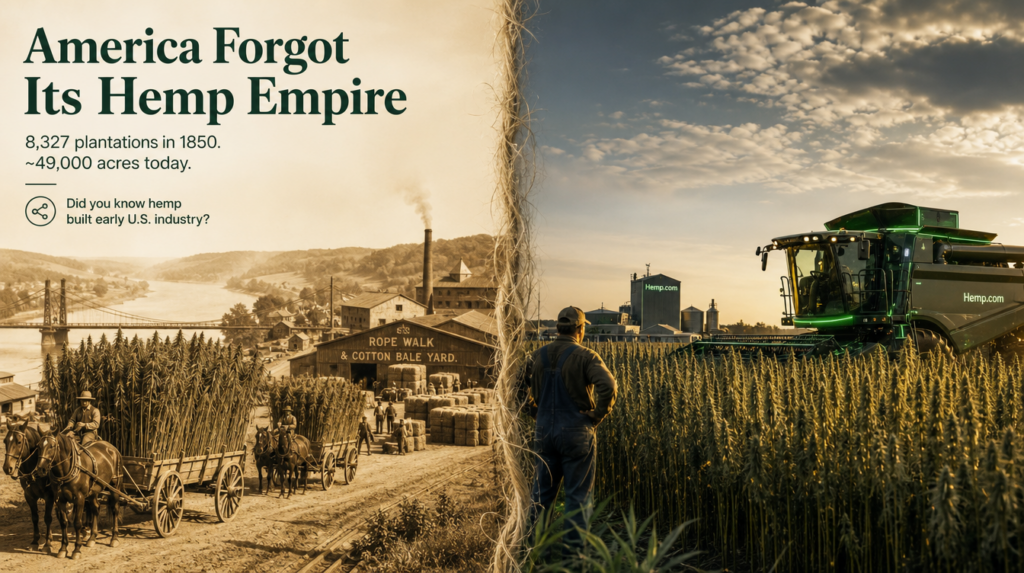
Picture the United States in 1850: steam power is reshaping factories, clipper ships still depend on rope and sailcloth, and cotton is moving through ports wrapped in heavy fiber bags. Into that landscape walks a census taker with a ledger—and a number that modern readers rarely hear in school.
8,327 hemp plantations of at least 2,000 acres that grew hemp
Historical accounts citing the 1850 U.S. Census report 8,327 hemp plantations—defined in many secondary histories as farms of at least 2,000 acres that grew hemp. That count did not include thousands of smaller hemp operations, nor the family-scale patches that supplied local mills and homesteads.
At one point, hemp was not a curiosity crop on the margins of American agriculture. It was infrastructure material—woven into the ropes, textiles, and packaging that connected farms, rivers, and ports. Most Americans today would barely recognize the scale of what existed then.
To understand why that census figure lands like a thunderclap, start with what hemp actually did in the nineteenth-century economy. Hemp fiber became rope, rigging, canvas, bagging, and coarse textiles. It wrapped bales of cotton. It outfitted ships. It fed early paper mills and homestead workshops. In Kentucky and neighboring states, hemp production peaked around mid-century with historical estimates of roughly 40,000 tons nationally in 1850—Kentucky alone supplying more than half, according to widely cited historical summaries of census-era production.
The 8,327 figure is not the same as “8,327 farms each devoted entirely to hemp.” Historians describe these as large agricultural operations—plantations in the census sense of sizable landholdings—where hemp was a major commercial crop alongside other production. Critically, the count excludes smaller growers. If your mental image is a few scattered experimental fields in 2025, the historical picture is almost inverted: hemp once sat near the center of American industrial supply chains, especially wherever cotton, shipping, and fiber processing intersected.
That scale came with a moral cost historians do not sugarcoat. In the Bluegrass and border states, hemp’s labor-intensive retting, breaking, and processing relied heavily on enslaved labor. Emancipation, competition from cotton and imported fibers, and the shift from sail to steam all weakened the old model long before federal cannabis restrictions arrived. By 1889, the Census Bureau reported just 25,054 acres nationally devoted to hemp—already a shadow of the antebellum peak, with Kentucky still dominating production (1890 Census bulletin on flax and hemp).
Fast-forward to the present. After the 2018 Farm Bill removed hemp from the Controlled Substances Act and the USDA stood up the Domestic Hemp Production Program, U.S. hemp farming returned legally—but on a very different footprint. The USDA’s National Hemp Report counted 49,267 acres planted in the open in 2025, with 43,707 acres harvested and total production valued at $739 million.
Read those numbers twice. Measured by field acreage, modern U.S. hemp farming is measured in tens of thousands of acres—not the vast plantation network implied by an 1850 count in the thousands of large operations, and not the wartime emergency expansion of the 1940s. During World War II, the USDA’s own Hemp for Victory campaign urged farmers to plant tens of thousands of acres of seed hemp in 1942 alone (USDA film transcript, 1942)—a brief revival before postwar restrictions and the loss of processing infrastructure pushed commercial hemp toward extinction by the late 1950s.
So how did a crop that once undergirded shipping, textiles, and early American manufacturing nearly vanish from the national imagination?
The decline was layered, not mysterious. Mechanical and material substitution mattered: cotton, jute, and later petrochemical fibers and synthetic rope displaced hemp in many applications. The maritime economy’s pivot from sail to steam reduced demand for hemp rigging. The Marihuana Tax Act of 1937 imposed registration and tax burdens that treated industrial hemp like its high-THC cannabis cousins, making compliant commercial cultivation impractical for most handlers. The Controlled Substances Act of 1970 completed the legal freeze.
When hemp returned after 2018, it did not simply resume its old supply chains. Early expansion leaned heavily on floral hemp for cannabinoid markets. Licensed acreage reported by industry trackers surged into the hundreds of thousands of acres in 2019, but actual planted and harvested acreage tracked by USDA remained far lower—evidence of enthusiasm outpacing infrastructure, financing, and stable end markets. Farmers encountered processor bottlenecks, price volatility, and a patchwork of state rules that still complicates interstate commerce.
Even in 2025, the USDA report tells a split story: floral hemp drove most of the sector’s dollar value, while fiber hemp covered more harvested acres but returned far less revenue per pound. America remembered hemp as a headline. It has not yet rebuilt hemp as a fully integrated industrial pipeline.
The surprising insight
Here is the pivot most shareable charts miss: America’s hemp collapse happened long before the word “marijuana” entered popular panic. By the time the Marihuana Tax Act passed in 1937, census data already showed hemp reduced to a narrow regional specialty—not a continent-spanning plantation network.
The real discontinuity is infrastructural. Nineteenth-century hemp was profitable because an ecosystem existed: seed sources, retting pools, breaking mills, rope walks, textile factories, and guaranteed buyers in shipping and cotton packaging. That ecosystem dissolved across decades. Legalization in 2018 reopened the field—but decorticators, fiber scutching lines, long-term offtake contracts, and standards for hemp building materials and biocomposites are still catching up.
In 2025, U.S. open-field fiber hemp production reached an estimated 67.3 million pounds from about 21,693 harvested acres, according to USDA— meaningful growth, but a sector where fiber value totaled roughly $13.5 million compared with hundreds of millions for floral hemp. The plant did not forget how to grow. The country forgot how to use it at scale.
Industry stakes
Farmers and rural communities face the sharpest short-term risk. Hemp can fit rotation schemes and regenerative goals, but without reliable processors and priced contracts, acreage swings wildly year to year. The gap between licensed intent and planted acres remains a warning sign for anyone treating hemp like a guaranteed cash crop.
Processors and manufacturers hold the bottleneck keys. Fiber hemp’s economics improve only when decortication, quality grading, and downstream offtake—textiles, insulation, bioplastics, hemp-lime building systems—scale together. A single weak link strand snaps the whole chain.
Brands and builders searching for lower-carbon inputs have a long-term upside if supply stabilizes. Hemp’s environmental story—fast growth, potential soil benefits when managed well, versatile biomass—is credible enough to warrant investment, but not automatic. Certification, testing, and transparent sourcing will separate durable industrial adoption from greenwashing.
Policymakers still shape the playing field. Federal legalization removed one barrier; state-level THC product rules, USDA plan compliance, and FDA oversight of hemp ingredients in foods and supplements continue to inject uncertainty. Clarity here determines whether the U.S. rebuilds a fiber economy or cycles through another boom-and-bust.
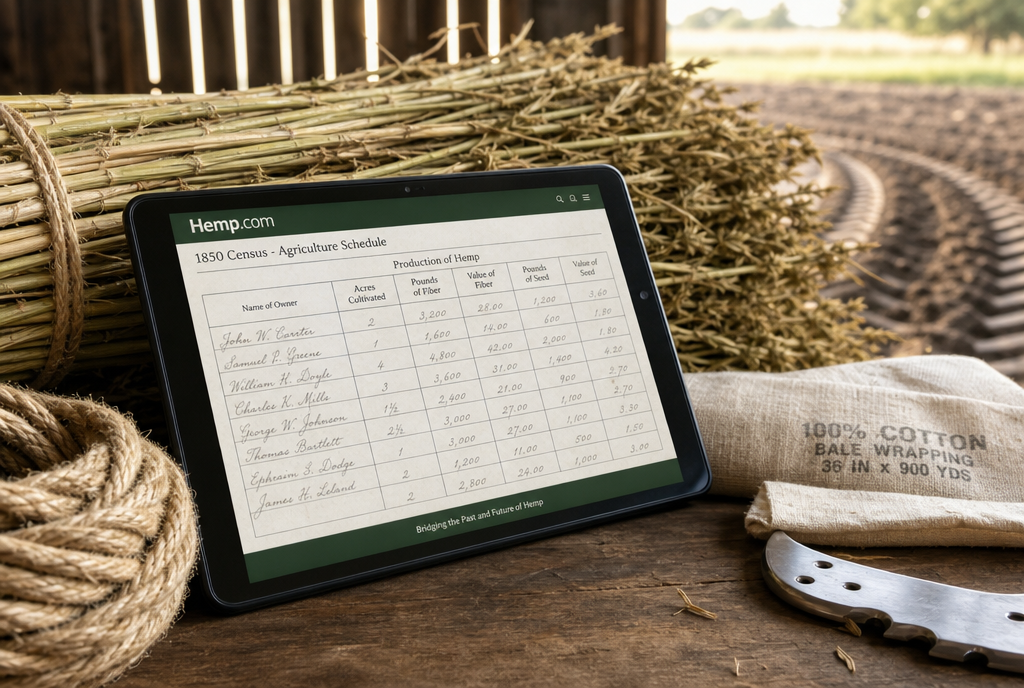
Imagine standing at the edge of a modern fiber hemp field at harvest—tall canes swaying in late-summer light—while on a tablet screen beside you, a digitized 1850 agricultural schedule lists hemp production by county in looping nineteenth-century script. The contrast is not nostalgia versus progress. It is infrastructure versus intention: yesterday’s rope walks and cotton bagging mills replaced today by a single combine, a distant decortication facility, and pallets of biomass waiting for a buyer. That is the scene this story lives in—the physical crop returned, the industrial ecosystem still under construction.
Did you know?
- Colonial and early U.S. authorities repeatedly encouraged hemp cultivation for cordage and naval stores; Virginia required farmers to grow flax and hemp as early as the seventeenth century, according to Colonial Williamsburg research.
- The 1850 census count of 8,327 large hemp-growing operations is widely cited in hemp historiography, but it excludes smaller farms—so the true number of hemp producers in that era was higher than the headline figure alone suggests.
- By 1889, nationwide hemp acreage had fallen to about 25,054 acres, with Kentucky producing nearly 94% of the U.S. crop—decades before federal prohibition.
- USDA’s 2025 National Hemp Report measured roughly 49,267 acres planted in the open—smaller than the temporary wartime push documented in the 1942 Hemp for Victory campaign materials.
- Modern hemp value is uneven by use: in 2025, floral hemp accounted for the majority of open-field production value, while fiber hemp covered more harvested acres but a much smaller share of revenue—signaling that industrial markets remain underdeveloped relative to cultivation capacity.
You saw it early
If you are reading this now, you are early to a second act—not a replay of the antebellum plantation economy, and not the CBD gold rush alone. The next phase belongs to integrated industrial hemp: dual-purpose cultivars, regional processing hubs, verified fiber standards, and products where hemp replaces petrochemical inputs in construction, packaging, and textiles.
Watch three signals. First, whether harvested fiber acreage grows with rising fiber prices—not just rising acreage. Second, whether public infrastructure investments pair with private offtake agreements instead of one-season speculative planting. Third, whether federal and state rules converge enough to let hemp move across borders like any other agricultural commodity.
The 1850 census reminds us America already built a hemp economy once. The 2025 USDA tables remind us it has not finished building the next one.
Why Hemp.com
Hemp.com tracks this transition in real time—from historical production records and policy milestones to today’s acreage reports, processor maps, and emerging material applications. Whether you are a grower evaluating contracts, a brand sourcing fiber, or a reader trying to separate myth from measurable fact, the through-line is the same: industrial hemp is not new to America. What is new is the chance to rebuild it with modern science, transparent supply chains, and markets that reward durability over hype.
Verification & sources
Historical plantation counts citing the 1850 U.S. Census appear frequently in hemp history literature; primary census publications document extensive agricultural schedules but do not always surface the 8,327 figure in modern digital abstracts. This article treats that number as a widely reproduced historical claim and pairs it with better-verified metrics such as nineteenth-century production tonnage estimates and later census acreage totals. Modern figures come from the USDA National Hemp Report (2025 crop year), the USDA Agricultural Marketing Service hemp program pages, university extension summaries of the Marihuana Tax Act, and the publicly archived USDA Hemp for Victory transcript. Where industry license totals differ from USDA planted-acre surveys, both are described as distinct measures—intent versus actual cultivation.
Editorial standards
Hemp.com does not present industrial hemp as a medical cure, legal loophole, or guaranteed profitable crop. Historical scale comparisons avoid multiplying plantation counts by minimum acreage to imply tens of millions of hemp-only acres without primary documentation. The antebellum hemp economy’s dependence on enslaved labor is acknowledged because accurate industrial history requires it. Market outlook language reflects documented processing gaps and USDA value splits rather than speculative revenue promises. No named individual quotes were invented for this article.
Explore further
Explore Hemp.com’s coverage of hemp farming, state licensing requirements, fiber processing developments, and building-material innovators to go deeper than the headline numbers. If you operate along the supply chain—farm, mill, brand, or policy—consider listing in the Hemp.com directory so readers rebuilding America’s industrial hemp ecosystem can find verified partners. Disclosure: directory listings and partner links may be monetized; editorial comparisons and census summaries are prepared independently of those relationships.
Find suppliers
Browse verified industrial hemp businesses in the Hemp.com directory.