
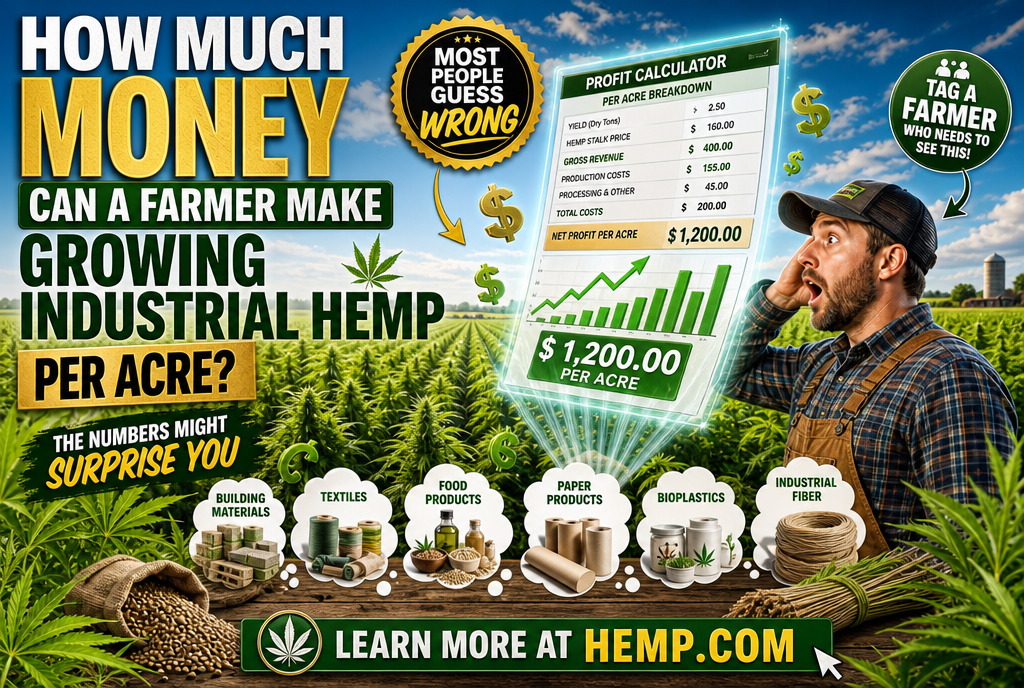
Short answer: In 2024, USDA-estimated gross production value for open-field industrial hemp ranged from roughly $540 per acre (grain) to about $32,600 per acre (floral)—before subtracting seed, labor, drying, testing, hauling, and marketing costs. That is not take-home profit.
The 2024 National Hemp Report, released April 17, 2025, by USDA’s National Agricultural Statistics Service (NASS), is the clearest national benchmark available. It summarizes survey responses from producers across the United States on planted area, harvested area, yield, production, and value by end use.
Why this matters now: hemp acreage rebounded in 2024—45,294 acres planted and 32,694 harvested in the open, up 64% and 55% from 2023—but the money still concentrates in floral markets. Fiber covers the most harvested open-field acres, yet returns per acre stay far lower than floral or seed. If you are budgeting a 2025 or 2026 crop, start with your market, not a national average.
What it means for industrial hemp
For growers, the 2024 numbers reinforce a split industry. Floral hemp generated an estimated $386 million on 11,827 harvested acres—about 93% of total open-field hemp value ($417 million) on roughly 36% of harvested acres. That makes floral the revenue engine, but also the segment most exposed to volatile buyer demand, cannabinoid policy shifts, and post-harvest processing bottlenecks.
Fiber hemp tells a different story. It accounted for the largest open-field footprint—18,855 harvested acres—but only $11.2 million in estimated production value. Average yield was 3,205 pounds per acre, yet gross value worked out to roughly $594 per acre. Processors and fiber brands should read that as a scale-and-efficiency market: margin depends on decortication capacity, offtake contracts, and whether you are selling raw stalk, hurd, or refined inputs—not headline acreage alone.
Grain and seed occupy smaller acreage but serve distinct supply chains. Grain hemp (human-food markets) averaged 702 pounds per acre with about $539 per acre in gross value. Seed hemp averaged just 323 pounds per acre but roughly $7,824 per acre in gross value—reflecting high per-pound pricing for genetics and planting stock rather than bulk commodity economics. Brands sourcing domestically should note seed value jumped sharply year over year while clone and transplant production under protection fell.
Investors and lenders should treat NASS figures as farm-gate production value estimates, not EBITDA. Protected production—3.52 million square feet valued at $28.7 million—adds a greenhouse and indoor layer that field averages alone will miss. State-level variation is also large; national averages smooth out both high-performing contract farms and abandoned or failed acres.
Playbook: What to do now
Use the table below as a Monday-morning planning baseline. All figures are 2024 USDA estimates for hemp grown in the open; round numbers are derived from published totals.
| Market (open field) | Harvested acres | Avg. yield per acre | Est. gross value per acre | Implied avg. price per lb* |
|---|---|---|---|---|
| Floral | 11,827 | 1,757 lb | ~$32,600 | ~$18.56 |
| Seed | 2,160 | 323 lb | ~$7,800 | ~$24.25 |
| Fiber | 18,855 | 3,205 lb | ~$594 | ~$0.19 |
| Grain | 4,863 | 702 lb | ~$539 | ~$0.77 |
| All open-field uses | 32,694 | varies by crop | ~$12,800 blended** | — |
*Implied price = total reported value ÷ total reported production. **Blended average mixes unlike markets; do not use for a single-crop budget.
- Do now: Pick your end market first, then pull the matching row—not the blended national average.
- Do now: Download your state tables from the 2024 National Hemp Report or query NASS Quick Stats for state-level yield and value.
- Do now: Build a net-margin worksheet: gross value per acre minus seed/transplants, fertility, irrigation, labor, harvest, drying, testing, transportation, and buyer fees.
- Do now: Secure written offtake terms before planting floral or fiber at scale—2024 floral yield rose 669 lb/acre nationally, but price and buyer stability are not guaranteed.
- Watch: Fiber acreage expanded 56% while fiber value fell 3%; oversupply without local decortication can compress bids.
- Watch: Seed value rose sharply (+482%) on lower per-acre yield (-236 lb/acre)—quality, certification, and varietal performance matter more than raw pounds.
- Watch: Protected floral production fell (-35% by weight; -30% by value)—indoor economics may be tightening relative to field production in some regions.
- Avoid: Quoting “$32,000 an acre” without specifying floral, region, contract type, and cost stack.
- Avoid: Planting without a compliant buyer and documented total THC sampling plan—unmarketable biomass zeros out gross value.
- Avoid: Treating hemp like a passive row crop; grain and fiber still need weed control, harvest timing, and storage discipline comparable to other specialty crops.
Risks & compliance
USDA value estimates do not adjust for compliance failures, rejected loads, or crops destroyed for exceeding applicable total THC limits. Under the USDA Domestic Hemp Production Program, producers must work within approved state or tribal plans—or the federal default—and maintain sampling and remediation records. A high-yield floral field has zero realized income if the lot fails testing or lacks a legal market channel.
Floral and cannabinoid-oriented production carries the most regulatory and market scrutiny. State rules differ on sampling windows, remediation, and what products may be sold. Operators should confirm requirements with their state department of agriculture before ordering genetics—not after harvest. This article is industry information, not legal advice; consult qualified counsel for contract and licensing questions.
Contract risk sits outside the NASS survey. Production value reflects what producers reported; it does not capture unpaid invoices, chargebacks, or production grown without a buyer. For fiber and grain, identity preservation, moisture standards, and mycotoxin or foreign-material specs in buyer agreements can turn a profitable yield on paper into a discounted or rejected delivery.
Banking, insurance, and interstate transport add friction even when a crop is compliant. Document chain-of-custody for seed sources, field maps, and lab certificates early—auditors and processors increasingly expect that packet at intake.
Cost & tradeoffs
NASS reports gross value of production, not net farm income. USDA does not publish a standardized national cost-of-production budget for hemp by market in this report, so precise net-margin figures vary by state, irrigation, mechanization, and whether you own drying infrastructure.
If floral gross value ~$32,600/acre: High revenue potential, but typically higher input intensity—feminized seed or clones, staking or trellising in some systems, hand or semi-mechanized harvest, drying barn capex or opex, and multiple compliance tests. Without a locked contract, downside risk is also highest.
If fiber gross value ~$594/acre: Lower per-acre revenue requires low cost per ton and proximity to processing. Dedicated dual-purpose or fiber varieties, swathing timing, and baling logistics drive whether the crop clears land rent and equipment payments.
If grain ~$539/acre or seed ~$7,800/acre: Grain behaves like a small-acreage specialty oilseed at national averages—scale and combine access matter. Seed production pays more per acre at reported averages but demands isolation distances, rogueing, and certification work that field-run floral acres may not need.
University extension enterprise budgets (where available for your state) remain the best next step for opex modeling; pair them with the gross-value rows above rather than relying on social-media profit claims.
Opportunities
Lean in if you have a verified buyer, compliant genetics, and post-harvest capacity matched to floral or seed economics. The 2024 data show floral yield improvements nationally (1,757 lb/acre, up 669 lb from 2023) alongside rising acreage—operators who combine agronomic discipline with contracted outlets capture the bulk of industry value.
Lean in if you are building regional fiber infrastructure. Fiber acres lead the country in footprint, and stalk volume is substantial (60.4 million pounds reported). Processors who colocate decortication with farm clusters can arbitrage low farm-gate stalk pricing—if they solve logistics and consistent quality.
Wait or stay small if you lack drying, testing, and sales channels for floral biomass. National averages hide wide dispersion; entering without a contract in a rebound year can mean commodity-style price pressure.
Wait or partner if you are a grain or food-ingredient brand expecting hemp to price like mainstream oilseeds on day one. At ~$0.77/lb implied national average, identity-preserved supply chains and multi-year grower partnerships are how brands stabilize cost—not spot buying after harvest.
At a glance
- 2024 open-field hemp gross value spanned ~$539/acre (grain) to ~$32,600/acre (floral), per USDA estimates—not net profit.
- Floral dominated dollars: ~$386M of $417M open-field value on ~11,827 acres, at ~1,757 lb/acre average yield.
- Fiber led acreage, not revenue: ~18,855 harvested acres but ~$594/acre gross value at ~3,205 lb/acre yield.
- Seed paid more per pound, less per field: ~323 lb/acre yield but ~$7,824/acre gross value—genetics and quality drive the model.
- National acreage rebounded in 2024 (45,294 planted; 32,694 harvested), but market choice matters more than the blended ~$12,800/acre average.
- Protected production is a separate lane: 3.52M sq ft valued at $28.7M—field averages alone understate greenhouse economics.
Verification & sources
Primary source: the 2024 National Hemp Report (NASS, released April 17, 2025). Methodology is described on USDA’s Hemp Production and Disposition Inquiry page. Historical releases are archived at the National Hemp Report publication page.
Per-acre gross value figures in this article are estimates calculated by dividing reported total value by reported harvested acres for each utilization. Implied prices divide total value by total production pounds. USDA publishes some price series directly in report tables; minor rounding may differ from our derived figures.
Limits: survey-based estimates are subject to nonresponse bias and producer recall; small-market categories (grain, seed) can swing year to year on limited acreage. National averages mask state and varietal differences. NASS value data reflect production sold or expected to be sold, not full cost accounting. Protected-structure production is reported in square feet, not directly comparable to per-acre field benchmarks without local conversion assumptions.
Editorial standards
Hemp.com prepared this article for operators, compliance leads, and procurement teams evaluating industrial hemp economics. All yield and value figures trace to USDA NASS 2024 survey estimates unless labeled as derived calculations. We do not assert medical outcomes, guaranteed profits, or cultivation advice that would violate federal or state law.
Where net-margin data are unavailable nationally, we say so rather than invent cost benchmarks. Directory listings or partner links that may appear elsewhere on Hemp.com are disclosed at point of use; this analysis is editorial, not paid placement. Figures should be re-verified against the latest NASS release before contractual or lending decisions.
Explore further
Next reads on Hemp.com: state hemp program guides, post-harvest drying and storage basics, fiber processing primers, and grain hemp food-ingredient sourcing checklists. Pair this income snapshot with a compliance calendar for your state before you scale acreage.
Directory starting points: use Hemp.com’s grower, processor, and genetics directories to identify regional decorticators, floral buyers, and certified seed suppliers—filter by state and end market rather than browsing nationally. Ask vendors for 2024–2025 offtake references, typical test-pass rates, and delivered-versus-field pricing.
Don’t forget to: bookmark the annual National Hemp Report each April and cross-check your plan against Quick Stats as new state data publish.
Find suppliers
Browse verified industrial hemp businesses in the Hemp.com directory.