
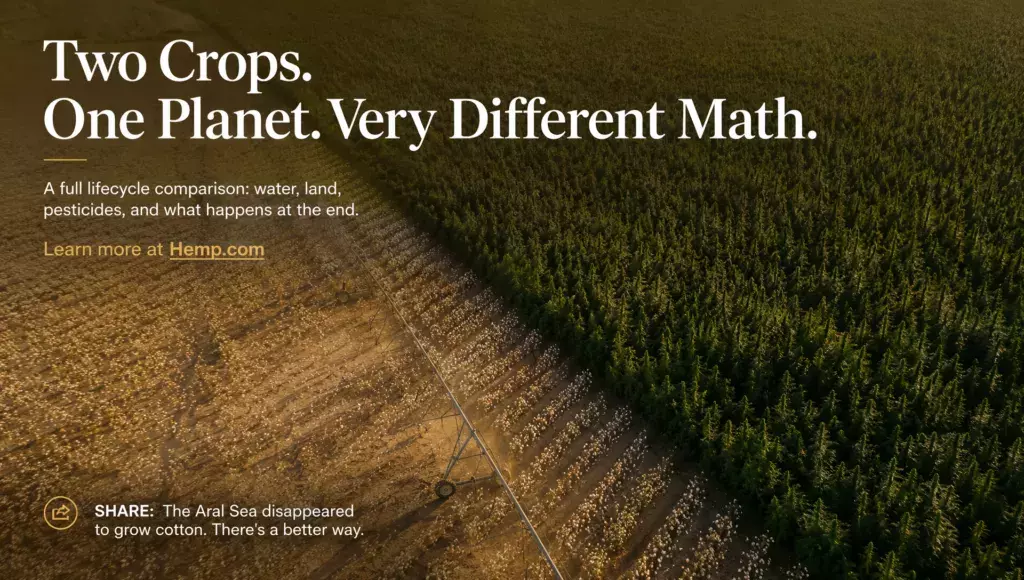
In 1960, the Aral Sea in Central Asia ranked as the fourth-largest inland body of water on Earth. Fifty years later, it had lost more than 90 percent of its volume. The cause was not drought or climate shift alone — it was cotton. Soviet planners diverted the two great rivers feeding the sea to irrigate cotton fields across Uzbekistan and Kazakhstan on an industrial scale. The fishing industry vanished. The surrounding region became one of the most contaminated landscapes on the planet, coated in pesticide-laden salt that winds carried for hundreds of miles. Ships rusted in the sand, miles from any water.
That story is the extreme end of a pattern that still plays out across cotton-producing regions today. Cotton is the most widely grown non-food crop on Earth, and it remains among the most resource-intensive agricultural commodities in global supply chains. Its relationship with water, soil, and chemistry has reshaped entire ecosystems over generations.
Industrial hemp — the non-psychoactive variety grown for fiber, seed, and biomass — produces comparable textile material while using a fraction of the water, almost no synthetic pesticides, and leaving soil in better condition than it found it. Comparing the two across their full lifecycle is not a marketing exercise. It is a supply chain reckoning — and the numbers deserve to be laid out clearly.
The Hemp/Cotton Lifecycle- Biggest Impacts
Stage One: Water
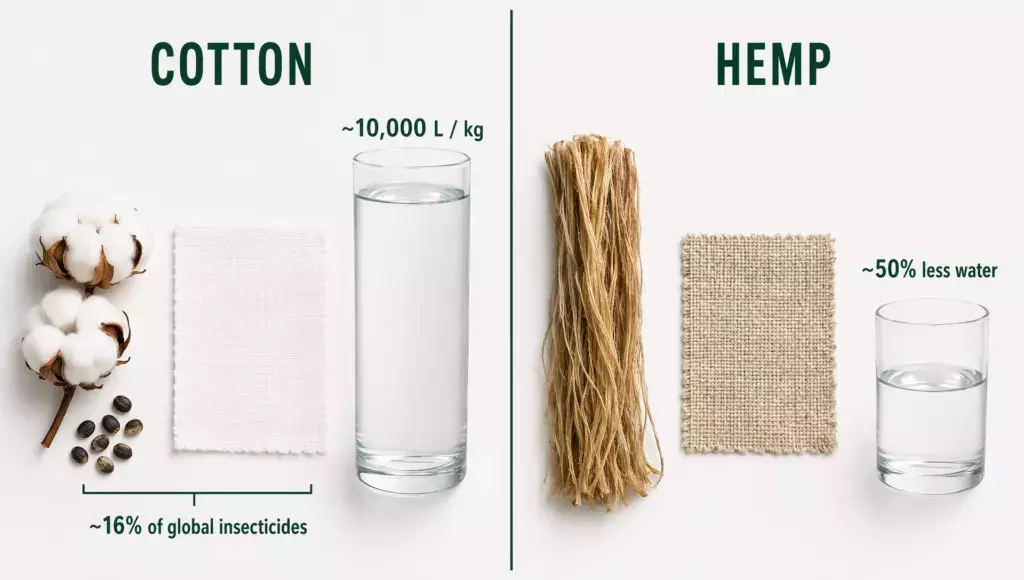
Cotton’s thirst is well-documented. The World Wildlife Fund estimates that producing one kilogram of cotton fiber can require approximately 10,000 liters of water — enough to fill a small backyard swimming pool. The range varies significantly by region and growing method, from around 7,000 liters in efficient drip-irrigated systems to more than 20,000 liters in flood-irrigated fields in water-scarce areas. Global cotton production draws heavily from both rainfall and groundwater, placing sustained pressure on aquifers in the American Southwest, Pakistan, India, and China.
Hemp’s water demand is substantially lower. Agricultural researchers and lifecycle analyses consistently place hemp’s water requirement at roughly half that of cotton for an equivalent weight of raw fiber, though direct comparisons vary depending on local conditions, processing methods, and where in the production chain water is measured. Hemp is commonly grown as a rain-fed crop across temperate regions in Europe and North America and does not require the extensive irrigation infrastructure cotton demands. Multiplied across millions of acres, that difference represents an enormous volume of water returned to watersheds rather than diverted from them.
Stage Two: Land and Yield
Hemp grows fast. Most cultivars reach harvest in 70 to 120 days from planting. In that window, it can produce significantly more fiber per acre than cotton. Agricultural comparisons commonly cite hemp yielding two to three times more usable fiber per unit of land than cotton, though precise yield figures depend on cultivar, climate, and soil conditions. Hemp’s dense canopy closes quickly after germination, crowding out weeds without herbicide intervention in many growing conditions. Cotton’s longer growing season and more open structure typically requires multiple herbicide applications to manage weed pressure across the same period.
Hemp also demonstrably improves the soils it occupies. Its deep taproot system aerates compacted earth, and the leaf litter it sheds returns organic matter to the surface. European farmers have used hemp as a rotation crop specifically to rehabilitate fields for subsequent plantings. Cotton, grown continuously on the same land over years, can degrade soil structure and contributes to erosion in poorly managed operations — a particular concern in regions where it displaces native vegetation at scale.
Stage Three: Pesticides and Soil Chemistry
This is where the comparison becomes most stark. Cotton is one of the most chemically intensive crops in global agriculture. The WWF and multiple environmental research organizations have cited cotton as accounting for roughly 16 percent of global insecticide sales despite occupying only about 2.5 percent of the world’s agricultural land. The specific chemicals involved — organophosphates, pyrethroids, and herbicides such as glyphosate — carry documented risks to soil microbiomes, pollinators, aquatic ecosystems, and farmworker health. The Food and Agriculture Organization of the United Nations tracks pesticide use patterns in cotton-producing regions as part of broader agricultural sustainability monitoring.
Hemp is naturally resistant to most pest pressures. Its rapid growth rate and dense foliage suppress many insects and weed species before they can establish. Certified organic hemp cultivation is commercially viable and increasingly common — a contrast with certified organic cotton, which still represents a small fraction of global cotton production despite meaningful growth in recent years. Hemp typically requires little or no synthetic pesticide application under normal growing conditions, and this is supported by grower experience across Europe, North America, and China.
Stage Four: Carbon and End-of-Life
What happens when clothing or industrial fabric wears out matters more than it once did. Natural fibers biodegrade faster than synthetics, but even within natural fibers the picture is uneven. Pure hemp fabric breaks down relatively quickly in compost conditions — weeks to months under active microbial decomposition, depending on weave density and any finishing chemistry applied. Pure cotton behaves similarly but tends to be slower when heavily processed or blended with synthetic dyes and finishes.
The real end-of-life problem for both fibers is blending. Most commercial textiles combine cotton or hemp with polyester, nylon, or elastane, and blended fabrics can persist in landfills for decades regardless of natural-fiber content. Neither crop is fully sustainable at end-of-life while the industry defaults to blended constructions. Hemp does, however, hold a growing advantage: its biomass applications extend beyond fabric into hempcrete building blocks, hemp fiber composites, and compostable nonwovens designed for industrial use — end-of-life pathways that cotton simply does not offer at scale.
On carbon, hemp has gained attention as a sequestering crop. The European Industrial Hemp Association has published estimates suggesting hemp sequesters approximately 1.63 tonnes of CO₂ per tonne of dry matter produced — comparable to or exceeding sequestration rates associated with many forestry plantings. When hemp biomass is incorporated into long-lived products like hempcrete, that carbon remains stored rather than released through decomposition. Cotton has no comparable carbon-positive story in conventional cultivation; factoring in irrigation energy, fertilizer manufacturing, and ginning, it is primarily a net emitter across its production lifecycle.
Bonus: Regenerative Farming- Fix the Soil
Hemp was planted near Chernobyl. This is not agricultural folklore — it is documented environmental science. Following the 1986 nuclear disaster in Ukraine, Cannabis sativa was used in phytoremediation efforts to draw heavy metals and radioactive cesium and strontium from contaminated soil. Hemp’s deep root system and its biochemical tendency to accumulate minerals from surrounding earth made it a practical tool in one of the most severe contamination events in human history. The same property that makes hemp a soil-improver on working farms makes it a remediation instrument in damaged landscapes.
No other major textile fiber crop has been deployed for industrial-scale environmental cleanup. That is not a footnote. It is a window into a plant whose relationship with soil chemistry is fundamentally different from any conventional agricultural alternative — and a compelling signal that the full value of hemp in the environmental toolkit has barely been measured, let alone fully applied.
What’s at stake for the Hemp Industry?
The fashion and textile industries are moving — slowly and unevenly, but visibly — toward supply chains that can survive environmental scrutiny. The European Union’s Strategy for Sustainable and Circular Textiles establishes mandatory durability, recyclability, and environmental-impact requirements for products sold across the EU market. The Textile Exchange, which benchmarks fiber sustainability globally, has documented growing brand commitments to alternative natural fibers. Similar legislative and disclosure pressure is building in the United Kingdom, Canada, and several U.S. states. These regulatory frameworks create structural incentives for brands to document and reduce lifecycle impacts across water, chemicals, and end-of-life — precisely the categories where conventional cotton underperforms and hemp has a clear story to tell.
The challenge is infrastructure. Decades of global investment have optimized every stage of the cotton supply chain — spinning equipment, dyeing chemistry, finishing processes, retail sourcing networks — for cotton fiber’s specific characteristics. Hemp fiber, particularly at the fine-yarn quality required for mainstream apparel, requires different processing equipment. A growing number of specialized processors in Europe, China, and North America have invested in the necessary machinery, but the bottleneck is real. For hemp to displace a meaningful share of cotton production, brands would need to commit to long-term sourcing contracts that justify the capital investment — a decision most major apparel companies have not made at scale.
That hesitation may be time-limited. Water scarcity is no longer an abstract supply chain risk. Cotton-producing regions in Pakistan, India, and the American Southwest are experiencing the kind of long-cycle drought conditions that force agricultural systems to adapt or fail. As water pricing, pesticide regulation, and mandatory corporate sustainability disclosures tighten simultaneously, the true environmental cost of cotton fiber will become harder to conceal in supply chain accounting — and the case for hemp will not require advocacy so much as arithmetic.
Did you know?
- Cotton covers roughly 2.5% of global agricultural land but accounts for an estimated 16% of global insecticide sales — a chemical concentration that has drawn sustained attention from environmental researchers and regulators for decades.
- Hemp was deployed near Chernobyl as a phytoremediation tool after the 1986 nuclear disaster, drawing radioactive cesium and strontium from contaminated soil using its deep root system — a real-world environmental application no other major textile crop has matched.
- Hemp fiber can yield two to three times more usable material per acre than cotton in comparable growing conditions, meaning significantly less land is required to produce an equivalent weight of raw fiber.
- One kilogram of cotton may require up to 10,000 liters of water depending on where and how it is grown — a figure the Aral Sea disaster made visible at civilizational scale, and one that remains relevant in every drought-stressed cotton region on Earth today.
- Hemp’s end-of-life story extends beyond textiles: hemp biomass is used in hempcrete building blocks, fiber composites, and compostable nonwovens — meaning the crop’s useful life can continue through multiple material cycles rather than ending in a landfill after a single use.
Let’s bring Hemp Back!
The textile industry’s sustainability reckoning is not coming — it is underway. EU mandatory textile labeling and lifecycle-disclosure rules are in phased implementation. Brands from mid-market retailers to luxury houses are documenting fiber origins and environmental impacts in ways their sourcing teams were never required to do before. In that environment, hemp’s lifecycle advantages are not just marketing differentiators — they are compliance assets with quantifiable value in sustainability reporting frameworks.
The early signals are visible for those paying attention: investment in European hemp decortication and fine-spinning technology; university research programs in France, Germany, and the United States testing new cultivar varieties optimized for apparel-grade fiber; a growing number of apparel brands incorporating hemp-cotton blends as a near-term transition strategy. These are the leading indicators of a shift, not its conclusion. The USDA’s Agricultural Marketing Service and counterpart agencies in the EU are actively expanding the regulatory and licensing frameworks that will allow hemp agriculture to scale in new geographies.
The honest timeline: hemp will not replace cotton across global textiles within a decade. The infrastructure gap is real, and the agronomic knowledge base outside traditional hemp-growing regions is still developing. But the direction of travel is clear. Water scarcity, pesticide regulation, carbon disclosure requirements, and soil health mandates are all converging toward the same conclusion — favoring the crop that uses less of everything, grows faster, leaves land better, and sequesters carbon while doing it. Readers who understand that trajectory now are watching the beginning of a multi-decade materials transition, not its middle.
Explore further
Readers interested in exploring industrial hemp textiles, fiber processing, and sustainable agriculture further can browse Hemp.com’s hemp fiber resource sections, farming guides, and business directory — which connects buyers, processors, cultivators, and manufacturers across the growing hemp supply chain. Hemp.com’s editorial archive covers hemp materials science, sustainability applications, policy developments, and market trends on an ongoing basis, providing the factual foundation that complements the lifecycle story told here.
Find suppliers
Browse verified industrial hemp businesses in the Hemp.com directory.