
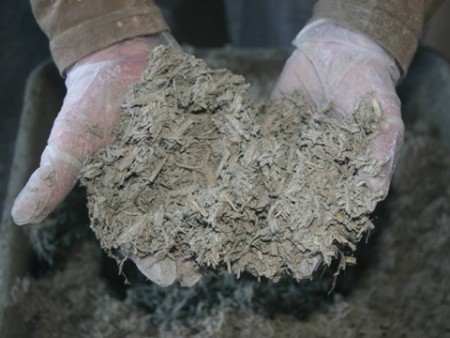
 Across industrial hemp supply chains, one of the most discussed downstream outlets for processed hurd and fiber is hemp-lime composite, widely called hempcrete. Unlike ordinary portland-cement concrete, typical hempcrete mixes bind hemp shiv with hydraulic lime or lime-cement binders to form a lightweight, vapor-permeable mass used chiefly as insulating infill around a structural frame—not as primary structural “concrete” in the engineering sense.
That distinction matters for buyers, insurers, and code officials: hempcrete’s value proposition is usually framed around embodied carbon, moisture buffering, and acoustic damping, with fire performance debated in the same breath as any bio-based assembly. Because code acceptance depends on assembly testing, jurisdiction, and the specific mix design, neutral coverage should separate general material behavior from project-specific approvals.
Context
Hempcrete sits in a broader push to diversify industrial hemp markets beyond fiber and grain. The U.S. Department of Agriculture oversees the domestic hemp production framework that can influence how consistently raw materials are grown and handled before processing, even though building products themselves are not “farm programs” in the narrow regulatory sense. Operators evaluating hempcrete should trace hurds quality, binder chemistry, mixing, placement, and curing as tightly as they trace genetics in the field.
In relation to conventional systems, comparisons are clearest when you name the functional layer you are replacing: hempcrete commonly substitutes for portions of stud-cavity insulation plus sheathing air barriers in some designs, or complements mass-timber or steel frames. Versus ordinary concrete, hempcrete is far less dense and much lower compressive strength, but it can contribute to hygrothermal buffering in ways dense mineral concrete does not. Versus petrochemical foams, hemp-lime mixes generally avoid blowing agents tied to high global-warming-potential categories in many conventional foam products, while introducing moisture-chemistry and installer-skill constraints that affect durability if details are wrong.
- Structural role: carry gravity loads with an engineered frame; hempcrete stabilizes, insulates, and can improve airtightness when detailed correctly.
- Moisture: permeable assemblies can be beneficial or risky depending on climate, rain screens, and interior conditioning—professional energy and hygrothermal review is normal at this stage of market adoption.
- Supply chain: binder sourcing, local shiv availability, and trained crews often matter as much as farm yield for delivered cost.
What it means
For stakeholders—farm cooperatives, processors, architects, and general contractors—hempcrete’s near-term story is less about a single “breakthrough” product line and more about gradual normalization alongside other low-carbon envelopes. Second-order effects include seasonal production smoothing if hurd can be contracted into predictable offtake agreements, and workforce training because site practices differ from conventional batt-and-drywall rhythms.
Fire behavior is where cautious language is essential. Many lime-bound bio-aggregate systems are discussed in terms of limited combustible contribution and char formation compared with some foam plastic insulations, but real-world performance is assembly-dependent (thicknesses, coatings, joint details, concealed spaces, and exterior exposure). Code pathways may rely on testing and equivalency arguments, not on a one-line claim that a named mix is “fireproof.” Insurers and authorities having jurisdiction often ask for test reports, engineering judgment, and observed field performance history, which varies by country and project type.
What to watch next: movement toward repeatable mix designs, transparent environmental product disclosures where available, and more public documentation of large-project approvals that reduce perceived novelty risk for lenders. Trade participants should assume procurement due diligence will tighten as volumes grow, similar to other emerging biomaterials.
Verification & sources
This article relies on widely repeated building-science descriptions of hemp-lime composites and on the need for assembly-level evidence in code work; it does not cite proprietary test data for a specific commercial mix because such numbers can change batch-to-batch and project-to-project.
Authoritative anchors readers can use to ground further research include the USDA Agricultural Marketing Service hemp regulations overview (for understanding how hemp crops fit the federal production context in the United States), the National Institute of Standards and Technology as a portal to measurement science relevant to material characterization, the National Fire Protection Association for how fire safety concepts and codes are communicated in the U.S. ecosystem, and ASTM International as a standards-development venue where construction materials testing methodologies are commonly centralized.
Uncertainty flags: regional codes differ; “hempcrete” is not one formula; binder selection changes density, strength, and hygrothermal response; published academic and industry case studies exist globally but should be interpreted with climate and detail differences in mind rather than as universal proof of performance.
Editorial standards
Hemp.com publishes industrial hemp information for professionals and curious readers. When markets are fast-moving, we prioritize transparent sourcing, defined terms, and explicit limits over sweeping claims. We do not provide engineering sign-off: always retain qualified architects, structural engineers, fire consultants, and code specialists for permitting and life-safety decisions.
If a supplier asserts exceptional fire ratings, energy performance, or carbon numbers, ask for third-party test reports, scope limits, and product-specific environmental declarations. If we learn material facts change—new code adoptions, withdrawn claims, or corrected technical guidance—we update articles and note corrections in line with our editorial practices.
This piece is informational about building materials and supply chains; it is not medical advice and does not address cannabinoid products or consumption.
Explore further
On Hemp.com, readers new to upstream basics may want to revisit explainers on hemp fiber and hurd processing, quality grading, and market channel development, because hempcrete economics usually hinge as much on consistent shiv supply as on jobsite technique. For industrial operators, the site’s directory can help you locate processors, regional suppliers, and trade services—use it as a starting point for due diligence, then confirm capabilities with references and, where relevant, material safety data and third-party certifications tied to the exact product line you intend to specify.
If you are researching fire topics alongside hempcrete, treat fire safety as a systems question: assemblies, penetrations, cladding, and occupant egress matter as much as insulation chemistry. When independent deep dives are appropriate, cross-check guidance from institutions such as NIST and code-oriented organizations such as NFPA, and keep USDA production context in view via USDA AMS hemp information.
Find suppliers
Browse verified industrial hemp businesses in the Hemp.com directory.