
Hemp Companies are making moves…
What changed: After a decade-long reset from early “CBD boom” turbulence, credible industrial hemp work is consolidating around measurable outcomes buyers actually pay for—fiber cleanliness and consistency, audited food-processing lanes for grain, and materials that survive building codes and factory trials.
Why it matters now: Procurement teams hate unknown quality and unknown liability. Operators that pair traceable raw supply with repeatable processing—not just acreage anecdotes—earn contracts. That dynamic shapes who gets banked, who gets prioritized by brands, and which geographies stabilize as exportable supply nodes.
Who is affected: Hemp growers (contract incentives and acceptance specs), processors (capital intensity and uptime), industrials sourcing natural fibers (nonwovens, composites, construction), insurers and lenders (collateral and performance risk), and state regulators licensing cultivation and handling under USDA-domestic hemp production rules.
This brief is a selector’s watchlist, not a stock pick or completeness claim—built for executives who need plausible counterparties plus the policy and data scaffolding to diligence them.
What happened
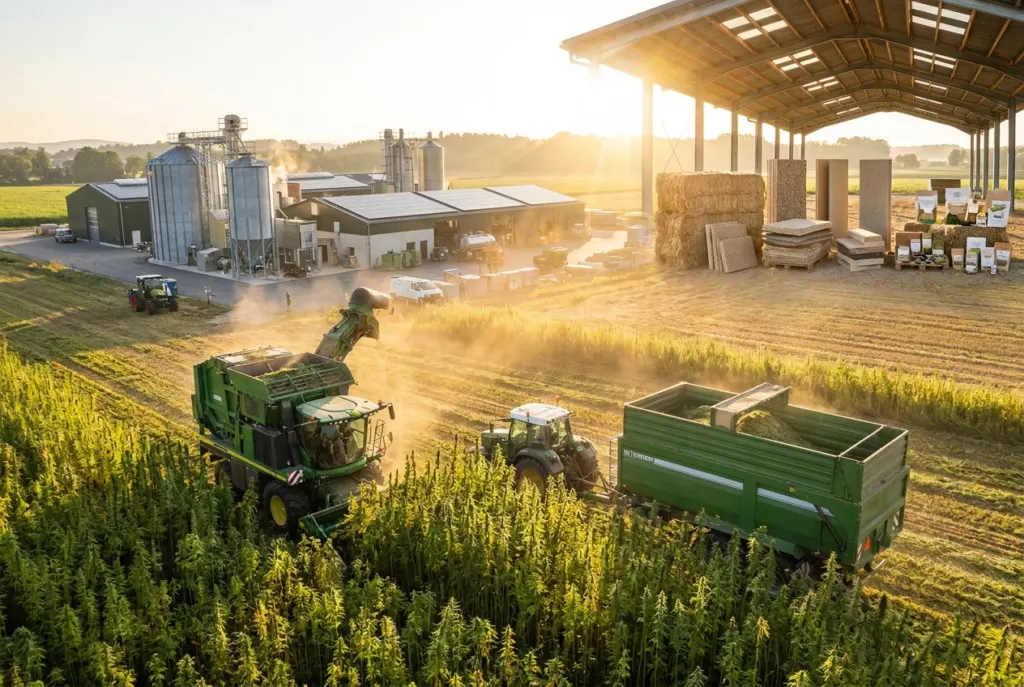
U.S. industrial hemp was re-legitimized for commercial cultivation under successive federal frameworks, culminating in domestically administered licensing and hemp definitions tied to THC limits under the USDA’s hemp program summarized at Agricultural Marketing Service. In practice, the market split into loosely connected lanes: floral/raw cannabinoid supply (highly regulated and volatile), grain/food ingredients (GFSI-type expectations often apply when selling into major channels), fiber/hurd commodities (equipment- and logistics-heavy), and advanced materials/composites where specifications dominate.
In Europe, industrial hemp never fully “re-started” the way the U.S. did; instead, long-standing fiber supply chains and trade associations continued to normalize hemp alongside flax—visible in institutional coordination bodies such as The Alliance for European Flax-Linen & Hemp.
Narrative for 2024–2026: The story is less about headlines and more about facility economics—large virgin capacity must clear quality gates, farmer programs must pencil at basis levels processors can hedge, and brands must tolerate batch variation while suppliers improve carding/decortication and cleaning.
Market impact
Processors as price-setters: When fiber throughput is scarce, converters accept premia for reliability; when gin capacity ramps, basis pressure shifts upstream unless offtake diversifies beyond a narrow set of SKU trials.
HempFlax (Netherlands / broader European sourcing footprint): HempFlax publicly positions itself as an industrial-scale hemp fiber supplier with diversified applications (automotive/industrial composites, construction-adjacent uses, horticulture substrates, textiles, nutrition categories per its taxonomy). Strategically, HempFlax functions as continent-scale fiber credibility for EU procurement teams benchmarking American startups—useful reference material is on its industrial applications pages, but buyers should validate lots against their own QA protocols.
IND HEMP (Montana grain + fiber footprint): IND HEMP markets an integrated hemp seed/grain pathway alongside fiber-processing capability on a Montana campus framing (public materials highlight Fort Benton operations and SQF-aligned food pathways for oilseed/hearts-style products alongside fiber refining). Regulatory context sits under Montana’s state hemp program summarized at Montana Department of Agriculture; diligence should focus on Organic/Kosher/non-GMO claims applicability by SKU and contractual specifications for inbound biomass.
Panda Biotech (Texas large-format fiber gin): Panda Biotech emphasizes very large virgin processing capacity oriented to industrial bast fiber derivatives; it issued a commercial-operations commencement announcement tied to its flagship gin in Wichita Falls (Business Wire, April 3, 2024). For procurement, the operative question is not headline scale alone but run-rate quality consistency, logistics windows, indemnities, and which derivative grades are production-stable versus pilot-grade.
Fibonacci / HempWood (engineered lignocellulosic lumber substitute): HempWood commercializes hemp stalk feedstock into lumber-style products for interiors; trade coverage of its Kentucky ramp provides third-party corroboration of early manufacturing milestones (example: opening coverage in Woodworking Network). Investor and buyer diligence should emphasize moisture management, VOC profiles for binders/adhesives (by SKU), hardness/abrasion performance vs. incumbent species boards, and regional fiber contracts.
Hempitecture (hemp insulation + hempcrete systems): Hempitecture focuses on low-VOC cavity insulation/hemp-building materials anchored in repeatable SKUs distributors can quote—critical because building-products markets punish SKUs that break code review cycles. Evaluate thermal resistivity claims by assembly (not slogan), fire and smoke propagation testing by assembly, sourcing chain-of-custody, and stocking lead times via product documentation on Hempitecture’s product overview.
Bast Fibre Technologies (technical hemp fibers—often nonwoven substitution plays): BFT advertises mechanically processed hemp fibers formulated for hygienic/nonwoven substitutes (see brand positioning pages such as BFT Hemp / Sero). Procurement teams should map claims to compostability/certification applicability category-by-category because retail wipe and hygiene channels have sharp compliance edges.
Eco-Technilin (European natural-fiber composites): Eco-Technilin markets semi-finished natural-fiber composites (hemp/flax/kenaf families) oriented to thermocompression, infusion, RTM-style industrial workflows (composite lineup overview). For automotive/industrial laminators, diligence centers on fiber orientation control, VOC from resins partner-side, recycling pathways, and lot-to-lot mechanicals.
Expert analysis
Three procurement lenses separate signal from novelty:
- Specification discipline: Industrial buyers pay for certs, test matrices, incident response, and change control—not “bio” vibes.
- Baseload vs. blockbuster: Surviving models usually combine one steady commodity lane (grain, hurd, bast for defined industrial uses) with one higher-margin differentiated lane (engineered insulation, composites, specialty nonwovens).
- Jurisdiction realism: Montana’s hemp program documentation is illustrative of licensing cadence burdens that shape contract windows for regional aggregators (MDA hemp hub).
Trade-offs are structural: Large gins amortize capex fastest when farmers receive predictable schedules and rejects are explicit; vertically integrated campuses absorb margin but multiply operational risk across food-grade and fiber-grade housekeeping silos.
Neutral stance on intoxicating outcomes: This briefing intentionally avoids extrapolating from floral cannabinoids into industrial channels—different compliance surfaces, buyers, and price discovery.
Portfolio angle (non-prescriptive): Institutional investors rarely “buy hemp”; they finance throughput certainty. That pushes diligence toward uptime, bottleneck equipment spares, working-capital cycles tied to hemp’s harvest concentration, and whether management can survive one bad agronomic season without covenant strain.
Industry context
U.S. policy spine: USDA AMS maintains the authoritative regulatory framing for domestically cultivated hemp—including licensing concepts and THC testing expectations—summarized publicly at Hemp Rules & Notices. States implement approved plans; operational friction (sampling turnaround, interstate movement nuances, handling licenses) swings contract economics.
Statistics silos your finance team cares about: Federal surveys separate hemp disposition into buckets such as floral, grain, fiber, and seed classifications—critical because pricing and inventories are not fungible across those buckets. The survey gateway is outlined by USDA NASS Hemp Production inquiry documentation, with dissemination via ESMIS report pages including the recurring National Hemp Report listings.
Industrial reality check: Fiber markets reward standardization comparable to incumbent bast fibers—carding impurities, lignin residuals, microbial loads, moisture, and pesticide/MRL traceability kill deals quietly long before CEOs issue press releases.
Future implications
Baseline scenario (“digestion”) through 2026–2028: New capacity emphasizes yield learning curves; growers see tougher acceptance thresholds; buyers insist on audited chains for food and documented mechanical properties for composites.
Upside scenario (“platform pull”): One major nonwoven or automotive laminator standardizes hemp blends at measurable blend ratios; European fiber majors partner or toll-process for U.S. startups to stabilize exportable grades.
Downside scenario (“basis shock”): A production miss at a marquee gin concentrates regional defaults; lending tightens across the sector hurting smaller decorticators without contracted offtake.
Watch items: USDA report revisions impacting benchmarked acre-by-type trends; AMS weekly/industry reporting rhythms useful for tactical buyers; Montana licensing cycles affecting IND HEMP’s regional aggregator model; composites qualification timelines with Eco-Technilin-style suppliers; Hempitecture scale if code adoption spreads for hemp-lime/hemp insulation assembles.
Data & metrics
Recommended “metric anchors” readers can verify (do not treat any company marketing figure as industry truth until tied to a third-party test report or audited financial):
- Federal structure: Use USDA NASS publication landing pages (example listing: National Hemp Report (ESMIS)) to compare year-over-year planted area and production by hemp type—this is the cleanest macro sanity check for “is fiber actually scaling on paper?”
- Commercial milestones: Track PR-verified commissioning dates (e.g., Panda’s April 2024 commercial-operations notice) against subsequent customer references and repeat orders—PR marks start, contracts mark durability.
- Regulatory throughput: State program mechanics (Montana hemp hub at agr.mt.gov/hemp) inform realistic contracting windows vs. agronomic calendars.
Visualization prompt for editors: A dual-axis chart juxtaposing federally reported hemp category production (fiber vs. grain vs. floral classifications, sourced from USDA releases) beside a qualitative “capacity announcements” timeline would highlight when steel-in-the-ground preceded—or lagged—reported biomass flows.
Verification & sources
Primary regulatory sources: USDA AMS hemp program overview (ams.usda.gov/rules-regulations/hemp) and USDA NASS hemp survey documentation (nass.usda.gov/…/Hemp/).
Macro series access: National Hemp Report listings via USDA ESMIS publication pages (example: ESMIS National Hemp Report entry dated 2025-04-17).
State program reference (case study): Montana industrial hemp program hub (agr.mt.gov/hemp).
Company and trade literature: corporate sites for HempFlax, IND HEMP, Panda Biotech, HempWood, Hempitecture, Bast Fibre Technologies, Eco-Technilin; third-party trade piece on HempWood facility context (Woodworking Network); Panda milestone via Business Wire.
European institutional context: Alliance portal (allianceflaxlinenhemp.eu).
Limits: corporate pages can lag operations; press releases are issuer-authored; this article does not reproduce proprietary test reports or forward financials.
Editorial standards
Hemp.com publishes industrial intelligence for education and business planning—not individualized investment, legal, agronomic, or medical advice. This watchlist is editorially selected; absence of a company is not a negative signal unless explicitly stated.
Corrections: If facility status, certification scope, or leadership changes after publication, Hemp.com will correct material facts when verified with primary documents (company filings, regulator notices, or dated third-party reporting).
Monetization & directory disclosure: Hemp.com may operate supplier directories, partnerships, or sponsored placements elsewhere on the site; this editorial brief is written to stand alone. When directory listings or paid placements relate to named entities, those relationships should be disclosed on-page per Hemp.com’s standards.
Rumor discipline: Unverified social claims, anonymous “whale orders,” and uncited acreage figures are excluded by design.
Explore further
Directory utility: procurement teams should cross-check counterparties against Hemp.com’s supplier/directory listings and request facility audits where food-grade pathways or engineered materials claims apply—starting from the site homepage at hemp.com.
Find suppliers
Browse verified industrial hemp businesses in the Hemp.com directory.