
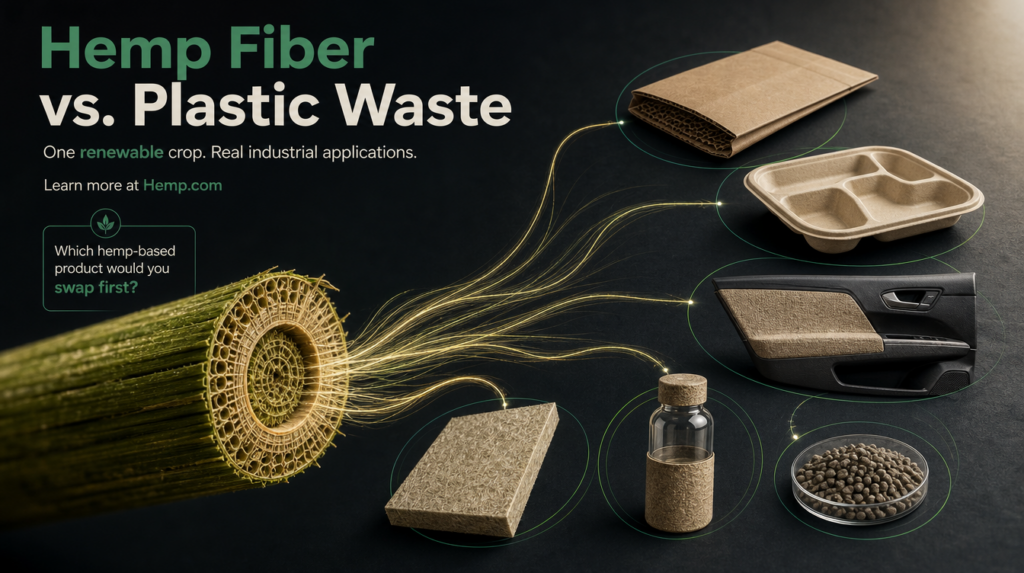
Every year, the world generates hundreds of millions of tonnes of plastic waste—and a large share never reaches a recycling bin. Packaging, consumer goods, and short-lived products dominate the stream, while mismanaged waste continues to leak into land and waterways.
That pressure is pushing manufacturers toward renewable feedstocks. Industrial hemp—grown for fiber and cellulose, not intoxicating compounds—is increasingly discussed as one input for biodegradable packaging, molded composites, and certain bioplastic blends designed to reduce reliance on fossil-based resins.
The idea is straightforward: replace part of the petroleum in everyday materials with a fast-growing crop that can be processed into fibers, fillers, and cellulose-rich fractions. Hemp will not replace all plastics. But in specific applications, it is already moving from lab bench to supply-chain conversations.
Why this matters now
Plastic waste is not a future problem—it is a present manufacturing and policy problem. Global analyses estimate roughly 300 million tonnes of post-consumer plastic waste were generated in 2023, with a significant portion still mismanaged rather than recycled. The OECD has warned that without stronger policy action, plastic waste volumes could roughly triple by 2060.
Regulation is catching up. The European Union’s Packaging and Packaging Waste Regulation entered into force in 2025, with core design and documentation requirements beginning in 2026 and recyclability targets ramping toward 2030. Brands exporting into major markets now face tighter scrutiny of packaging design, recycled content, and end-of-life performance—not just marketing claims.
That creates a window for industrial hemp. Packaging engineers, automotive suppliers, agricultural processors, and sustainability teams should pay attention now—not because hemp is a magic substitute, but because renewable fiber inputs are being evaluated alongside recycled resin, redesign, and reuse systems as part of a broader materials shift.
Did you know?
Hemp’s role in the plastics conversation is more industrial—and more surprising—than most people expect:
- Hemp fiber can reinforce bioplastics, not just replace them. U.S. Department of Energy–supported research documented hemp bast fiber mats laminated with polylactic acid (PLA) to produce fully bio-based composite panels intended as biodegradable alternatives to some synthetic fiber-reinforced plastics. (OSTI)
- Automotive suppliers are already using hemp in interior composites. FORVIA’s NAFILean line blends roughly 20% natural hemp fiber with polypropylene for lighter, lower-carbon interior components—an example of hemp entering high-volume manufacturing, not just niche packaging. (FORVIA)
- North American firms are shipping hemp-based panels and pellets today. BioComposites Group produces natural-fiber composites for automotive interiors and compostable hemp-fiber insulation used in cold-chain and e-commerce packaging—showing fiber applications beyond “plastic replacement” headlines. (BioComposites Group)
- USDA researchers are actively developing hemp fiber packaging foams. A current USDA Agricultural Research Service project targets fiber-based cushioning and insulative foam packaging made from cellulosic feedstocks including hemp—an area where petroleum foams are notoriously hard to recycle. (USDA ARS)
- “Biodegradable” depends on conditions—not slogans. Many hemp-blended materials are designed to break down faster than conventional plastics under specific compost or landfill conditions, but performance varies by formulation, thickness, and local waste infrastructure. EU policy also limits where compostable plastics can be marketed, restricting them to applications where they deliver real environmental benefit.
- Hemp grows fast enough to matter in carbon accounting conversations. Industrial hemp is often cited as a rapid-growing crop that captures CO₂ during growth; suppliers use that lifecycle logic when positioning fiber composites against heavier, fossil-intensive materials—though exact sequestration figures depend on farming practices and processing.
Industry proof
The evidence base for hemp in plastics-adjacent markets is still emerging, but several threads are converging.
On the waste side, macroplastic emissions remain enormous. A 2024 Nature study estimated roughly 52 million tonnes of macroplastic waste entered unmanaged systems globally in 2020—underscoring why material substitution alone cannot solve leakage without better collection and design. (Nature)
On the materials side, peer-reviewed work continues on PLA- and PHB-based biocomposites reinforced with hemp fibers and granules for thermoforming and packaging—research focused on balancing stiffness, processability, and end-of-life behavior rather than hype. Recent studies in Biomolecules and related journals highlight how fiber size, treatment, and loading change composite performance in real manufacturing conditions.
Commercial activity is visible in automotive and logistics. Hemp-reinforced polypropylene composites are used in door panels, consoles, and structural interior parts where weight reduction supports fuel efficiency. Separately, hemp-fiber insulation panels target temperature-sensitive shipping—an application where single-use plastic foams face growing scrutiny.
What is not proven at scale: a wholesale swap of all petroleum plastics for hemp. Cost, consistent fiber quality, regional processing capacity, and compatibility with existing extrusion and molding lines remain practical constraints cited across both trade and research literature.
The future angle
Over the next 12–36 months, expect hemp to appear less as a standalone “hemp plastic” headline and more as a formulation ingredient inside broader sustainable-materials portfolios—blended with PLA, PHB, starch blends, or polypropylene where regulations and customer specs allow.
Early adopters will likely include brands facing EU packaging rules, automotive OEMs pursuing lighter interiors, and logistics firms replacing hard-to-recycle cushioning. Processors that can deliver consistent, decorticated fiber at industrial spec—and document lifecycle data—will have an edge as buyers demand traceability, not just green labels.
Research frontiers worth watching include hemp waste as filler in bio-based polymer blends, improved fiber–matrix adhesion through surface treatment, and USDA-led work on grease-resistant fiber foams for food-adjacent packaging. Breakthroughs in hemp-derived polymer chemistry remain experimental and, where published, often target high-value niches before commodity packaging volumes.
The realistic future is plural: recycled content, redesign, reuse systems, and renewable fibers—including industrial hemp—working together. Hemp’s opportunity is to earn a defined seat at that table, application by application.
Why Hemp.com
Plastic waste is a systems problem. Industrial hemp is one renewable industrial input—not a single-shot cure. Hemp.com tracks where fiber science, farming capacity, and real manufacturing meet: which applications show traction, which claims outrun the evidence, and which suppliers are building the supply chains behind the next generation of hemp materials.
If you are exploring hemp fiber, biocomposites, or packaging alternatives for your operation, start with verified use cases and qualified performance data—not miracle marketing. That is the conversation Hemp.com is built to document and connect.
Verification & sources
Plastic waste figures cited draw on global flow analyses and OECD policy projections; exact totals vary by methodology and year. Hemp composite examples reference published research (DOE/OSTI), USDA ARS project descriptions, and manufacturer product pages for FORVIA NAFILean and BioComposites Group. Biodegradability claims should always be qualified by test standard, environment, and product form—terms like “compostable” and “biodegradable” are not interchangeable. Hemp.com does not invent statistics, study titles, or URLs; where market share data for hemp bioplastics is unavailable, we describe directionally rather than quantify.
Editorial standards
This article is educational industrial hemp coverage, not medical or legal advice. Hemp.com may link to directory listings or partner resources where relevant; such relationships are disclosed when applicable. Performance claims about hemp materials reflect published research and manufacturer statements and should be validated for specific applications before procurement decisions.
Explore further
Readers exploring this topic may also follow Hemp.com coverage of hemp fiber processing, biocomposite manufacturers, sustainable packaging innovators, and U.S. industrial hemp farming trends. Our directory connects growers, processors, and materials suppliers working across fiber, hurd, and cellulose value chains—useful for teams evaluating feedstock sourcing or pilot partnerships in packaging and composites.
Find suppliers
Browse verified industrial hemp businesses in the Hemp.com directory.