
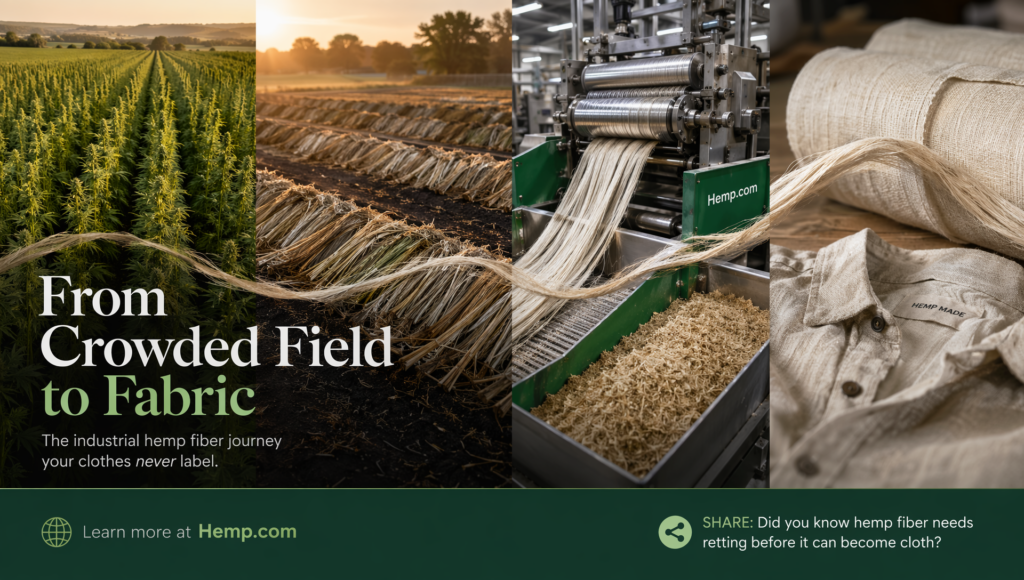
Glance at the label inside your shirt. Cotton. Polyester. Maybe a trace of spandex. What you will almost never see is the industrial journey that turns a tall stalk in a crowded field into something soft enough to wear.
That gap matters. Global textile supply chains are under pressure to cut petrochemical inputs, improve traceability, and source lower-impact fibers that still perform in mills built for cotton and synthetics. Industrial hemp keeps surfacing in that conversation—not because it is new, but because its bast fiber is among the strongest natural cellulose structures farmers can grow at scale. Yet most consumers have never seen retting windrows, a decorticator, or the difference between line fiber and tow.
This is the story of how raw hemp fiber moves from planting to fabric—and why the same plant can yield coarse insulation matting or a surprisingly refined textile, depending on choices made long before a designer picks a weave.
The Hemp Fiber Process
What is hemp fiber? Inside every industrial hemp stalk are two structurally different materials. Bast fiber—sometimes called bark fiber—runs in long bundles through the phloem, the outer vascular layer beneath the stem skin. It is rich in cellulose and prized for ropes, textiles, composites, and insulation. Hurd (also called shive) forms the woody inner core: shorter, absorbent fibers used in animal bedding, particle boards, and hemp-lime building mixes. A single stalk is a split supply chain waiting to happen. The USDA Hemp Descriptor and Phenotyping Handbook documents how researchers measure bast-to-hurd ratios because that fraction shapes every downstream market.
Stage 1 — Planting for fiber, not grain. Fiber hemp is managed differently from seed or floral crops. Growers plant dense stands in tight rows so plants compete for light, grow tall and thin, and put energy into long primary bast fibers rather than branching. Extension guidance from Rutgers, Oklahoma State University, and Purdue University commonly targets hundreds of thousands of plants per acre—often discussed in the range of roughly 800,000 to 1,000,000 plants per acre for dedicated fiber production, with row spacing measured in inches rather than feet. Seeding rates vary with seed size and germination, so experienced growers calculate pure live seed rather than copying a single bag-per-acre number.
Stage 2 — Growth and harvest timing. Fiber quality is decided in the field. For textile-oriented production, the Canadian Hemp Trade Alliance advises cutting when male plants shed pollen and before seed set on female plants—when bast fiber is not yet heavily lignified. Delay harvest, and fiber coarsens. Purdue similarly notes harvest around early flowering when pollen release is visible. Dual-purpose grain-then-fiber systems exist, but fiber-only contracts typically sacrifice grain income for finer bast quality.
Stage 3 — Retting: controlled biological separation. Cut stalks are laid in windrows for field retting (dew retting)—a microbial process that degrades pectin and other binding compounds so bast bundles can separate from hurd. The USDA Economic Research Service describes retting as essential for textile-grade fiber and notes that farmers must monitor moisture and drying closely: too little retting leaves fiber glued to the core; too much weakens the cellulose. Under favorable weather, industry guides cite retting windows on the order of two to five weeks, with turning recommended for thick windrows destined for apparel. Water retting can yield more uniform fiber but requires tanks and carries higher capital and environmental costs—reason most North American growers rely on field methods.
Stage 4 — Drying, baling, and transport. Once retting is judged complete—stalks shifting from green toward pale gold—hemp is dried and baled for transport to a central processor. CHTA guidance warns against baling overly wet stalks, which can continue uncontrolled retting inside the bale and destroy quality. At this point the crop is still straw, not yarn.
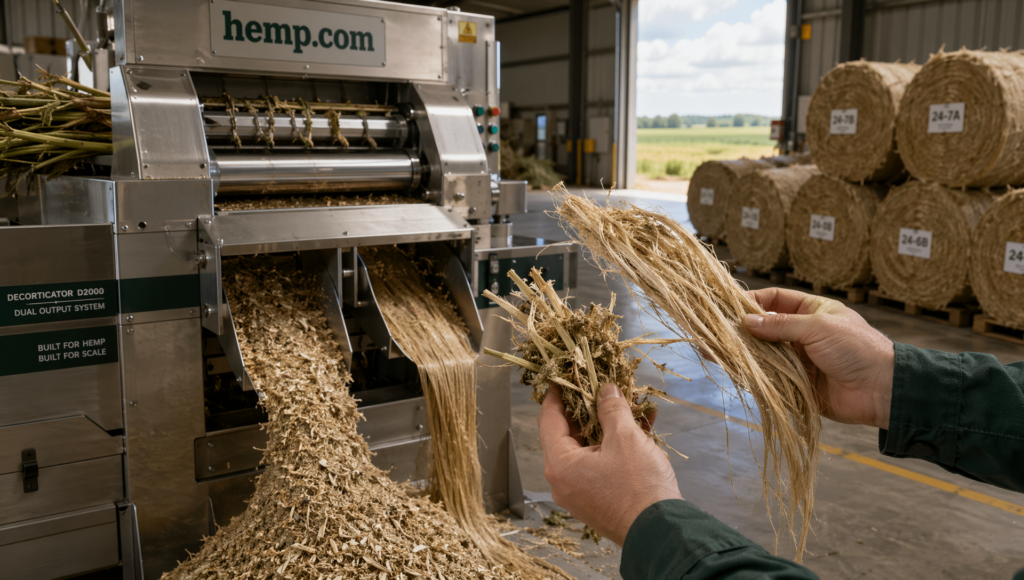
Stage 5 — Decortication and fiber cleaning. At the mill, stalks enter decortication equipment that crushes and separates bast from hurd. Traditional flax-era workflows also use breaking rollers, scutching beats, and hackling combs to remove hurds and align long line fiber while collecting shorter tow. Modern lines integrate these steps, but the logic is unchanged: mechanical stress separates bundles. As reviewed in peer-reviewed textile-processing literature, decortication alone typically produces fiber bundles still glued together with lignin and pectin residues—usable for mats and technical nonwovens, but not yet shirt-ready.
Stage 6 — Refinement for textiles. Apparel pathways add degumming (chemical, enzymatic, or mechanical purification) to loosen fiber bundles into finer elements, followed sometimes by cottonization—mechanical shortening and softening so hemp can run on cotton spinning frames. The result may be blended with organic cotton or lyocell for hand-feel, then spun into yarn, woven or knitted into fabric, washed, and cut into garments. What began as a crowded summer field ends as a labeled bolt of cloth—if, and only if, every upstream decision aligned with textile specifications.
But did you know this about Hemp Fiber?
Here is the shareable pivot: the same hemp stalk can become either a scratchy technical mat or a wearable textile, and the fork happens before any factory lights turn on. Coarse fiber is not a separate species—it is often the same bast bundles harvested late, under-retted, over-retted, or decorticated without degumming. Lignification increases as plants mature past pollen shed; aggressive field retting without turning can rot bottom stalk layers while tops remain under-processed; and decortication without follow-up purification leaves stiff, impurity-heavy bundles that feel nothing like cotton.
Soft, consistent apparel fiber therefore behaves less like a commodity grain and more like a manufacturing specification carried backward through the supply chain. Textile buyers are effectively buying a protocol: cultivar, plant density, harvest date, retting degree, hurd contamination limits, and fineness after processing. That is why two farms in different counties can grow “hemp fiber” that performs differently in the same loom—and why the industry is racing to name those differences with standards instead of anecdotes.
Impact on the Hemp Industry
Farmers need contracted harvest windows and retting protocols matched to end use. A stalk grown for hurd insulation can be cut later and baled with less retting; a textile contract may require pollen-stage cutting, turned windrows, and penalties for weed seed contamination in bales.
Processors and mill investors sit at the bottleneck. Decorticators are capital-intensive; degumming and cottonization lines are rarer still. Without regional aggregation, small lots from many farms cannot justify continuous mill runs—one reason fiber hemp acreage can grow faster than wearable fabric supply.
Brands and manufacturers chasing lower-carbon materials must reconcile hemp’s sustainability story with performance specs. Blended hemp-cotton jerseys are common partly because pure hemp yarn still varies in fineness and staple length. Consistency is a product-design variable, not a marketing footnote.
Standards bodies and USDA researchers are defining the common language the market lacks. A multi-institution USDA ARS project on industrial hemp fiber and hurd standards aims to characterize length, strength, color, fineness, and non-fiber content, while ASTM work on hemp fiber measurement methods moves toward trade-grade test protocols. Until those grades circulate commercially, buyers and growers negotiate quality verbally—fragile ground for scale.
More Hemp Facts- Did you know?
- Industrial hemp stalks contain two commercial fiber types—long outer bast and short inner hurd—that feed different product lines from the same harvest.
- Fiber hemp is often planted at dense populations (commonly discussed around 800,000–1,000,000 plants per acre in U.S. extension guides) to produce tall, thin stalks with longer primary bast fibers.
- Retting is a microbial process, not washing: field moisture and temperature degrade pectin so bast separates from hurd before decortication.
- Textile-oriented harvest typically targets early flowering/pollen shed; delayed cutting yields coarser, more lignified fiber suited to industrial—not apparel—uses.
- Decortication alone rarely produces shirt-ready fiber; degumming and cottonization are often required before hemp runs on conventional cotton spinning equipment.
The industry is changing
If you now think about retting windrows when you pull on a tee (the moment when the rake passes through the hemp stalks and the tines engage), you are ahead of most apparel supply-chain conversations. Industrial hemp fiber is not waiting for discovery—it is waiting for coordination: shared grades, regional processing hubs, and cultivars bred for predictable bast content rather than experimental acreage.
Watch three signals over the next few seasons. First, whether USDA and ASTM fiber standards show up in commercial contracts—not just research papers. Second, whether brands publish harvest and retting specifications alongside fiber content percentages on hang tags. Third, whether dual-purpose grain-plus-straw systems give way to dedicated fiber corridors with documented quality bands. The crop already knows how to grow; the market is still learning how to speak the same language from field to fabric.
Why Hemp.com
Hemp.com documents this transition as it happens—mapping planting guides, processing milestones, and emerging fiber standards so growers, mills, and curious readers share one factual timeline. Industrial hemp is not a wardrobe gimmick or a cannabis sidebar; it is a cellulose engineering pipeline older than modern polyester and newly relevant to every brand rethinking what its clothes are made from.
Editorial standards
Hemp.com presents industrial hemp fiber as an agricultural and manufacturing material, not a medical product or legal workaround. This article does not promise that hemp clothing cures environmental harm, outperforms all synthetics in every use case, or delivers guaranteed farm profitability. No named individual quotes were invented. Where the U.S. fiber apparel supply chain remains thin relative to cultivation interest, that limitation is stated directly rather than smoothed over.
Explore further
Continue on Hemp.com with coverage of hemp farming, decortication facilities, textile innovators, and state extension resources linked from our directory. If you grow, process, or source industrial hemp fiber, a directory listing helps readers find verified partners across the supply chain. Disclosure: directory placements and partner links may be monetized; this article’s process summary was prepared independently of those relationships.
Find suppliers
Browse verified industrial hemp businesses in the Hemp.com directory.