
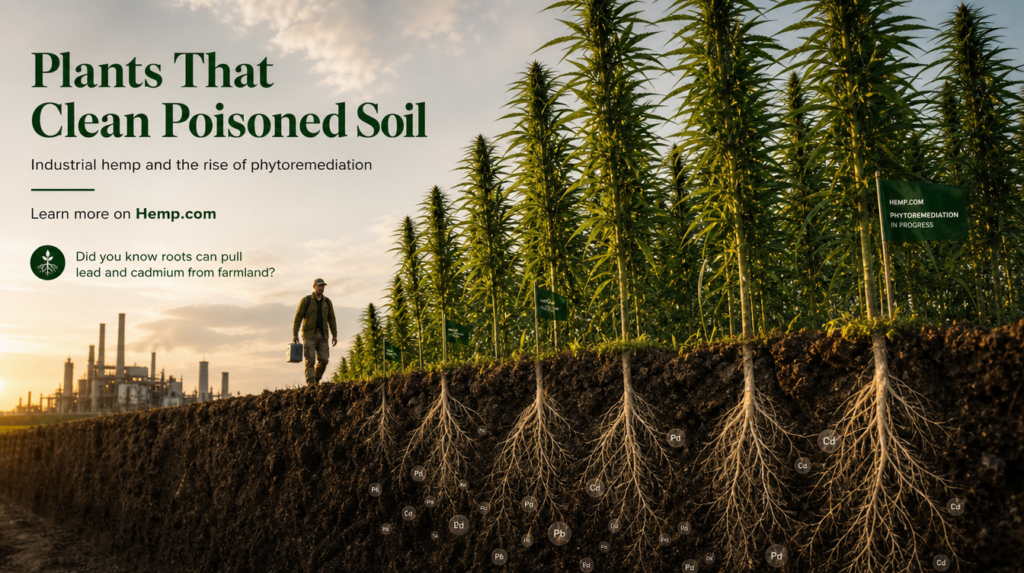
Every year, industrial runoff, legacy mining, and decades of chemical agriculture leave behind a quiet crisis: soil that still holds lead, cadmium, nickel, dioxins, and solvents long after the factory gate closes or the crop fails. Excavating and trucking that dirt away can cost millions, scar the landscape, and simply move the problem somewhere else. Phytoremediation offers a different logic — let living plants do the work on-site, powered by sunlight, pulling contaminants into roots and shoots or locking them in place while roots hold the soil together.
The U.S. Environmental Protection Agency defines phytoremediation as the direct use of green plants for in-place risk reduction in contaminated soil, sediment, sludge, and groundwater through removal, degradation, or containment. It is not magic and it is not instant. But on large, shallow, low-to-moderate contamination zones — the kind scattered across brownfields, former military land, and exhausted farmland — plants can begin cleanup without bulldozers, and industrial hemp is emerging as one of the most versatile candidates in the toolbox.
Why Hemp for Phytoremediation
At its core, phytoremediation is biology applied as infrastructure. Different mechanisms handle different pollutants. Phytoextraction draws metals and some radionuclides into plant tissue for harvest and safe disposal. Phytostabilization keeps contaminants from migrating through wind, rain, or groundwater. Rhizodegradation uses root-zone microbes to break down organic compounds like solvents and petroleum residues. Phytovolatilization releases transformed compounds through leaves in forms that may be less harmful — a pathway used carefully and only where monitoring supports it.
For decades, cleanup crews reached first for concrete caps and dig-and-haul contracts. Phytoremediation flipped the question: what if the remediation itself could be a crop cycle? Sunflowers drew early attention near Chernobyl. Poplars and willows anchored Superfund sites across the United States. Switchgrass and Indian mustard entered the research literature. Then scientists began testing industrial hemp — Cannabis sativa bred for fiber and seed, not drug potency — and the case grew stronger with every field season.
Researchers at the USDA Agricultural Research Service and in peer-reviewed journals have documented hemp’s deep root system, tolerance to heavy-metal stress, and ability to produce large above-ground biomass even on marginal ground. Studies from contaminated soils — including material linked to the Tar Creek Superfund area in Oklahoma — show hemp taking up cadmium, lead, and zinc, with uptake varying by soil chemistry, contamination level, and cultivar. Italian field trials near Mount Etna tested hemp varieties against cadmium, lead, and nickel in polluted soils, finding tolerance at levels that would halt many conventional crops. Hemp does not win every matchup against every toxin. No single plant does. But its combination of depth, speed, hardiness, and downstream material potential is unusually strong.
That last point matters for economics. Traditional remediation bills the landowner for destruction. Hemp phytoremediation opens a parallel question: can fiber, hurd, or carefully managed non-food biomass help offset the cost of growing a cleanup crop? In Taranto, Italy — where dioxin and heavy-metal fallout from the ILVA steel complex devastated local agriculture — farmers including Vincenzo Fornaro turned to legal industrial hemp after livestock herds were culled due to soil contamination, as reported by CBS News. The goal was not a headline. It was to hold the land, pull toxins upward through roots, and explore whether stalks could enter non-food supply chains while contaminated leaves and roots were managed separately.
The surprising insight-The Hemp Solution
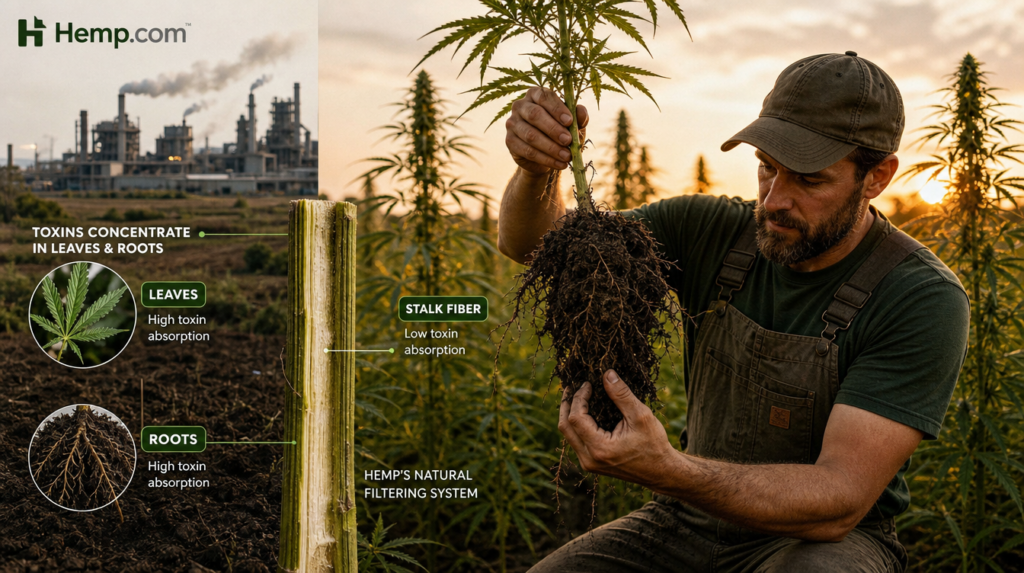
Here is the detail most people miss when they first hear “hemp cleans soil”: the plant often concentrates heavy metals in roots and leaves, not necessarily in the bast fiber farmers want for textiles, paper, and building materials. Research summarized in Italian phytoremediation projects around the ILVA site notes that after removing apical growth and roots, stalk cellulose can be processed for non-food uses while the most contaminated plant parts are segregated. That changes the business model. You are not just growing a filter — you are potentially growing a renewable industrial feedstock on land too damaged for food production, turning liability acreage into a materials pipeline if testing and handling protocols are strict.
Another surprise sits in the root zone itself. Hemp’s taproot can penetrate compacted, disturbed soils that shallow grasses never reach, opening channels for water, oxygen, and microbial activity. Combined with amendments such as biochar — studied in hemp trials on heavy-metal-contaminated soils — uptake of metals like zinc can improve under specific conditions. Hemp is not a universal hyperaccumulator for every element at every concentration. But its root architecture addresses a fundamental phytoremediation bottleneck: surface-only cleanup leaves deep reservoirs of pollution untouched.
Industry stakes
Who gains if hemp phytoremediation scales responsibly? Landowners with stranded acreage — former mine sites, urban brownfields, floodplain farms with legacy pesticide loads — gain a lower-cost first line of treatment that can run alongside monitoring and, where needed, mechanical methods. Industrial hemp processors and manufacturers gain access to fiber narratives tied to genuine environmental restoration, not greenwashing. State agriculture departments and extension services gain a crop that fits rotation, carbon, and rural economic development goals simultaneously.
Who must adapt? Remediation contractors accustomed to capital-intensive dig-and-haul models will need hybrid playbooks: plants for breadth and depth at shallow zones, engineering controls where contamination is extreme or groundwater is at risk. Regulators must clarify how remediated biomass is tested, transported, and destroyed or sequestered — because a hemp field that captures lead is doing its job; mishandling the harvest undoes it. Insurers, lenders, and food-system gatekeepers will demand transparent chain-of-custody rules before any remediated acre returns to edible crops.
Policy shapes speed. U.S. industrial hemp is legal under the USDA hemp program, but site-specific permits, Superfund oversight, and state soil rules still govern what can be planted where. The opportunity is global: as manufacturing reshoring, climate-driven flood recovery, and soil-health mandates converge, phytoremediation shifts from niche experiment to supply-chain prerequisite.
Did you know?
- Phytoremediation is solar-powered cleanup. The Federal Remediation Technologies Roundtable describes the method as driven by natural plant hydraulics and metabolism — no heavy machinery required for the plants themselves to begin work.
- Hemp faced the world’s most famous contamination zone early. In the late 1990s, biotechnology firm Phytotech and partners planted industrial hemp near Chernobyl to study uptake of radionuclides including cesium-137 and strontium-90. Reporting in New Scientist noted promising fiber recovery but also hard limits — much cesium remains tightly bound to soil particles, so plant cleanup alone removes only a fraction without soil amendments and repeated cycles.
- USDA scientists explicitly back hemp’s potential. An ARS interpretive summary calls industrial hemp an excellent phytoremediation candidate because of its deep roots, metal tolerance, biomass volume, and commercialization pathways.
- Real Superfund science exists. University researchers have grown hemp cultivars in heavy-metal-contaminated soils from the Tar Creek area, measuring cadmium, lead, and zinc uptake across contamination levels — evidence that phytoremediation is field-tested, not internet folklore.
- Cleanup crops need cleanup discipline. The EPA’s Citizen’s Guide to Phytoremediation notes plants work best where concentrations are low enough to sustain growth — and harvested biomass from metal-accumulating plants must be managed so contaminants are not re-released.
You saw it early
Most contaminated acreage worldwide is still treated with exclusion fences and expensive earthmoving, not living crops. Hemp phytoremediation sits at the intersection of three accelerating trends: regenerative agriculture seeking to rebuild soil function, industrial demand for low-carbon fiber and biobased materials, and regulatory pressure to restore brownfields without bankrupting communities. Genomic tools now available for Cannabis sativa may eventually breed cultivars optimized for specific metal profiles — an avenue USDA and university researchers have flagged as realistic, not speculative.
Watch for pilot programs pairing hemp with biochar, mycorrhizal inoculants, and precision soil testing; for state-level hemp-soil remediation grants; and for insurance products that recognize phased phytoremediation as legitimate site prep. The readers who understand phytoremediation today — what it is, what hemp contributes, and where the limits are — will recognize legitimate projects years before they become standard procurement language in construction, textiles, and municipal planning. You are early to a conversation that will matter for food security, factory towns, and climate-resilient land use alike.
Why Hemp.com
Hemp.com tracks industrial hemp where it intersects real supply chains — farming, materials, policy, and the science that separates durable innovation from hype. Phytoremediation is one of the clearest examples of why hemp belongs in serious industrial conversation: a fast-growing fiber crop that can begin restoring land other sectors have written off. As pilots expand from Italy’s steel country to U.S. brownfields and research plots on polluted soils, we document the methods, the markets, and the standards that determine whether cleanup crops become a cornerstone of sustainable manufacturing — or remain an underfunded footnote.
Verification & sources
Definitions and scope of phytoremediation align with U.S. EPA and Federal Remediation Technologies Roundtable materials. Hemp-specific performance claims draw on USDA ARS publications and peer-reviewed studies in journals including Plants, Agronomy, and Soil Systems (MDPI). Chernobyl-era hemp trials are described in contemporary journalism and 1990s research literature; formal published results from those specific field trials remain limited, and radionuclide binding in soil constrains removal rates — a constraint reported in Environmental Science & Technology research cataloged via OSTI. Taranto field applications are documented by CBS News, Slate, and Italian regional reporting; outcomes vary by pollutant and require ongoing monitoring. No specific removal percentages are cited for hemp except where published research supports them. Site suitability, biomass disposal, and food-chain safety must be evaluated case by case with qualified environmental professionals.
Editorial standards
This article is explanatory journalism for Hemp.com, not environmental engineering advice. We do not claim hemp cures contaminated land in a single season, eliminates all heavy metals, or replaces regulatory cleanup where human health risks are acute. Industrial hemp discussed here is fiber-and-seed cultivars governed by federal THC limits — not medical cannabis products, and not advice about consuming crops grown on polluted soil. Named individuals appear only where reported by established news organizations. We avoid invented statistics, fabricated study titles, and unverified “hemp saved Chernobyl” simplifications. Where evidence is strong — deep roots, metal uptake documented in peer-reviewed trials, USDA endorsement of research potential — we state it directly. Where evidence is mixed — radionuclide remediation efficiency, long-term field results at industrial scale — we say so in the body, not in a footnote readers never see.
Explore further
Explore Hemp.com coverage of industrial hemp farming, hemp fiber supply chains, hemp building materials, and state hemp program updates to connect phytoremediation science with the businesses that could use restored land and non-food biomass. If you operate a remediation pilot, grow industrial hemp on marginal acreage, or manufacture with hemp fiber, consider listing your organization in the Hemp.com directory so researchers, landowners, and buyers can find verified partners. For site-specific cleanup decisions, consult certified environmental consultants and applicable federal, state, and local regulations before planting any crop on contaminated soil.
Find suppliers
Browse verified industrial hemp businesses in the Hemp.com directory.