
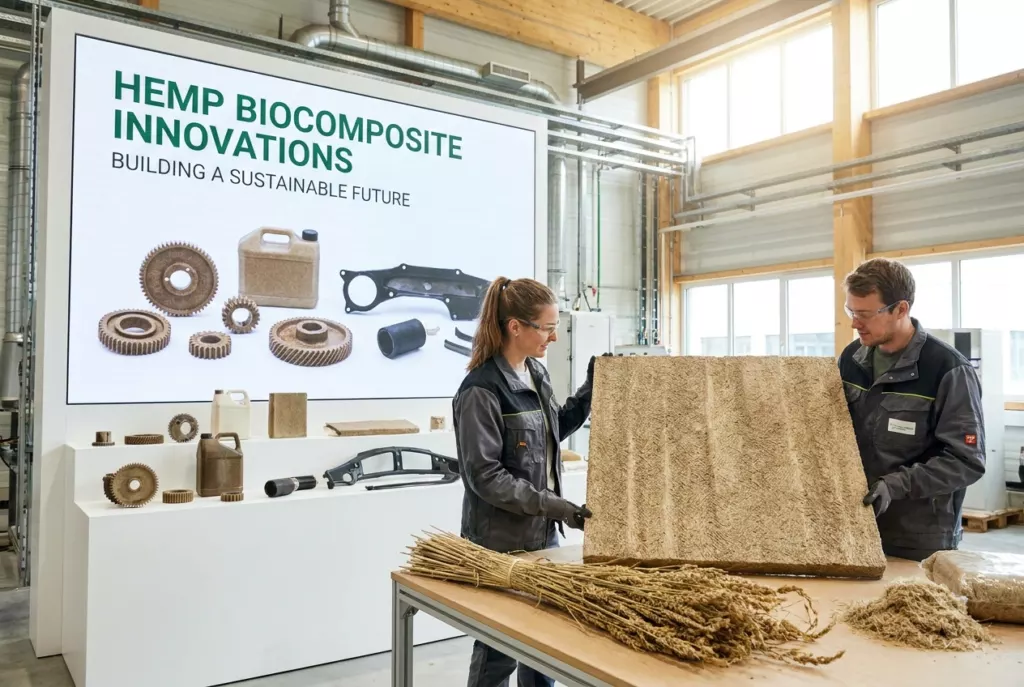
Hemp Biocomposites: Fiber Supply, Polymer Pairings, and the Path to Spec-Grade Parts
From molded panels to automotive trim, plant-fiber-reinforced polymers are an established materials strategy; hemp is one candidate feedstock in a crowded field that also includes flax, jute, and wood flour. The operational question is not whether fibers can bond to a matrix—laboratory and pilot outcomes are widely reported—but whether processors can deliver repeatable mechanical properties at plant scale and meet buyer specifications.
For hemp operators, the near-term opportunity is typically B2B: selling consistent bast fiber, optimizing retting and cleaning, and aligning moisture, length distribution, and surface chemistry with compounders. For manufacturers, the decision is total landed cost versus performance: cycle times, tool wear, odor, lot-to-lot variance, and compliance with fire, VOC, and end-of-life requirements.
This matters now because OEMs and public procurement increasingly ask for lower-carbon-intensity materials and biobased content—yet those asks translate into purchase orders only when materials pass validation gates. Hemp enters that workflow as a specialty fiber input, not as a universal plastic replacement.
Who is affected: growers and primary processors (decortication, degumming), toll compounders, injection molders, tier suppliers, capital providers underwriting drying and cleaning assets, and regulators interpreting waste, labeling, and import rules for hemp derivatives used in manufacturing.
What happened
The underlying technical story is incremental rather than a single “breakthrough moment.” Industrial hemp cultivation was reshaped in the United States by the phased federal definition and state-administered programs that matured across multiple farm bills; the governing framework for U.S. hemp production is summarized by USDA’s Agricultural Marketing Service, which is the authoritative starting point for what “hemp” means in a regulatory sense when discussing fiber streams for commerce (USDA AMS hemp regulations overview).
On the materials side, hemp bast is attractive for stiffness-to-weight in thermoplastics such as polypropylene, while hurd and short fibers can participate in wood–plastic composites and some binder systems. Commercialization usually proceeds through compounding trials: fiber treatment (coupling agents, alkalization), drying, distributive mixing, pellet quality, then molded test plaques for tensile, impact, and heat-deflection metrics. Scale-up pain points are practical—static electricity, agglomeration, moisture management, and supply seasonality—not abstract.
Verified boundaries to keep reporting honest: “hemp plastic” is not one material; it is a formulation family. Performance depends on fiber loading, aspect ratio, orientation, matrix choice, additives, and process window. Any article that implies a single universal performance envelope is misleading.

Market impact
Pricing and procurement reality. Industrial buyers rarely trade “hemp composite” as a homogeneous commodity. What moves markets is the spread between conventional filled polymer pellets and spec-grade biocomposite feedstocks once qualification is complete. Public, continuously quoted price series for hemp-specific biocomposites are limited; most contracts are private, which means diligence relies on mill certificates, trial lots, and supplier audits rather than screen prices.
Capacity and cadence. Fiber availability is seasonal; storage and drying capex can dominate unit economics for processors aiming at polymer-grade cleanliness. For compounders, the bottleneck is often consistent input quality, because a single high-moisture lot can create voids, odor, or degradation in the extruder.
Trade and standards. Cross-border shipments of processed hemp fiber raise documentation questions that differ by jurisdiction; firms model inventory and lead time conservatively. Separately, buyers increasingly ask whether a material supports biobased content claims tied to federal preference programs—where government-oriented marketing and certification pathways exist—such as the USDA BioPreferred Program hub for biobased products (USDA BioPreferred).
Investment lens. Capital tends to flow first to de-risked offtake (pilot lines with named customers) and to equipment that improves consistency (sorting, drying, surface treatment). Without those, “huge TAM” narratives rarely convert to EBITDA.
Expert analysis
A disciplined analyst frame treats hemp biocomposites as a substitution and lightweighting problem inside existing polymer value chains. The credible thesis is not that hemp replaces all plastics; it is that selected applications—non-structural panels, interior automotive components, crates, furniture elements—can absorb higher fiber loadings if lot consistency and fire/smoke testing cooperate.
Trade-offs executives actually negotiate:
- Mechanical targets versus viscosity: higher fiber loading can stiffen parts but may raise melt viscosity and threaten fill in thin walls.
- Aesthetics and odor: natural fibers can influence surface finish and volatile profiles—relevant for indoor air and brand-sensitive SKUs.
- End-of-life positioning: “biobased” does not automatically mean backyard compostable; recovery pathways depend on matrix chemistry and local recycling infrastructure.
- Insurance and liability: automotive and building products carry testing burdens; materials swaps can reset approvals.
Third-party framing from standards developers matters because commoditization follows repeatable test methods. ASTM International publishes numerous consensus standards relevant to plastics and composites broadly; ASTM is a common reference point for firms specifying test protocols and material comparisons—even when a hemp-specific line item does not exist yet (ASTM International).
Media and advocacy risk: boosters often conflate biobased feedstock with rapid biodegradation in the environment. Operators should separate polymer science claims from waste-management outcomes; confusion here is a reputational hazard.
Industry context
Hemp’s regulatory identity in the United States is farm-program-centric: fiber processing begins as an agricultural product stream subject to hemp production rules rather than consumer packaging rules until formulated into goods. That distinction influences insurance, contracts, and how firms describe intermediates in commerce (USDA AMS hemp program materials).
Policy and market silos still collide. Cannabinoid policy noise can distort non-CBD industrial narratives; fiber and hurd businesses often emphasize distance from flower markets to secure bankable relationships with industrial customers. Genetics workflows optimized for grain or cannabinoid yield do not automatically optimize bast fiber length Bark laydown—another reason agronomy and varietal selection are materials-strategy decisions, not sidebar trivia.
Fiber versus grain supply chains. Biocomposite programs typically pull from bast fiber streams; grain hemp channels matter indirectly through crop competition for acres and processing infrastructure. Facility siting decisions (power, humidity control, freight) frequently matter more than varietal branding for compounders.
Adjacent materials competition. Established natural-fiber supply chains (flax in automotive, wood flour in WPC decking) set performance baselines hemp must meet or beat on delivered cost and consistency—not on novelty alone.
Future implications
Base case: hemp grows as a niche reinforcement where regional supply clusters achieve kiln-dried, clean fiber at predictable specifications and compounders invest in process recipes. Win conditions mirror other specialty additives: fewer heroic claims, more certificates of analysis.
Upside case: OEM sustainability scorecards tighten; biobased content and embodied-carbon reporting become procurement gates; validated low-variance hemp compounds capture slots in interior modules and durable goods where weight and stiffness targets align.
Downside case: inconsistent fiber quality triggers line stoppages at molders; a few high-profile failures poison category trust; cheaper incumbent fillers win on total cost.
What to watch next: multi-year offtake pilots with public customer names, published technical data sheets with third-party test houses, regional processing hubs that shorten moisture reintroduction risk in logistics, and standards activity that reduces buyer uncertainty. Also watch whether insurance and building-product certification paths broaden for hemp-heavy formulations—those are often slower than press releases.
Data & metrics
How to read the “numbers gap.” Credible industry reporting should distinguish model estimates from verified market statistics. For hemp biocomposites, the useful metrics are operational: moisture content after drying, fiber length distribution, ash/impurity levels, pellet bulk density, and molded-part mechanical tests under ASTM-type protocols—rather than splashy market size figures that may be extrapolated from unrelated categories.
- Scanner callout — qualification cycle: many industrial materials require 12–36 months from first pellet trials to production nomination; hemp compounds are unlikely to be an exception for risk-averse buyers.
- Scanner callout — economic sensitivity: drying energy, yield loss during cleaning, and packaging to prevent re-moistening frequently dominate marginal cost; spreadsheets that ignore them misprice reality.
- Scanner callout — performance regime: fiber loading percentage is meaningless without naming matrix, coupling chemistry, and process temperatures; comparisons without that context are not decision-grade.
If Hemp.com publishes charts later, the highest integrity approach is to label series clearly—pilot plant versus commercial, region, and test method—and to avoid stitching unrelated datasets into a single slope.
Key takeaways
Executive scan:
- Hemp biocomposite adoption is a manufacturing qualification problem, not a single-material revolution.
- Commercial value concentrates in consistent fiber processing (cleaning, drying, sizing) more than in catchy product names.
- USDA anchors the U.S. hemp production definition and administers the hemp program context producers must respect when describing agricultural origin (USDA AMS).
- Procurement teams evaluate total cost, lot variance, fire/smoke behavior, and end-of-life narratives—biobased appeal is necessary but not sufficient.
- BioPreferred-style biobased positioning can matter for institutional buyers and messaging, but claims must match the actual formulated product (USDA BioPreferred).
- ASTM-style standardized testing is a lingua franca for comparing compounds responsibly (ASTM).
- Regional clustering—processor near compounder near molder—often beats long-distance “green” narratives when moisture and freight risks are modeled honestly.
- Operators should separate fiber-grade hemp supply chains from cannabinoid politics to reduce counterparty anxiety in industrial accounts.
Verification & sources
Hemp.com prioritizes institutional and primary-adjacent references over unattributed statistics. For this briefing, baseline regulatory context for U.S. hemp production is drawn from USDA AMS materials (USDA AMS hemp rules/regulations portal). For biobased product program context relevant to procurement narratives, USDA’s BioPreferred resource hub is used (BioPreferred.gov). For standardized materials testing and composites norms commonly cited in engineering workflows, ASTM International is referenced at the organization level (ASTM International).
Limits: this article does not cite proprietary customer trial data, named commercial pricing schedules, or specific peer-reviewed papers; readers should treat any external market-size statistics encountered elsewhere with scrutiny unless methodology and sourcing are visible.
Editorial standards
Hemp.com does not present materials science claims as medical advice, and it avoids implying environmental superiority without specifying test boundaries (matrix chemistry, part geometry, disposal pathway). Corrections policy: if a program name, agency pathway, or technical description becomes outdated, Hemp.com should update the page and log the change transparently.
Conflicts and monetization: directory listings, sponsored placements, and affiliate relationships—where present elsewhere on Hemp.com—are labeled for readers and do not influence the underlying technical limits described here. When Hemp.com links to suppliers, those links are for discovery, not endorsements of performance claims.
Explore further
For continued research, prioritize technical data sheets, third-party test reports, and case studies with identifiable end markets (automotive tier, building product OEM, durable goods brand). On Hemp.com, pair this briefing with upstream supply-chain explainers (decortication economics, fiber grading) and downstream application maps (WPC versus injection molding qualification).
Use the Hemp.com industrial directory to shortlist fiber processors, compounders, and molders, then qualify vendors through trial lots—not through marketing language alone: Hemp.com home and navigation.
Find suppliers
Browse verified industrial hemp businesses in the Hemp.com directory.