
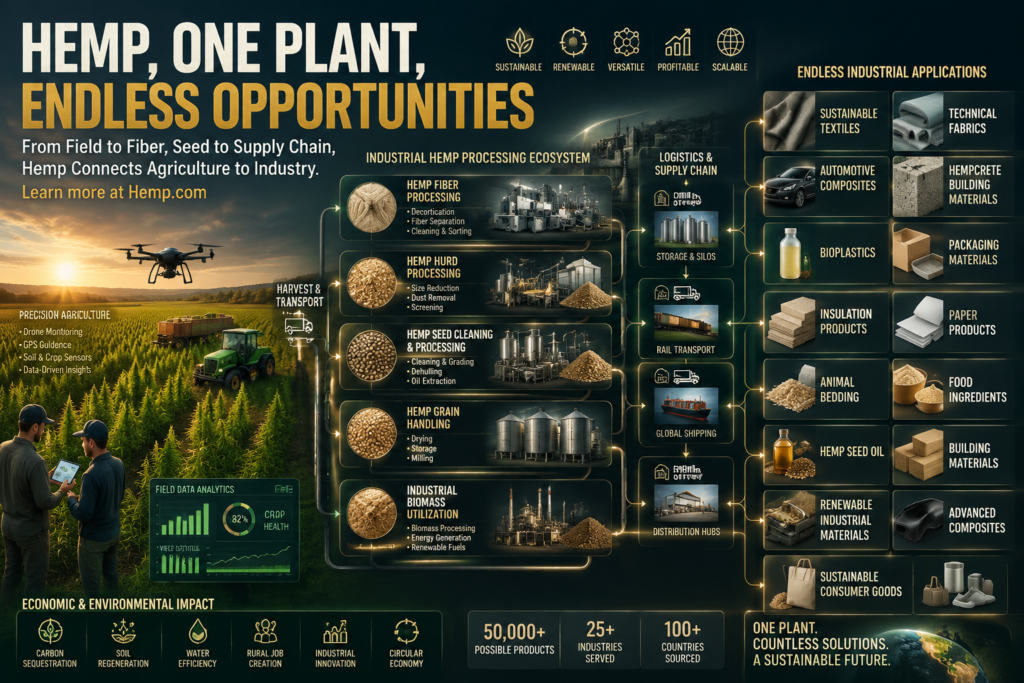
Industrial hemp—Cannabis sativa L. with no more than 0.3% delta-9 THC on a dry-weight basis—is legally distinct from marijuana under federal law and is overseen at the farm gate by the USDA Domestic Hemp Production Program. That reclassification, rooted in the 2018 Farm Bill, opened the door for growers, decorticators, and manufacturers to treat hemp as an agricultural raw material again rather than a controlled crop.
What matters Monday morning: the plant is not one product. Bast fiber, hurd (shives), seed, and oil each follow different processing paths, buyer specs, and margin profiles. Textiles, construction materials, composites, paper pulp, animal bedding, and food ingredients from hemp seed are the nearer-term industrial lanes; advanced applications in batteries, aerospace composites, and novel bioplastics remain mostly R&D and pilot-scale.
The opportunity is real but fragmented. Domestic processing capacity still lags acreage in many regions, federal and state rules continue to evolve, and downstream buyers increasingly ask for traceability, THC compliance documentation, and performance data—not sustainability slogans.
What it means for hemp
For growers, the core shift is moving from “what can I plant?” to “who will buy which fraction, and on what schedule?” Dual-purpose or fiber-first varieties, harvest timing, and on-farm drying/storage decisions directly affect decortication yields and contract eligibility. Grain/hemp-seed production sits in a separate agronomic and regulatory lane from fiber/hurd, with different equipment, buyers, and food-safety considerations when seed enters the human food chain.
Processors and manufacturers sit at the bottleneck. Decortication, degumming, sizing, and hurd cleaning require capex and operating expertise that many regions still lack at commercial scale. Peer-reviewed reviews of hemp fiber composites and hemp-lime construction materials describe strong mechanical and environmental potential, but also emphasize surface treatments, binder compatibility, and batch consistency as gating factors for automotive, packaging, and building applications.
Brands and procurement teams should treat hemp as a spec-driven feedstock, not a green label. A hemp composite panel, hemp insulation batt, or hemp-blend textile must meet fire, tensile, moisture, and supply continuity requirements that conventional materials already satisfy. Investors should distinguish between infrastructure plays (mills, regional hubs, toll processing) and application plays (branded SKUs)—the former often determines whether the latter can scale.
Policy remains a live variable. Congressional Research Service summaries note ongoing federal debate over hemp definitions, cannabinoid products, and enforcement boundaries. Operators building multi-year plans should monitor rule changes separately from cultivation hype cycles.
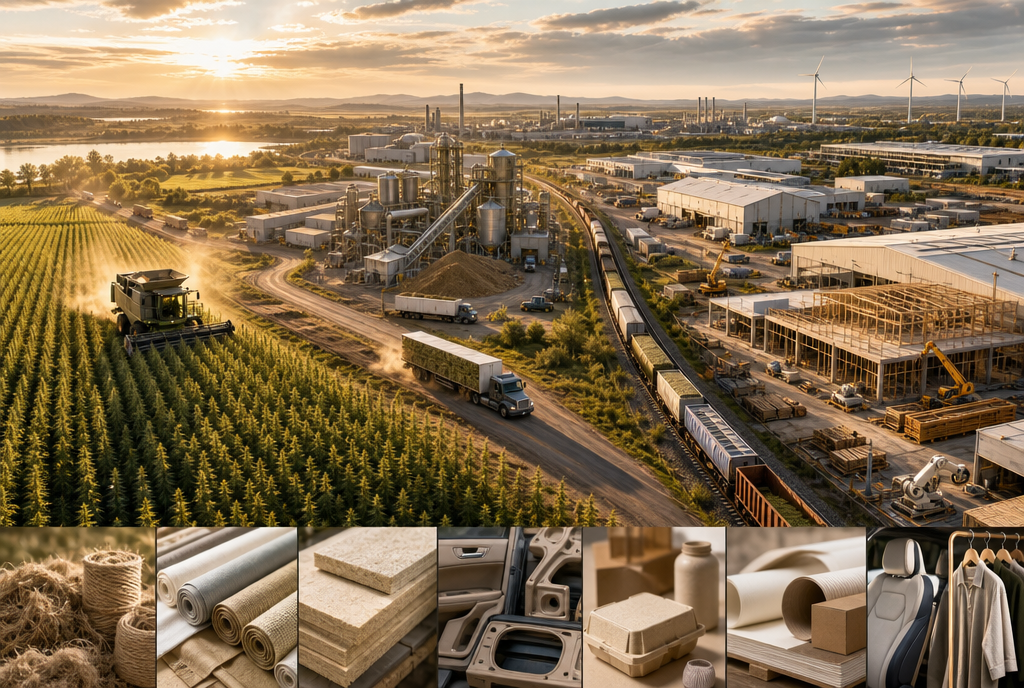
Playbook: what to do now
Use this playbook to translate “one plant, endless opportunities” into contracts and compliant operations.
- Pick your fraction first. Decide whether the near-term revenue path is bast fiber, hurd, grain/seed, or toll processing for others. Mixing goals without matching equipment and buyers is the fastest route to unsold biomass.
- Map the buyer before you map the field. Identify 2–3 purchasers or offtake partners and obtain written quality specs: moisture, THC testing protocol, fiber length, hurd particle size, and delivery windows.
- License and report correctly. Confirm whether your state, tribe, or the USDA holds primary authority, complete licensing through the appropriate program, and file acreage with the Farm Service Agency as required under 7 CFR Part 990.
- Build a THC compliance folder. Retain sampling dates, lab results, chain-of-custody records, and disposal documentation for any non-compliant lots. Treat this like a loan covenant—buyers and insurers will ask.
- Match processing to geography. If no regional decorticator exists within economical haul distance, model tolling, mobile decortication, or cooperative ownership before committing to large fiber acreage.
- Separate industrial from ingestible SKUs. Hemp seed ingredients used in food have a different regulatory path than fiber sold into construction. Confirm product category early with qualified counsel.
- Run a 12-month pilot. One season, one fraction, one buyer, one spec sheet. Expand only after you can repeat quality and logistics.
- Watch (do not chase) frontier applications. Track university and trade R&D on biocomposites and advanced materials, but anchor revenue to markets with existing purchase orders.
- Avoid: planting “generic hemp” without variety selection; signing grower contracts without defined rejection terms; assuming CBD or cannabinoid revenue streams apply to industrial fiber plans.
| Plant fraction | Primary industrial uses | Near-term readiness | First compliance check |
|---|---|---|---|
| Bast fiber | Textiles, nonwovens, composites, insulation | Moderate—needs decortication + fiber prep | Buyer spec on length, cleanliness, moisture |
| Hurd / shives | Hemp-lime (hempcrete), bedding, panels, bio-fillers | Moderate—construction niche growing | Particle size, binder compatibility, local codes |
| Grain / seed | Food oil, protein, animal feed | Higher for food-grade with proven buyers | FDA food pathway if for human consumption |
| Biomass / whole stalk | Pulp, energy, bulk feedstock | Variable—often lowest margin | End-market contamination + THC retest rules |
Risks & compliance
Compliance for industrial hemp starts at cultivation and does not end when bales leave the farm. Under the USDA framework, producers must operate under an approved state, tribal, or federal plan, maintain acreage records, follow sampling and testing procedures for delta-9 THC, and dispose of non-compliant plants according to program rules. State plans may be more stringent than the federal baseline; multi-state operators need jurisdiction-specific workflows.
Once hemp enters commerce, regulatory ownership splits by product type. The USDA regulates production; the FDA and state agencies may regulate hemp that becomes human or animal food, dietary supplements, cosmetics, or drug products. FDA has recognized certain hemp-seed-derived food ingredients through the GRAS process, but cannabinoid-containing foods and supplements face a different—and much narrower—pathway than industrial fiber or hurd sold into construction. As FDA officials have noted, products like textiles, biodiesel, or industrial composites may involve little or no FDA role, whereas ingestible products trigger full food or drug frameworks.
Contract risk is equally material. Grower agreements should define acceptable THC levels, testing methodology, rejection and remediation, payment timing, and force majeure for weather or equipment failures. Processors should document cross-contamination controls when handling both grain and fiber streams.
Building and automotive buyers may impose additional requirements: fire performance, VOC limits, structural engineering review for hemp-lime assemblies, and insurance acceptance. None of this is legal advice—operators should confirm obligations with qualified counsel and their state agriculture department.
Federal hemp policy continues to draw Congressional Research Service attention, including questions about enforcement resources and evolving definitions of lawful hemp products. Treat regulatory uncertainty as a planning input, not a reason to skip documentation.
Cost & tradeoffs
Industrial hemp economics hinge on which fraction you capture and how far you transport wet or semi-processed biomass. Fiber systems typically require decortication capex—often the largest upfront cost between farm and industrial buyer—plus ongoing labor for quality control. Without regional processing, freight can erase margins on bulky hurd and stalk, which is why cooperative and toll models persist in many U.S. regions.
On the farm, tradeoffs are straightforward but unforgiving. Fiber varieties sacrificed for grain yield (or vice versa) underperform on both specs. Retting, field drying, and storage choices affect mold risk and buyer acceptance. Seed cleaning and food-grade handling add equipment and audit costs that fiber-only models avoid.
Downstream, hemp-lime construction materials can offer insulation and carbon-storage attributes documented in building-science literature, but they generally require trained installers, compatible structural systems, and local code acceptance—adding soft costs compared with conventional insulation SKUs. Hemp fiber composites can reduce synthetic content in panels and nonwovens, yet surface treatments and polymer binders add process steps that must be modeled per application.
Public, product-level margin benchmarks for U.S. industrial hemp remain incomplete in open sources; most reliable planning uses buyer-specific quotes rather than industry averages. If a vendor promises “thousands of products” from one undifferentiated harvest, request a bill of materials, throughput assumptions, and off-take letters before capital commitments.
Opportunities
Advantage accrues to operators who control quality at the fraction level and sit close to end markets. Regional decortication hubs, hurd cleaning for construction supply chains, and spec-compliant fiber for composites and nonwovens are practical entry points with identifiable buyers. Food-grade hemp seed and oil remain viable where GRAS-eligible ingredients and established food manufacturers align—distinct from speculative cannabinoid markets.
Construction and building-materials firms willing to pilot hemp-lime or hemp-insulation assemblies can differentiate on low-carbon narratives when backed by third-party performance testing. Automotive and packaging teams exploring natural fiber reinforcement should engage early with fiber suppliers on length distribution, moisture content, and lot traceability—requirements that generic commodity brokers rarely meet.
Who should lean in now: experienced growers with off-take visibility; equipment investors targeting known bottlenecks; brands with R&D budgets to qualify hemp feedstocks against existing specs; and rural economic development groups coordinating multi-farm processing pools.
Who should wait: entrants expecting immediate national scale without processing partners; companies seeking to substitute hemp into regulated ingestible categories without a compliance roadmap; and investors betting on laboratory-stage applications (advanced energy storage, aerospace-grade composites) without commercialization timelines from credible partners.
At a glance
- Industrial hemp is a multi-fraction crop—bast fiber, hurd, seed, and biomass follow different buyers, equipment, and compliance paths.
- USDA governs lawful cultivation and THC testing at the farm; FDA and states step in when hemp becomes food, supplement, cosmetic, or drug products.
- Near-term industrial demand clusters in textiles, construction (hemp-lime and insulation), composites, pulp, bedding, and food-grade seed—not unproven “miracle” SKUs.
- Processing geography often matters more than acreage; decortication and spec consistency are the usual bottlenecks.
- Run a single-season, single-fraction pilot with written buyer specs before scaling capex.
- Federal hemp policy and cannabinoid enforcement remain in flux—build documentation and contract flexibility into every plan.
Verification & sources
Start with primary government sources. The USDA hemp production page and Hemp Laws and Regulations timeline document licensing, 7 CFR Part 990, and the split between USDA cultivation oversight and FDA product regulation. The Congressional Research Service primer 2018 Farm Bill Primer: Hemp Cultivation and Processing provides neutral background on definitions and state-plan mechanics.
For product-science context—not market hype—peer-reviewed reviews such as hemp fiber bio-composites and life-cycle assessment and hemp fibre treatments in bio-composites summarize applications, processing constraints, and building-material performance themes. FDA’s consumer update on cannabis-derived products clarifies when hemp ingredients trigger food/drug rules versus industrial pathways.
Limits: open-access market-size forecasts vary widely by methodology; this article does not cite proprietary dollar estimates. Performance claims for hempcrete, composites, and novel materials depend on formulation, climate, and codes—always request project-specific test data. State rules differ; verify with your state agriculture department before planting or processing.
Editorial standards
This article was prepared for Hemp.com readers—growers, processors, brands, procurement teams, and investors—using publicly available federal documents, Congressional Research Service summaries, and peer-reviewed literature. It is informational industry intelligence, not legal, medical, or agronomic advice.
We avoid disease-treatment claims, illegal cultivation guidance, and unsourced statistics. Where commercial data is incomplete (typical margin ranges, national processing capacity totals), we say so rather than invent figures. Product categories such as CBD foods and supplements are mentioned only to distinguish them from industrial fiber and hurd markets; Hemp.com does not endorse circumventing FDA requirements.
Hemp.com may earn revenue through directory listings, sponsored placements, or partner referrals in related articles. Those relationships do not change our sourcing standards. When directory or vendor links appear on Hemp.com, they are labeled according to site disclosure policy; this draft describes conceptual next steps only.
Explore further
Keep reading on Hemp.com: state hemp program trackers, decortication and processing equipment primers, hemp-lime construction explainers, and grain-vs-fiber variety selection guides pair well with this overview.
Directory starting points: Use the Hemp.com directory to locate licensed growers, decorticators, testing labs, and construction suppliers by state—filter by service type (fiber processing, hurd supply, seed cleaning, compliance testing) rather than generic “hemp company” searches.
External anchors worth bookmarking: your state agriculture department hemp page, local extension offices with fiber crop trials, and trade groups focused on industrial hemp rather than cannabinoid retail. Cross-check any vendor ROI slide deck against the USDA/FDA sources listed in the data section before contract signatures.
If you operate in multiple states, build a short vendor scorecard—THC testing turnaround, fraction capabilities, certified scales, insurance certificates, and reference customers—before adding partners to your supply chain map.
Find suppliers
Browse verified industrial hemp businesses in the Hemp.com directory.