
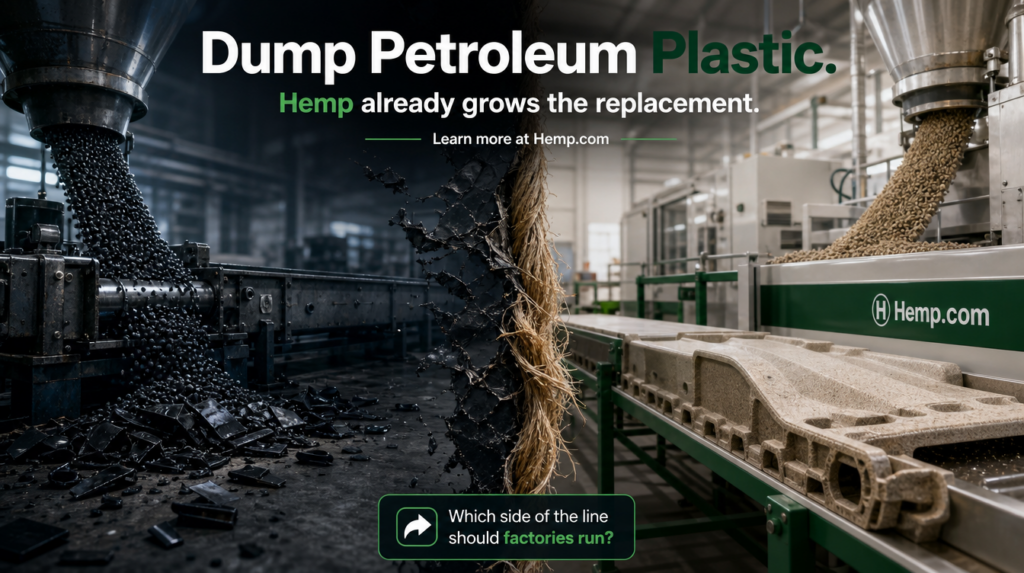
Every yogurt cup, shipping mailer, and dashboard trim you touch this week likely started as ancient carbon pulled from the ground, refined into resin, molded once, and sent into a waste stream that was never designed to close the loop. The U.S. Environmental Protection Agency reports that Americans generated 35.7 million tons of plastic in municipal solid waste in 2018—the most recent year for which the agency published comprehensive national figures—and recycled just 8.7% of it. The rest was burned, buried, or scattered into environments where it persists for decades.
That is not a recycling problem. That is a materials choice problem. We chose a feedstock tied to fossil extraction, optimized for cheap throughput, and called the resulting mess a consumer behavior failure. It was not. It was industrial design with the exit strategy left blank.
Meanwhile, on farms from Kentucky to Montana, industrial hemp produces dense cellulose in stalks and hurd that processors can turn into fiber composites, films, foams, and reinforced biopolymer structures—the exact class of materials petroleum plastic was supposed to replace but never did at scale. The replacement is not hypothetical. It is growing in fields right now, and we are still debating whether hemp belongs in serious supply chains.
The plastics story
For sixty years, the plastics industry sold a simple bargain: moldability, durability, and price. That bargain worked—until the externalized costs arrived in landfills, waterways, and carbon ledgers. Packaging alone accounted for more than 82 million tons of U.S. municipal solid waste generation in 2018, according to the EPA’s materials breakdown. Plastic’s share of that stream keeps climbing even as mechanical recycling rates for most resin types remain stubbornly low.
The honest response is not another awareness campaign. It is a feedstock swap. Industrial hemp is a lignocellulosic crop: bast fiber on the outside, woody hurd inside, both rich in cellulose and hemicellulose that researchers and manufacturers can process into structural materials. The USDA Agricultural Research Service explicitly targets hemp among cellulosic feedstocks for fiber-based packaging, nanofiber films, and bioproducts designed to degrade in compost and, in some formulations, marine environments. A separate USDA-funded project at Tuskegee University is developing sustainable biopolymers from industrial hemp residues for intelligent packaging—using crop waste, not virgin petrochemical resin.
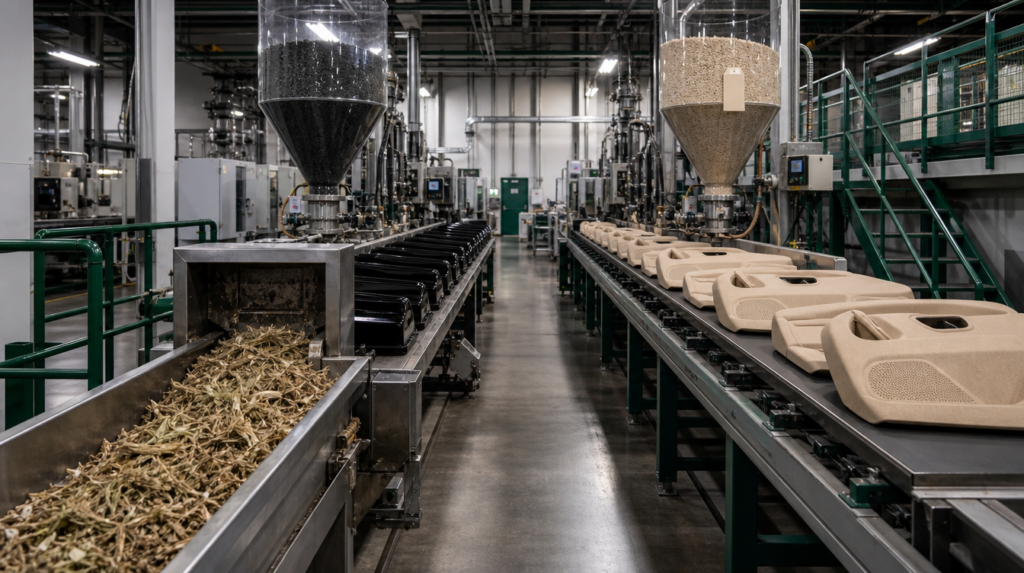
On factory floors, the transition is already visible if you know where to look. In France, Automotive Performance Materials blends polypropylene with roughly 20% processed hemp for injection-molded interior parts—air ducts, door inserts, console structures—already integrated into Peugeot models, as reported by Plastics Engineering. At Germany’s Fraunhofer WKI, researchers developed vehicle underbodies from natural fibers—including hemp—and recycled plastics that meet structural and moisture requirements in one of the harshest zones on a car, detailed in a 2024 Fraunhofer press release.
These are not hemp-branded tote bags. They are load-bearing, production-line materials entering automotive supply chains because they reduce weight, improve lifecycle carbon math, and answer regulatory pressure on embedded emissions. The question is no longer whether hemp can perform in plastics-adjacent applications. The question is why petroleum plastic remains the default when a renewable cellulose pipeline exists.
The surprising insight
Here is the detail most plastic debates skip: hemp plastic work often starts with what the crop industry already throws away.
After fiber stripping, hemp stalk residues still contain lignocellulosic polymers suitable for packaging films, sensing layers, and reinforced structures. Researchers have demonstrated cast hemp stalk papers impregnated with bio-based crosslinkers that achieve tensile strengths up to 70 MPa and elastic moduli up to 2.9 GPa—material properties that sit firmly in industrial territory, not craft-project territory. Peer-reviewed work on hemp stalk waste bioplastics, published through Riga Technical University’s research repository, also documents a recycling route for pulp recovery—an explicit rebuttal to the claim that every bio-based material is a one-way disposable.
Read that again: the same harvest that produces textile fiber and hurd for construction can also yield packaging polymers from residues we currently underutilize. Petroleum plastic has no parallel circular story at the farm level. You cannot grow polypropylene. You can grow hemp, and the waste stream is still polymer-rich.
That is the shareable insight—hemp turns agricultural surplus into plastic replacements before the plastic ever exists. If your sustainability strategy starts at the recycling bin, you are already downstream of the decision that mattered.
Industry stakes
Who wins if hemp displaces conventional plastic feedstocks? Farmers and regional processors gain a high-value outlet for fiber, hurd, and residues in a crop the USDA treats as an established agricultural commodity. Biorefining equipment makers, compounders, and tier-one suppliers who invest early in hemp-reinforced formulations capture contracts as automakers and packaging firms chase lower embodied carbon. Brands that switch defensible portions of their packaging and components to documented bio-based inputs reduce exposure to resin price volatility tied to oil markets.
Who must adapt—or lose margin? Commodity resin producers wedded to volume over lifecycle performance. MRF operators and recyclers face a mixed future: some hemp-blended and bio-based products require industrial composting or dedicated recovery routes, not curbside bin wish-cycling. Retailers and CPG companies that keep marketing petroleum plastic while slapping “recyclable” labels on low-recovery resin types invite regulatory and reputational risk as extended producer responsibility frameworks expand.
The transition will not be clean or instant. A 2024 Materials journal study on hemp fiber–PHBV composites notes that standardization, moisture behavior, and reprocessing quality still require rigorous quality control before mass adoption. Trade analysis of natural fiber-reinforced plastics in automotive flags end-of-life recovery as an unresolved gray zone for many composite parts. Hemp is not a magic erase button for plastic pollution. It is a superior starting molecule with a supply chain that still needs capital, specs, and honest labeling.
But the status quo is not neutral. Continuing to scale petroleum plastic while recycling less than one-tenth of it is a policy and procurement failure dressed up as consumer convenience. Industrial hemp gives procurement officers something petroleum never could: a domestic, photosynthetic feedstock that gets stronger the more seriously we treat it as infrastructure, not Instagram fodder.
Visual moment
Did you know?
- U.S. plastic generation in municipal solid waste reached 35.7 million tons in 2018, but the national plastic recycling rate was only 8.7%—meaning the vast majority of that material never returned to productive use, per EPA material-specific data.
- USDA researchers list industrial hemp among priority cellulosic feedstocks for fiber foam packaging, nanofiber films, and bioproducts engineered for degradation in compost and selected marine conditions—not just landfilling with a green label.
- Peugeot has integrated hemp-reinforced interior components—including air ducts and door inserts—using compounds that blend polypropylene with roughly 20% processed hemp fiber, according to 2024 automotive composite reporting.
- Fraunhofer WKI researchers developed hemp-inclusive natural fiber underbodies that meet structural and moisture requirements while targeting cascading reuse at end of vehicle life—a part category traditionally dominated by conventional plastics.
- Peer-reviewed hemp stalk bioplastic research documents elastic moduli up to 2.9 GPa and a demonstrated alkaline depolymerization route for pulp recovery—evidence that bio-based does not have to mean single-use by default.
You saw it early
Most consumers still hear “hemp plastic” and picture a crunchy alternative storefront, not a Peugeot door panel or a USDA-funded intelligent packaging film. That perception lag is your edge. The material science moved first; the cultural narrative is still catching up.
Watch three signals over the next 24 months: automotive compound adoption beyond concept fleets, as natural fiber-reinforced plastics spread from interiors to structural zones; packaging procurement mandates from retailers requiring verified bio-based content and compostability claims backed by third-party certification—not marketing adjectives; and hemp processing capacity co-located with decortication and pulping lines that can absorb stalk residue at scale instead of shipping it as low-value waste.
If you understand that petroleum plastic is a feedstock decision—not a recycling inconvenience—you are already thinking like the supply chain will within this decade. The factories are running trials. The USDA is funding residue-to-polymer pathways. The landfills are not waiting.
Why Hemp.com
Hemp.com tracks industrial hemp where it actually changes outcomes: farm gate economics, processing infrastructure, material specifications, and the companies moving hemp fiber and hurd into packaging, composites, and building products. The shift away from petroleum plastic will not happen because someone posted an angry thread—it will happen when buyers, engineers, and policymakers can see a documented supply chain from field to finished part.
That is the work we document. Explore our directory of hemp processors and material innovators, follow our coverage of bioplastics and manufacturing, and use Hemp.com as the reference point when someone asks whether hemp is real industry or just real hype. The answer is on the factory floor. We put you there.
Verification & sources
Plastic waste generation, recycling, combustion, and landfill figures cited here come from the EPA’s Plastics: Material-Specific Data page, reflecting 2018 municipal solid waste data—the latest comprehensive national set published by the agency at the time of writing. Municipal solid waste composition and packaging share figures draw on the EPA Facts and Figures guide.
Hemp biopolymer and packaging research references include active and recent USDA ARS project documentation and the USDA National Agricultural Library entry for Tuskegee University’s hemp residue packaging work. Automotive and composite applications are sourced from Plastics Engineering and the Fraunhofer WKI. Material property claims for hemp stalk bioplastics reference peer-reviewed publication metadata via Riga Technical University and composite reprocessing research in Materials.
Updated EPA plastics data beyond 2018 was not available in the agency’s published national series at drafting time; where newer figures exist in future releases, this article should be refreshed.
Editorial standards
This is editorial opinion grounded in published government data, USDA research descriptions, and trade and peer-reviewed sources—not a paid product endorsement. Hemp.com may link to directory listings or sponsored partners elsewhere on the site; this article does not recommend specific brands for purchase.
We do not claim hemp bioplastics eliminate plastic pollution, cure environmental harm, or universally biodegrade in home compost bins. Degradation pathways depend on formulation, thickness, additives, and available infrastructure. Some hemp-inclusive products remain blended with conventional polymers. We state those limits plainly because overstating bio-based performance erodes the same trust petroleum marketers already burned.
No fabricated interviews, executive quotes, or proprietary statistics appear in this piece. Market size projections and company-specific adoption timelines beyond cited sources are intentionally omitted.
Explore further
Ready to go deeper? Browse Hemp.com’s coverage of hemp manufacturing, hemp sustainability, and supply chain development for fiber and hurd processors. If you are sourcing compounders, decortication facilities, or bioplastics researchers, start with our industrial hemp directory and filter by processing capability and region.
Related topics worth reading next: hemp fiber specifications for composites, the economics of dual-purpose fiber-and-grain hemp contracts, extended producer responsibility trends affecting packaging buyers, and how USDA research programs fund residue-to-material pathways. Have a facility or material innovation we should list? Submit through our directory intake—we prioritize documented industrial applications over consumer novelty products.
Find suppliers
Browse verified industrial hemp businesses in the Hemp.com directory.