
Quick answer: Industrial hemp (Cannabis sativa L. with ≤0.3% delta-9 THC by dry weight in the U.S.) produces three major product streams from one crop: grain (seed), bast fiber, and hurd (core). Each stream has real, lawful applications—but quality, economics, and regulation depend on genetics, harvest timing, and processing. This hub maps every major use to an honest guide on Hemp.com; we separate proven markets from pilot projects and marketing hype.
Updated: June 2026 · Educational content; not legal, medical, or investment advice.
Industrial hemp is not a single product. A field grown for seed is harvested differently than a fiber crop. A stalk split by decortication yields bast for textiles and hurd for building materials. Understanding those streams is the fastest way to evaluate any hemp claim.
Explore the map
Click any zone on the infographic below—or use the topic list under the image on mobile.
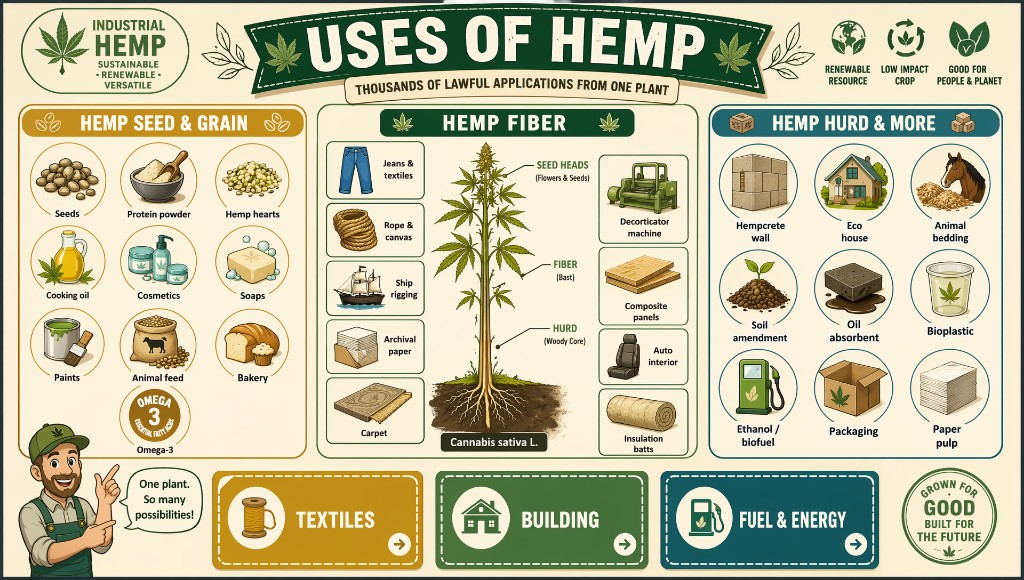
Tap a zone on the map—or browse all topics below.
- Hemp Seeds
- Hemp Protein Powder
- Hemp Hearts
- Hemp Seed Oil
- Hemp Cosmetics
- Hemp Soap
- Hemp Paint
- Hemp Animal Feed
- Hemp Bakery
- Hemp Omega-3
- Hemp Jeans & Textiles
- Hemp Rope & Canvas
- Hemp Ship Rigging
- Hemp Paper
- Hemp Carpet
- Hemp Decortication
- Hemp Composites
- Hemp Auto Parts
- Hemp Insulation
- Hempcrete
- Hemp House
- Hemp Animal Bedding
- Hemp Soil & Phytoremediation
- Hemp Oil Absorbent
- Hemp Bioplastics
- Hemp Fuel
- Hemp Packaging
- Hemp Paper Pulp
- Textiles
- Building Materials
- Fuel & Energy
Three streams from one plant
Seed & grain
Hemp grain is a food ingredient: whole seeds, hulled hearts, cold-pressed oil, and protein ingredients. The U.S. FDA has issued GRAS notices for hulled hemp seed, hemp seed protein powder, and hemp seed oil for human food—but that is not a blanket approval for every hemp product or claim. See our guides on hemp seeds, protein, and seed oil.
Fiber (bast)
Long outer fibers become yarn, rope, canvas, paper, nonwovens, and reinforcement in composites. Textile-grade fiber requires tight process control; technical fiber for insulation or mats is often easier to produce at scale. Start with hemp textiles, weaving, and fiber processing.
Hurd & core
The woody inner core feeds hempcrete, animal bedding, absorbents, pulp, and some biocomposite fillers. Hurd markets are real but logistics-sensitive—local processors and moisture specs matter. See building materials, bedding, and oil absorbents.
Pillar guides (deep dives)
- Textiles & fabric — from field to finished product, certifications, and honest sustainability comparisons.
- Building materials — hempcrete, insulation, codes, and what hemp can and cannot replace structurally.
- Fuel & energy — ethanol, biodiesel, and biomass pathways without overpromising.
- Bioplastics & composites — fiber-filled polymers, durability, and end-of-life reality.
- Paper & packaging — pulp sources, hemp paper history, and modern packaging trials.
What hemp is not
- Not automatic carbon magic. Outcomes depend on cultivation inputs, processing energy, product lifetime, and disposal.
- Not one-size-fits-all regulation. Food, feed, cosmetics, and building products each have different compliance paths.
- Not a substitute for structural concrete. Hempcrete is an insulating infill/lime binder system—not drop-in structural concrete.
- Not universally cheaper. Many hemp products still compete on performance, story, or niche specs—not lowest unit cost.
On this site: What is Hemp? · Hemp University · Uses of hemp · Hemp textiles · Building materials · Hemp plastics · Paper & packaging · Glossary
Educational overview only. Industrial hemp rules differ by country and U.S. state/tribal program. For food, feed, cosmetics, and building products, confirm current FDA, USDA, and local code requirements with qualified professionals. About Hemp.com